Submersible implosion and loss of life
Submersible Titan and cargo vessel Polar Prince
372 nautical miles south-southeast of Cape Race, Newfoundland and Labrador
The Transportation Safety Board of Canada (TSB) investigated this occurrence for the purpose of advancing transportation safety. It is not the function of the Board to assign fault or determine civil or criminal liability. This report is not created for use in the context of legal, disciplinary or other proceedings. See Ownership and use of content. Masculine pronouns and position titles may be used to signify all genders to comply with the Canadian Transportation Accident Investigation and Safety Board Act (S.C. 1989, c. 3).
Executive summary
On 18 June 2023, the submersible Titan, with 5 people on board, was descending to the wreck of the Royal Mail Ship Titanic, located 372 nautical miles south-southeast of Cape Race, Newfoundland and Labrador. The Titan was owned by the U.S.-based company OceanGate.The Titan was owned by OceanGate, Inc.., a corporation organized under the laws of the State of Washington in the United States; it was operated by its wholly owned subsidiary, OceanGate Expeditions, Ltd, a Bahamas entity. The Titan was being supported by a Canadian cargo vessel, the Polar Prince, which was being used to tow the Titan to and from dive locations, as well as providing a base for OceanGate’s operations. During the Titan’s descent, an OceanGate surface support team aboard the Polar Prince was tracking the Titan and maintaining communication. Approximately 1 hour and 45 minutes after the Titan began its descent, the surface support team lost all contact with it. A search and rescue operation was initiated later that evening. On 22 June, the U.S. Coast Guard confirmed that the wreckage of the Titan had been found on the ocean floor near the Titanic. There were no survivors.
The Titan’s pressure hull consisted of a carbon fibre cylinder that was capped at either end by titanium domes. The use of carbon fibre in a pressure hull for a human-occupied submersible intended for deep-ocean diving is novel; submersibles used for deep-ocean diving are typically constructed of steel or titanium. As well, the pressure hull is typically spherical, not cylindrical, because this is the best shape for resisting external pressure and allowing even distribution of stresses.
The investigation determined that the as-built properties of the Titan’s carbon fibre cylinder were never validated to ensure they met the theoretical values used in the design process and that the construction and testing of the Titan did not follow standard engineering practices. As a result, OceanGate did not know for how long the Titan’s pressure hull would remain structurally intact when used repeatedly for dives to the depth of the Titanic.
In an attempt to mitigate this problem, OceanGate had developed 2 systems to monitor the integrity of the pressure hull: a strain monitoring system and an acoustic monitoring system. The strain monitoring system provided data for post-dive analysis to identify potential problems with the pressure hull that could lead to failure on a subsequent dive. However, analysis of the strain data by OceanGate was inconsistent and did not result in the pressure hull being removed from service before its failure. The acoustic emission monitoring system was being relied on to provide enough advance warning for the submersible to surface in the event of an impending hull failure. However, this system had not been tested to demonstrate that it would consistently provide enough advance warning, and it did not function as intended during the occurrence.
Analysis by the TSB Laboratory determined that the reduced compressive strength of the Titan’s carbon fibre cylinder, as well as defects that were potentially introduced during manufacturing, operations, storage, and transport of the Titan, likely led the cylinder to fail progressively, due to damage accumulating during each dive cycle, until it imploded.
The investigation found that risk management at OceanGate was hindered by the structure and composition of the company as well as by the influence of power dynamics and social and psychological factors. As a result, OceanGate did not identify and mitigate key risks associated with the structural integrity of the Titan. Also, the investigation looked at issues relating to oversight of submersible operations, emergency response preparedness for submersibles, and safety management as it relates to groups working on a vessel.
The investigation identified safety deficiencies related to oversight and standards that led the Board to issue 6 recommendations.
Canada’s approach to regulatory oversight
Under the Canada Shipping Act, 2001 (CSA 2001), Transport Canada (TC) is responsible for marine safety, security, and environmental protection in relation to Canadian vessels and foreign vessels operating in Canadian waters. Regulatory oversight from TC provides independent verification of the safe operation and regulatory compliance of these vessels through inspections either for mandatory certification where required, or compliance with regulations.
How TC identifies vessels and provides oversight depends on whether a vessel is Canadian or foreign-registered and on its size. For Canadian commercial vessels that do not require a certificate to operate and foreign vessels under international tonnage thresholds (500 GT), oversight consists of “risk-based inspections” or TC visits; TC may visit such vessels if they receive reports that raise concerns or may act based on their own observations. Although TC was aware that the Titan was operating from St. John’s and that it was supported by Canadian vessels, TC was unaware that the Titan was not registered with any flag state. The Titan did not receive any oversight from TC.
This situation is not unique; in fact, in Canada, it is relatively common for vessels to receive no oversight from TC. The investigation found that the lack of regulatory oversight to identify safety deficiencies resulted in increased risk to those involved in the Titan’s operations. Since 2015, the TSB determined that a similar lack of regulatory oversight was a factor in a number of occurrences involving uncertified and unregistered fishing vesselsTSB marine transportation safety investigation reports M21A0315, M20A0160, M19A0090, and M16A0327. and uncertified tugs.TSB marine transportation safety investigation reports M21P0030, M20P0230, M17P0244, and M15P0037. Given that uncertified vessels, such as the Titan, are often not subject to any regulatory oversight in Canada, the Board recommends that
the Department of Transport define criteria and priorities for risk-based oversight of Canadian commercial vessels that are not required to be certified, such that these criteria and priorities make it possible to evaluate the risk posed by the operation of these vessels and lead to additional oversight.
TSB Recommendation M26-02
The Board also recommends that
the Department of Transport define criteria and priorities for risk-based oversight of commercial vessels not registered or captured by port state control processes, and that these criteria and priorities make it possible to evaluate the risk posed by the operation of these vessels and act accordingly.
TSB Recommendation M26-03
Information sharing between Transport Canada and other government departments
Given the nature of marine operations, vessels and vessel owners and operators interact with government entities outside of TC, such as the Canadian Border Services Agency (CBSA), Fisheries and Oceans Canada (DFO), provincial authorities, and port authorities. A number of Canadian government departments, including DFO, interacted with OceanGate from 2019 up until the time of the occurrence.
The more information that TC has about a vessel’s operation, the greater the ability to assess risk and determine the appropriate level of oversight. Previous investigationsTSB Marine Transportation Safety Investigation Report M20A0160. have identified issues with information sharing between TC and other government departments. However, TC has no processes to obtain and use this information. Some progress is being made: in response to the Board’s recommendationTSB Recommendation M22-01, Requirement for Transport Canada vessel registration prior to Fisheries and Oceans Canada issuance of fishing licence, at https://www.tsb.gc.ca/eng/recommandations-recommendations/marine/2022/rec-m2201.html (last accessed on 20 May 2026). that the Department of Fisheries and Oceans require that any Canadian vessel that is used commercially to harvest marine resources have a current and accurate TC registration, DFO is working more closely with TC and the number of vessels registered with TC and licensed by DFO has increased.
The investigation found that there is limited information-sharing between TC and other government departments, which results in TC missing opportunities to access information that could be useful in assessing risk in commercial vessel operations and determining the appropriate level of oversight. Such information from other government departments can enable TC to act and evaluate a vessel’s operation from a Canadian port and within Canadian waters. Therefore, the Board recommends that
the Department of Transport establish processes to obtain information from other government departments about commercial vessel operations such that it can evaluate the risk of those operations and act accordingly.
TSB Recommendation M26-04
Oversight of submersibles
A submersible operator can obtain oversight for their submersible by classifying the submersible with a classification society or by registering the submersible with a flag state that provides oversight of submersibles. Some countries, including the Bahamas, the Cayman Islands, and Japan, require submersibles to be classified with a classification society. Other countries, have regulatory frameworks that cover the operation of submersibles. Some countries, such as Canada, have limited or no regulations in place.
The International Maritime Organization (IMO) has provided guidelines for the design, construction, and operation of submersibles that carry passengers (MSC Circular 981).International Maritime Organization, MSC Circular 981 – Guidelines for the Design, Construction and Operation of Passenger Submersible Craft (29 January 2001). However, this guidance is not incorporated into any international conventions or codes. As a result, it is only binding at the national level where member states have incorporated it into domestic regulations. Without a mandatory international standard for submersibles, oversight of submersible operations relies largely on individual flag state requirements, and safety depends largely on voluntary action from owners and operators, increasing the risk to people, vessels, and the environment. TC represents Canada as a member state at the IMO and can advocate for safety-related changes. Therefore, the Board recommends that
the Department of Transport advocate to the International Maritime Organization that the guidance in Maritime Safety Committee Circular 981 be incorporated into international conventions or codes.
TSB Recommendation M26-05
In Canada, submersibles are included in the definition of a vessel under the CSA 2001 and are therefore subject to the same regulatory oversight as other vessels. However, there are no comprehensive or specific regulations in Canada that govern the construction or the operation of human-occupied submersibles, although there are regulations regarding crewing.
In 2004, concerns were raised about passenger submersible operations in the Haliburton Forest and Wildlife Reserve, Haliburton, Ontario. In response, TC created a policy on domestic passenger submersibles that came into effect in 2005.Transport Canada, Tier 1 – Policy: Passenger Submersible Craft, 2005. The objective of the policy was to implement the IMO’s guidelines for passenger submersibles (MSC/Circ. 981). In April 2026, TC released Ship Safety Bulletin (SSB) 03/2026: Requirements for passenger submersibles operating in Canadian waters. The SSB identifies an approach to the department’s oversight of submersibles, using instruments, norms, and standards that existed at the time of the Titan’s operation, and adds reporting requirements for dive operations.
The implementation of MSC Circ. 981 through the TC policy on passenger submersibles and the publication of new and existing requirements in SSB 03/2026 are both steps in the right direction. However, SSBs and policies are intended to guide behaviour and are not enforceable. It is unclear if these steps will mitigate the risk associated with the operation of a vessel such as the Titan in the future. Without mandatory oversight of similar operations, covering all human-occupied submersibles, the underlying risk remains. Therefore, the Board recommends that
the Department of Transport require all human-occupied submersibles that are registered in Canada, operating with a Canadian support ship, or operating in Canadian waters or Canada’s exclusive economic zone to comply with the requirements of the International Maritime Organization’s Maritime Safety Committee Circular 981.
TSB Recommendation M26-06
Safety management system practices for one or more groups working on a vessel
Certain types of operations can result in 1 or more groups working on board a vessel. In operations where 1 or more groups are working on board, there will be interactions between the vessel’s SMS and the various systems used by other groups to manage safety. The company that operated the Polar Prince, Horizon Maritime Services Ltd., had an emergency response plan that noted that specific customer requirements for emergency response should be addressed in a bridging document and a joint emergency response plan. Typically, bridging documents are implemented to clarify how operations, including emergency response, will be coordinated and how safety will be managed. Bridging documents are common in certain industries, such as the oil and gas industry.The International Association of Oil & Gas Producers has guidance on bridging documents (https://www.iogp.org/bookstore/product/guide-to-preparing-hse-plans-and-bridging-documents-supplement-to-report-423/, last accessed on 12 May 2026). The Canadian oil and gas industry, in general, follows the guidance set out by the International Association of Oil & Gas Producers. In Norway and the Netherlands, there are requirements for bridging documents in the offshore oil and gas industry. For operations like those being undertaken by the Polar Prince and OceanGate, there is no external requirement for a bridging document to be developed.
When 1 or more groups work on board a vessel without comprehensive guidance from a bridging document to integrate safety management between their operations and those of the vessel, there is a risk that operations will be conducted without the necessary safeguards. The Board therefore recommends that
the Department of Transport ensure that, when 1 or more groups work on board a Canadian vessel or a vessel to which the Coasting Trade Act applies, safety management principles are comprehensively integrated between their operations and those of the vessel, including the use of a bridging document, to clarify how operations will be coordinated and how safety will be managed.
TSB Recommendation M26-07
1.0 Factual information
1.1 Particulars of the vessels
Vessel name | Titan | Titan launch and recovery system | Polar Prince |
|---|---|---|---|
Flag | None | None | Canada |
Port of registry | None | None | St. John’s, NL |
Official number | None | None | 310141 |
International Maritime Organization number | None | None | 5329566 |
Type | Submersible | Launch and recovery system | Cargo vessel |
Gross tonnage | Not officially assessed | Not officially assessed | 2062 |
Weight | 9.525 tonnes | 14.515 tonnes | N/A |
Length | 6.70 m | 11.6 m | 69.07 m |
Breadth | 2.80 m | 5.0 m | 14.63 m |
Depth | 2.50 m | 2.3 m | 6.40 m |
Year built* | 2018 (1st construction) 2020 (2nd construction) | 2018 | 1959 |
Propulsion | 4 electric thrusters, 7.5 kW each | None | 4 diesel-electric engines generating 3820 kW powering 2 electric motors driving 2 fixed-pitch propellers |
Crew complement | 2 | None | 17 |
Passengers | 3 | None | 24 (including the 5 people on the dive) |
Owner | OceanGate** | OceanGate | Miawpukek Horizon Maritime Services Ltd. |
Authorized representative*** | None | None | Miawpukek Horizon Maritime Services Ltd. |
Managing company | OceanGate | OceanGate | Horizon Maritime Services Ltd. |
Classification society | None | None | DNV |
Issuing authority for International Safety Management documentation | None | None | DNV |
* In this table, “Year built” refers to the date the keel of the vessel was laid: that is, when construction began.
** OceanGate consisted of a number of entities, including at least 2 U.S. companies, a Bahamian corporation, and a non-profit foundation.
*** See Section 1.8.1 for an explanation of the term “authorized representative”.
1.2 Summary description of the vessels
1.2.1 Titan
The Titan was a carbon fibre and titanium submersible used for deep‑ocean diving (Figure 1). It was designed and built by OceanGate in the United States. The Titan was originally constructed in 2018 (the 1st construction). However, in 2019, the carbon fibre cylinder that formed the midsection of the pressure hullA pressure hull is “the pressure boundary of a submersible that provides the human occupants with a pressure resistant habitat.” (Source: American Bureau of Shipping, “Rules for Building and Classing Underwater Vehicles, Systems and Hyperbaric Facilities,” 2025, p. 30). was found to be damaged and OceanGate began reconstructing the submersible in 2020, completing it in 2021 (the 2nd construction). All subsequent references to the Titan in this report are to the 2nd construction unless otherwise specified.
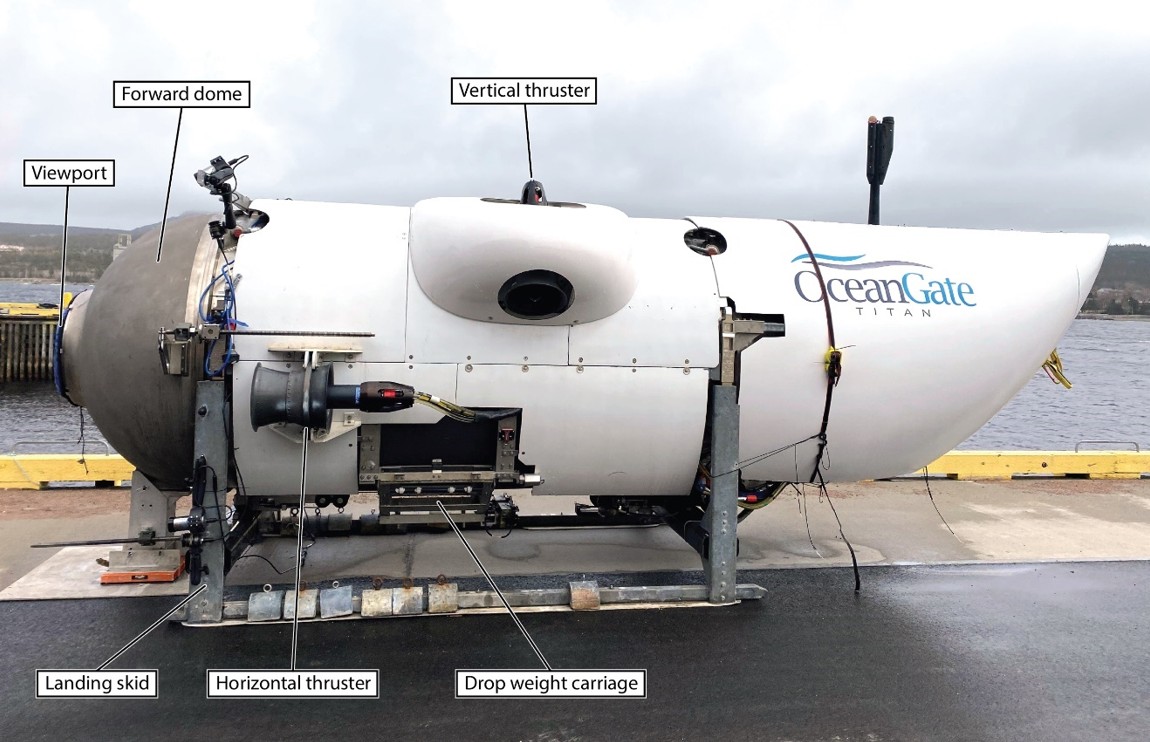
The cylinder that formed the midsection of the pressure hull was fabricated from a carbon fibre and epoxy resin composite material. The cylinder had been sprayed with a commercially available protective coating and covered with a fibreglass shell. Two hemispherical domes made of titanium were fitted to either end of the cylinder. The aft dome was surrounded by a tail framework covered by the fibreglass shell. There was an acrylic viewport in the forward dome. The forward dome could be bolted and unbolted from outside the submersible to provide access to the cabin; this was the only way that people could enter and exit the submersible. The aft dome was permanently affixed to the cylinder.
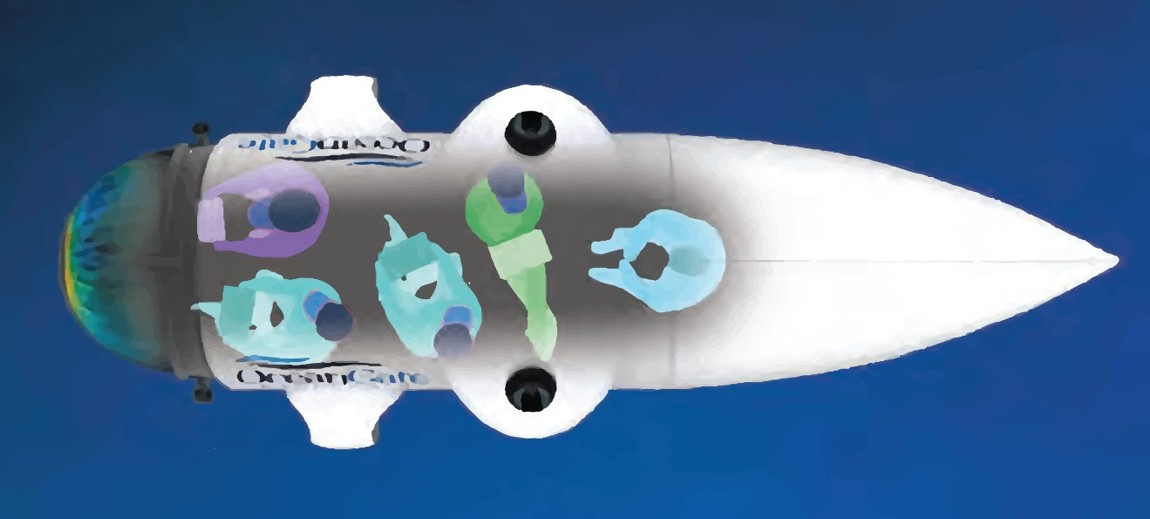
The submersible was able to descend, ascend, and maintain neutral buoyancy using a system that incorporated weights and an air-operated ballast bladder. The submersible was not tethered to a surface support vessel and was able to navigate autonomously using thrusters. The Titan’s cabin was designed to accommodate up to 5 people (Figure 2).
The cabin had an internal life support system that consisted of oxygen tanks with enough oxygen to last approximately 96 hours based on an occupancy of 5 people, and CO2 scrubbing capability for the same occupancy. The cabin also contained navigation and monitoring equipment for the Titan’s various systems.
The Titan had 2 acoustic communication and tracking systems; the primary one had been fitted in 2023. The 2nd system was an older system that had been used in previous years and was still fitted on the Titan. The primary system’s communication function allowed the Titan to exchange text messages with the surface support team during a dive, while its tracking function automatically transmitted information about the Titan’s speed, heading, and position (depth and coordinates) to the surface support team.
A more detailed description of the Titan is available in Section 1.10.
1.2.1.1 Titan launch and recovery system
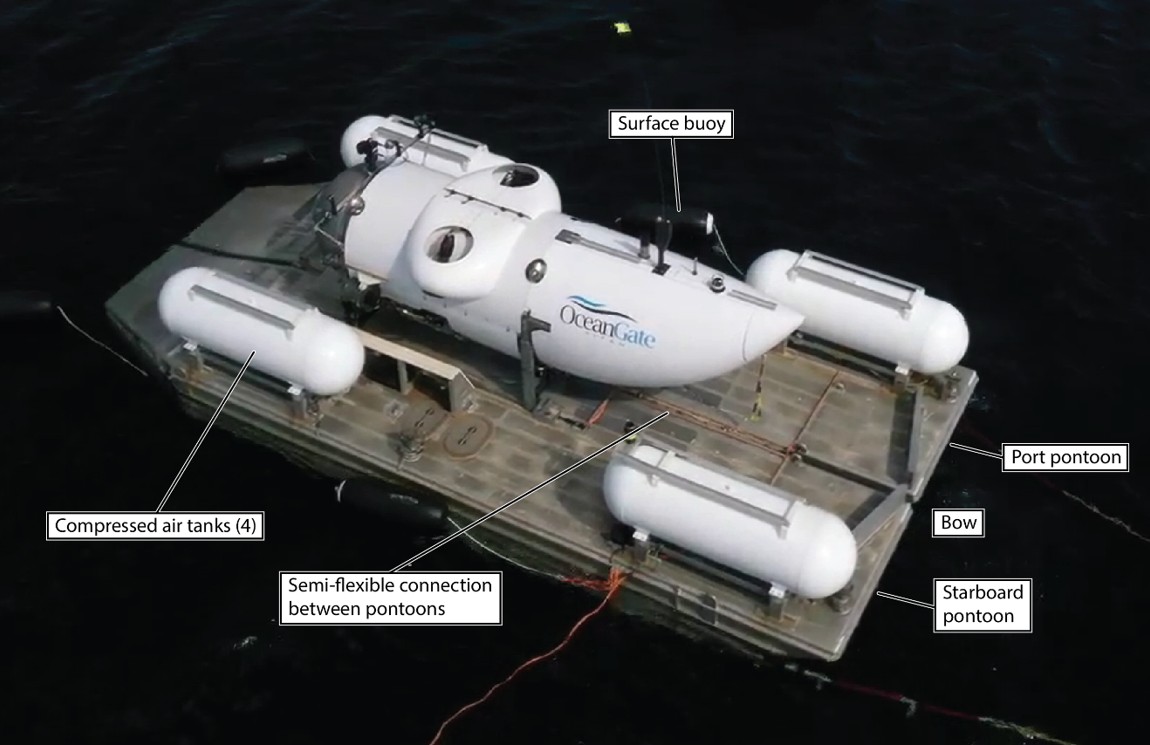
The Titan had a custom-designed launch and recovery system (LARS) (Figure 3) that had been built in 2018 by a contractor on behalf of OceanGate. The LARS was integral to launching and recovering the submersible. In 2023, the LARS was also used as a towing platform on which the Titan was transported to and from dive locations.
The LARS consisted of 2 welded aluminum pontoons joined by a semi-flexible connection. Each pontoon had 2 internal ballast tanks. During launching, the tanks could be flooded with water in order to submerge the LARS and allow the Titan to detach underwater. The LARS had 4 buoys attached to it to mark its location when underwater.
The LARS had 4 propane tanks fitted to it that were being used to store compressed air. When the LARS was submerged, compressed air could be released into the LARS’s internal tanks, displacing water and causing the LARS to rise to the surface.
A more detailed description of the LARS is available in Section 1.11.
1.2.2 Polar Prince
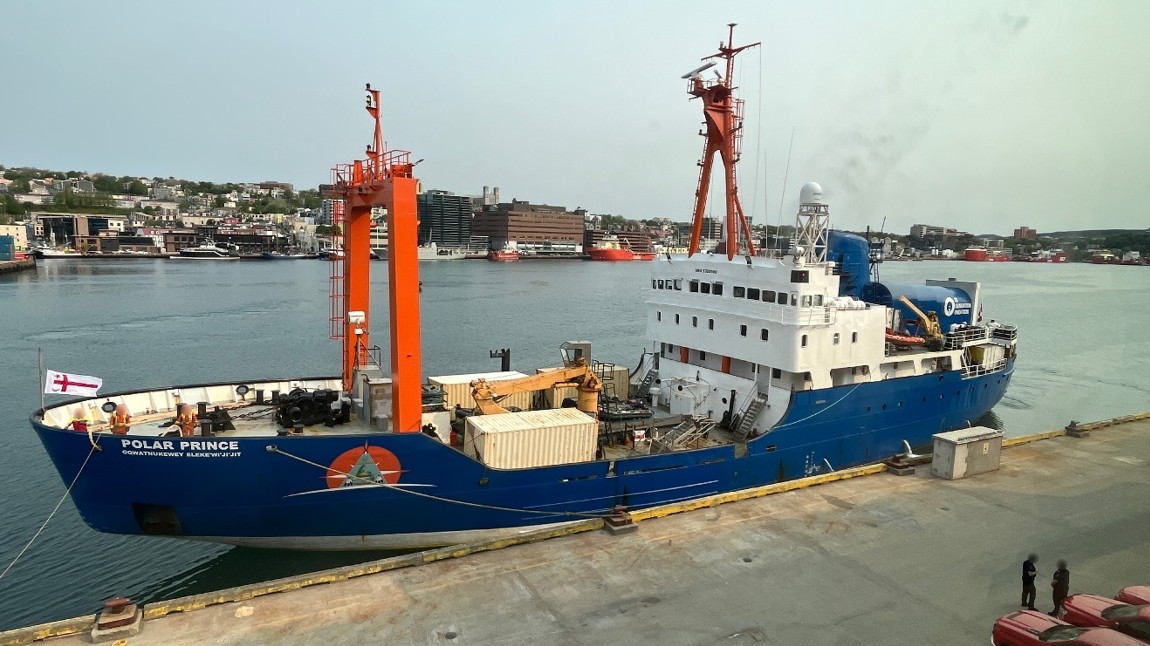
The Polar Prince (Figure 4) is a Canadian-flagged general cargo vessel. It is typically chartered out for a variety of purposes including educational voyages, documentary filmmaking, and support for various types of expeditions, such as those conducted by OceanGate. At the time of the occurrence, the Polar Prince was owned by Miawpukek Horizon Maritime Services Ltd. and was managed and operated by Horizon Maritime Services Ltd.
OceanGate first chartered the Polar Prince in March 2023. In previous years, OceanGate had chartered another vessel, the Horizon Arctic, which was also managed by Horizon Maritime Services Ltd.
Further details on the Polar Prince and the Horizon Arctic are available in Section 1.20.
1.3 Occurrence dive
The occurrence dive on 18 June was the Titan’s first dive to the TitanicThe Titanic is located at the edge of Canada’s extended continental shelf, beyond the 200 nautical-mile limit of Canada’s exclusive economic zone. in 2023. The goal of this dive was to reach the wreck, a descent of approximately 3800 m.The ocean floor around the Titanic varies slightly in depth. The report generally uses a measurement of 3800 m to approximate the depth of the ocean floor at the location of the Titanic’s bow. OceanGate used a measurement of 3840 m when recording dives that reached the ocean floor at the location of the Titanic. In some instances, the report uses OceanGate’s measurement of 3840 m. The Titan had previously made dives to the Titanic in 2021 and 2022. On these previous dives, the descent had taken the Titan about 2.5 hours. The entire occurrence dive was planned to last 11 hours and 15 minutes. Five people were scheduled to take part in the dive: the Titan’s pilot, who was OceanGate’s chief executive officer (CEO); the copilot, who was an expert on deep-sea exploration and the Titanic; and 3 passengers, who were referred to by OceanGate as mission specialists.OceanGate used the term “mission” to refer to the series of dives that took place between departure and return to port and the term “mission specialist” to refer to passengers who were joining or waiting to join a dive. These passengers were given the option to assist with some of the duties involved in dives, such as cleaning or organizing OceanGate storage areas or fetching various tools and equipment under the supervision of OceanGate employees. The report uses the term “Titan passenger” to refer to these passengers. See Section 1.20.1.1 for further details.
1.3.1 Voyage to the dive location and dive preparations
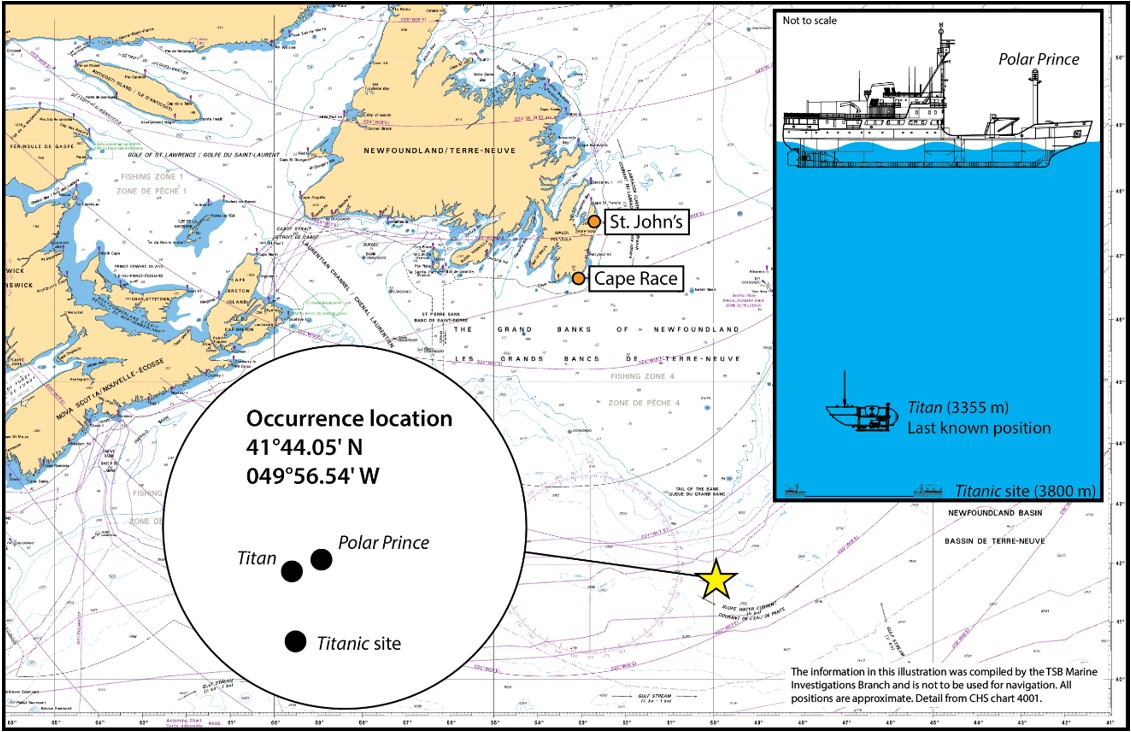
On 16 June at 0900,All times are Newfoundland Daylight Time (Coordinated Universal Time minus 2.5 hours). the Polar Prince departed St. John’s, Newfoundland and Labrador, for the Titanic wreck site (Figure 5) towing the Titan on the LARS. There were 41 people on board the Polar Prince in total: 24 people associated with OceanGate and 17 Polar Prince crew members. The distance from St. John’s to the wreck site was about 425 nautical miles, and the Polar Prince arrived with the Titan in tow on the LARS at 0400 on 18 June. The weather at the wreck site upon arrival was cloudy with some fog. The wind was southeasterly at 11 to 16 knots, and the sea state was 0.5 to 1.5 m.
At 0534, OceanGate held a briefing that provided an overview of the plan for the upcoming dive. At 0545, the 5 people boarding the Titan and their personal effects were weighed so that OceanGate could calculate the weight needed for the submersible to descend. From 0600 to 0800, OceanGate used rigid inflatable boats (RIBs) to transfer the Titan pilot, copilot, and other OceanGate personnel to the LARS, which remained connected to the Polar Prince by a towline. The OceanGate personnel fitted the Titan for the descent with 4 lead ingots weighing 85.5 kg in total, as well as 2 drop weights weighing 27.3 kg in total. They also began checks and preparations for the dive.
At approximately 0800, the 3 passengers were transferred from the Polar Prince to the LARS. All 5 people were on board the Titan by 0820. At 0824, OceanGate personnel on the LARS closed the Titan’s forward dome, bolted it shut, and used a torque wrench to tighten the bolts. At this point, the Titan crew and passengers were sealed inside the cabin, and the submersible was using its internal life support system. The Titan’s pilot and copilot continued to do checks and preparations for the dive from inside the Titan, as did OceanGate personnel on the LARS. At 0859, all OceanGate personnel took a scheduled 5-minute pause in operations to consider the progress and safety of the operations so far.
At 0904, OceanGate divers began to fill the LARS’s ballast tanks with water to submerge it. By 0905, the LARS and the Titan were submerged. At 0914, divers detached the Titan from the LARS, and the Titan began its descent. At 0916, the LARS returned to the surface.
Of the 19 people associated with OceanGate remaining aboard the Polar Prince, some were part of a surface support team that would communicate with, support, and track the Titan during the dive. Others were waiting to do a subsequent dive as Titan passengers or were family members of those passengers.
1.3.2 Descent of the Titan
During the Titan’s descent, its crew and the OceanGate surface support team exchanged a series of text messages through the primary acoustic communication and tracking system.
At 0919, 5 minutes after the Titan began its descent, the surface support team’s computer began tracking the Titan’s position via the primary acoustic communication and tracking system.This system tracked the Titan and automatically transmitted its position on average every 7.896 seconds to the computer being used by the surface support team, except during the last 200 m of the dive when the transmission interval averaged 6 seconds. The surface support team also received the 1st text message transmitted by the Titan crew.All data transmissions (both messages and tracking information) are based on the time they were sent or received by the surface support team’s computer. There was a delay of approximately 2.2 seconds from when data was transmitted by the Titan and when it was received by the surface support team’s computer. The delay was because the data was travelling at the speed of sound in water. Some of the messages transmitted were incomplete and/or included typos that made their meaning unclear. The TSB was therefore required to use some degree of interpretation based on the context in which the messages were sent to develop the following sequence of events. A verbatim transcript of the messages transmitted during the descent of the submersible is available in Appendix A. The surface support team sent a message back stating that they had tracking of the submersible. The Titan crew then transmitted a message stating that they were descending through 235 m. At 0923, the surface support team received a message from the Titan crew stating that the 2nd acoustic communication and tracking system was not functioning.It is not known why this system was not functioning.
At 0928, the surface support team sent a message to the submersible indicating that they could see the Titan descending at 33 m per minute on their display, and the Titan crew acknowledged. At 0931, the surface support team sent a message indicating that they could see the Titan at 680 m on their display. The Titan crew confirmed and indicated that they were having trouble entering the position offset.The Titan established its position in the water for navigational purposes by referencing the position of the Polar Prince. The position offset allowed for the Titan’s position to be correctly calibrated to the vessel’s GPS. A subsequent message from the Titan crew was incomplete but appeared to be a request for the surface support team to enter the position offset.
Between 0935 and 0953, the surface support team and the Titan crew communicated about dive payloadDive payload refers to the weight of the people and their effects inside the Titan. and the Titan’s depth as it descended. At 0953, the surface support team asked the Titan crew if they could see the Polar Prince on their display. The surface support team kept sending this message until 1010 without receiving a response.
At 1010, the surface support team stated that they needed better communications from the Titan crew. At 1011, the surface support team received a reply from the Titan crew confirming this message and indicating that the communication system had temporarily stopped working. At 1012, the surface support team again asked if the Titan crew could see the Polar Prince on their display. At 1014, the Titan crew replied yes and indicated there was no longer an issue. The surface support team acknowledged this message.
At 1023, there was an exchange between the Titan crew and the surface support team about the Titan’s position relative to the bow of the Polar Prince. At 1027, the surface support team sent a message indicating that their signal strength for the communication and tracking system was strong and asking whether the Titan crew could see the Polar Prince on their display.
At 1029, the Titan crew sent a message asking if the Polar Prince was above the bow of the Titanic. The Titan crew also gave their system’s signal strength. At 1030, the surface support team stated that the Polar Prince was not above the bow but was making its way there. The surface support team then stated to the Titan crew that the Titan’s position on the tracking system was jumping significantly with each transmission.
At 1047:26.903, when the submersible was at 3350 m, a message appeared on the surface support team’s computer from the Titan crew stating that they had dropped both drop weights.The TSB reviewed video camera footage taken on board the Polar Prince that included a view of the computer being used by the surface support team to communicate with the Titan. The footage showed that the message appeared on the computer screen at this time. The surface support team became aware of the message shortly after it was displayed on the computer screen. At this time, the submersible was approximately 500 m from the seabed. According to OceanGate procedures, the release of the drop weights on a normal descent was to be done when the submersible was closer to the seabed.OceanGate procedures indicated that the pilot was to use the vertical thrusters when the Titan was 50 to 75 m off the seabed in order to estimate the weight needed to be dropped to achieve neutral buoyancy. The drop weights were then to be released one at a time until the Titan was neutrally buoyant just off the seabed. (OceanGate, “Titan Crewed Submersible Operations Manual,” Launch Tow and Recovery Procedures, p. 32.) In practice, some of the Titan pilots began using vertical thrust to slow the Titan’s descent when they were around 200 m from the seabed.
At 1047:32.066, the surface support team’s computer received the last automated position update from the tracking system providing the Titan’s depth at 3355 m (Figure 5). At 1047:34.522, a loud sound, which could be characterized as a thud or a bang, reverberated through the hull of the Polar Prince. The sound was recorded by a video camera on the Polar Prince. Taking into account the delay in data transmission, it was calculated that the sound was generated at 1047:32.3, approximately 2.2 seconds before it was recorded by the video camera on the Polar Prince. This is consistent with the time it would have taken for acoustic energy to travel the distance from the location where the TSB calculated that the Titan had catastrophically failed.
A U.S. underwater acoustic recorder that was moored approximately 1448 km from the Titan recorded a loud sound in the ocean around 16 minutes after the sound was recorded on board the Polar Prince, which is consistent with the time it would have taken for acoustic energy to travel from the location where the TSB calculated that the Titan had catastrophically failed.
1.3.3 Events following the loss of contact with the Titan
The surface support team continued to send messages through the acoustic communication system stating that they had lost tracking of the submersible. They kept attempting to reestablish communication, but they received no reply. They also attempted to communicate with the Titan using the 2nd acoustic communication and tracking system, even though it had not been functioning earlier, but it still did not work.
In the event of a loss of communication between the Titan and the surface support team for more than 1 hour, OceanGate had a procedure that required the submersible to resurface. OceanGate also had a protocol for the surface support team to follow that involved communication checks while waiting for the submersible to resurface.
Based on the last position received from the Titan for this dive, the estimated resurfacing time was approximately 3 hours and 13 minutes (at 1500). After the estimated resurfacing time had elapsed, the protocol required the support vessel to conduct a 3-hour surface search to locate the submersible. If the submersible was not located within 3 hours (by 1800), the protocol required OceanGate personnel to request outside assistance.
In accordance with the protocol, the OceanGate surface support team began waiting for communication from the Titan. During this time, they sent messages at 15 minutes, 30 minutes, and 45 minutes, as required by the protocol. They also sent multiple other messages in attempts to reestablish communication. After 1 hour had elapsed, communication had still not been restored. The surface support team began waiting the 3 hours and 13 minutes allocated by the protocol for the submersible to resurface. They also continued to send messages in an ongoing attempt to reestablish communication. At 1500, with no communication from the Titan, the Polar Prince commenced the 3-hour surface search.
At 1634, as the surface search was ongoing, the master of the Polar Prince called the Horizon Maritime Services Ltd. shore-based emergency teamThe Horizon Maritime Services Ltd. shore-based emergency team was made up of people who fulfilled the following roles: emergency response team lead, safety and compliance support, client liaison, technical support, next-of-kin management and relative response, logistics support, office reception, internal security, media relations, and scribe. and notified them of the situation. By 1800, the surface search had found no signs of the submersible. The OceanGate surface support team kept attempting to reestablish communication with the submersible while also making calls to OceanGate contacts and the Horizon Maritime Services Ltd. shore-based emergency team.
At 1830, the Horizon Maritime Services Ltd. shore-based emergency team was activated, and their emergency response plan was initiated.The emergency response plan provided instructions for handling emergencies on Horizon Maritime Services Ltd. assets and described the internal and external resources required for managing emergencies of varying scales. The emergency response plan noted that specific customer requirements for emergency response should be addressed in a bridging document and respective joint emergency response plan. There was no bridging document in place with OceanGate (see Section 1.20.1.4 for more details). At 1855, the master of the Polar Prince called the Joint Rescue and Coordination Centre (JRCC) in Halifax to report the situation. JRCC transferred the call to the Rescue Coordination Centre (RCC) in Boston, Massachusetts, United States, because the Titan’s last-known position was in that RCC’s search and rescue (SAR) response zone. Meanwhile, OceanGate support personnel had called various organizations with remotely operated vehicles (ROVs) in an attempt to get one on site to conduct an underwater search.
Over the next 82 hours and 45 minutes, an international SAR response unfolded.In Canada, SAR resources are not equipped for subsea rescue. The International Submarine Escape and Rescue Liaison OfficeThe International Submarine Escape and Rescue Liaison Office is a military organization that facilitates international responses to distressed submarines with the goal of saving lives at sea. issued a request for any nearby vessels equipped with ROVs to proceed to the occurrence location. The pipelaying vessel Deep Energy, which was equipped with an ROV, responded and began proceeding to the occurrence location with an estimated time of arrival of 0630 on 20 June, which was 46 hours and 6 minutes after the Titan had started the dive. Meanwhile, OceanGate contacted a company about mobilizing an ROV from the United Kingdom, and the U.S. Navy began mobilizing another ROV from Buffalo, New York, United States.
The Deep Energy arrived on scene at 0606 on 20 June and attempted to use its ROV to reach the seabed, but the ROV was not capable of operating at these depths and was damaged in the attempt. On 21 June at 0450, the ROV mobilized by the U.S. Navy was loaded onto the Horizon Arctic in St. John’s. This vessel arrived on scene at 0540 on 22 June, and the ROV was deployed. This was 93 hours and 16 minutes after the Titan had started the dive.
At approximately 1040, the ROV discovered the Titan’s forward dome and tail piece on the seabed. Subsequently, the aft dome was discovered on the seabed. The U.S. Coast Guard indicated that the debris field was conclusive evidence of a catastrophic loss of the submersible. The SAR operation was then stood down. Efforts to search for debris continued.
In total, the SAR response involved 11 vessels and 4 aircraft, which searched approximately 12 000 square nautical miles of ocean.
1.4 Accident investigation jurisdiction
The Code of the International Standards and Recommended Practices for a Safety Investigation into a Marine Casualty or Marine Incident (the Casualty Investigation Code), which was developed by the International Maritime Organization (IMO), sets out the responsibilities of flag state administrations in conducting marine casualty investigations.International Maritime Organization, Code of the International Standards and Recommended Practices for a Safety Investigation into a Marine Casualty or Marine Incident (Casualty Investigation Code), 2008. Canada fulfills its obligations under the Casualty Investigation Code through the Canadian Transportation Accident Investigation and Safety Board Act (the CTAISB Act).
(2) This Act applies in respect of marine occurrences
(a) in Canada; and
(b) in any other place, including waters described in subsection (3), if
(i) Canada is requested to investigate the marine occurrence by an appropriate authority,
(ii) the marine occurrence involves a ship registered or licensed in Canada, or
(iii) a competent witness to, or person having information concerning a matter that may have contributed to, the marine occurrence arrives or is found at any place in Canada.Government of Canada, Canadian Transportation Accident Investigation and Safety Board Act (as amended 02 September 2022), Section 2.
1.4.1.1 Reporting of marine occurrences
As a Canadian vessel, the Polar Prince was required to report marine occurrences, as defined by the CTAISB Act, to Canadian marine authorities as soon as practicable no matter where it was operating. In Canada, a submersible is considered a vessel under the CTAISB Act and is subject to the same reporting requirements as other types of vessels.
The TSB was notified that the Titan was missing by the Horizon Maritime Services Ltd. shore-based emergency team at 0339 on 19 June.
1.5 Fatalities
All 5 people in the submersible were fatally injured.
1.6 Damage
The Titan’s pressure hull catastrophically failed. After the ROV mobilized by the U.S. Navy located the debris, the U.S. Coast Guard, with the help of the U.S. Navy, was able to recover some of the debris. The U.S. Coast Guard returned to the site in September 2023 and recovered additional debris. Not all of the debris was recovered.
ROV surveys of the debris showed that the titanium domes were intact, the viewport had blown outwards, and the carbon fibre cylinder had separated into numerous pieces of varying sizes.
Observation of the recovered debris showed that the retaining ring for the viewport was deformed in a manner that indicated the viewport had blown outward. The viewport was not found.
1.7 Environmental conditions
At its last-known depth of 3355 m, the Titan was calculated to be under 33.587 MPa of hydrostatic pressure. This is equivalent to a pressure of 342.49 kg per square cm.
On the surface, at the time of the occurrence, the air temperature was 20.3 °C, the wind was southwesterly at 16 knots, and there was a southeast swell of 1.2 m. The barometric pressure was 1013.3, and the visibility was clear at 4 nautical miles.
1.8 Registration and certification of vessels
The United Nations Convention on the Law of the Sea (UNCLOS) requires ships to be registered in a single state, and to fly the flag of that state.United Nations, United Nations Convention on the Law of the Sea, Part VII: High Seas, Article 92: Status of Ships, subsection 1, at https://www.un.org/depts/los/convention_agreements/texts/unclos/unclos_e.pdf (last accessed on 28 April 2026). This serves to establish jurisdiction over the ship while on the high seas. Every state has the right to fix its own conditions for granting nationality, registration, and use of its flag. Although the term “ship” is generally understood to have a broad application, it is not defined further in UNCLOS.
Canadian legislation predominantly uses the term “vessel” rather than “ship”. In Canada, the definition of a vessel is generally consistent across federal marine legislation. Under the Canada Shipping Act, 2001, a vessel is defined as
a boat, ship or craft designed, used or capable of being used solely or partly for navigation in, on, through or immediately above water, without regard to method or lack of propulsion, and includes such a vessel that is under construction. It does not include a floating object of a prescribed class.Government of Canada, Canada Shipping Act, 2001 (as amended 22 June 2023), section 2.
The Canada Shipping Act, 2001 requires Canadian vessels everywhere and vessels in Canadian waters or in Canada’s exclusive economic zone (EEZ) to be registered in Canada if they are “(a) not a pleasure craft; (b) wholly owned by qualified persons; and (c) not registered, listed, or otherwise recorded in a foreign state.”Ibid., section 46. There are some exempted vessels, such as those with less than 7.5 kW power, sail vessels that are 8.5 m or less in length, human-powered vessels, etc.,The Canada Shipping Act, 2001 defines a pleasure craft as “a vessel that is used for pleasure and does not carry passengers, and includes a vessel of a prescribed class.” It also defines a qualified person as “(a) a Canadian citizen or a permanent resident within the meaning of subsection 2(1) of the Immigration and Refugee Protection Act; or (b) a corporation incorporated under the laws of Canada or a province.” (Ibid., section 2.) In Canada, the responsibility for registering a vessel rests with the vessel’s owner.
UNCLOS requires flag states to maintain registers of ships and exercise control over administrative, technical, and social matters related to those ships.United Nations, United Nations Convention on the Law of the Sea, Part VII: High Seas, Article 94: Duties of the Flag State, at https://www.un.org/depts/los/convention_agreements/texts/unclos/unclos_e.pdf (last accessed on 23 March 2026).
A ship owner has the right to choose under which flag to register a vessel.
1.8.1 Authorized representative
The Canada Shipping Act, 2001 defines an authorized representative in respect of a Canadian vessel and a foreign vessel. In respect of a Canadian vessel, an authorized representative is “a person […] who is responsible […] for acting with respect to all matters relating to the vessel that are not otherwise assigned by this Act to any another person.”Government of Canada, Canada Shipping Act, 2001 (as amended 22 June 2023), subsection 14(1). In respect of a foreign vessel, the authorized representative is the master.Ibid., section 2.
1.8.2 Titan
The Titan and the LARS were not registered in any country, which meant that neither had an authorized representative identified. They were also not certified by any maritime authority or classification society.See Section 1.26.3 for more information about classification societies.
OceanGate had initiated a process to register the 1st construction of the Titan in The Bahamas on 01 August 2019. The Bahamas Maritime Authority has regulations requiring submersibles carrying people to be registered, classed, and compliant with domestic regulations. These requirements are summarized in a Marine Notice that is available online.The Bahamas Maritime Authority, “Marine Notice 74 – Manned Submersible Craft” (17 May 2021), at https://www.bahamasmaritime.com/wp-content/uploads/2021/05/MN074-Manned-Submersible-Craft.pdf (last accessed on 29 April 2026). The Bahamas Maritime Authority informed OceanGate of these requirements, and OceanGate did not pursue registration in The Bahamas further.
1.8.3 Polar Prince
The Polar Prince was registered in Canada as a general cargo vessel and held all the necessary certificates for domestic and unlimited voyages to carry up to 12 passengers. The Polar Prince had a safety management system (SMS) in accordance with the International Safety Management Code (ISM Code). The Polar Prince held a safety management certificate issued by DNV and Horizon Maritime Services Ltd. held a document of compliance issued by DNV.
1.9 Personnel certification and experience
Seafarers who work aboard commercial vessels on international voyages are subject to the International Convention on Standards of Training, Certification and Watchkeeping for Seafarers (STCW) in almost all countries. The STCW Convention establishes basic requirements for training, certification, and watchkeeping for seafarers, but it does not provide specific guidance about training and certification for those who work aboard commercial submersibles.
The IMO has published a circular providing some guidance to submersible operators on training and certification. Section 1.26.1 provides more details on the IMO circular.
Some countries have developed training and certification requirements for passenger submersibles, including Canada. In Canada, certifications required to operate a passenger submersible are set out under the Marine Personnel Regulations (MPR). The MPR apply to Canadian vessels and to foreign vessels in Canadian waters.
An applicant for a passenger submersible craft endorsement under the MPR is required to have the following:
- A certificate of competency as a master, mate, or engineer that is valid for the vessel and its route
- A commercial diver certificate recognized by the province
- A Marine Basic First Aid certificate
- A testimonial of training provided by the manufacturer of the vessel for which the endorsement is sought or by an agent of the vessel’s authorized representative, if the agent has been trained by the manufacturer.Transport Canada, Marine Personnel Regulations (as amended 20 December 2023), subsection 176(1).
Since the passenger submersible craft endorsement was introduced in Canada on 13 July 2005, none have been issued.
The MPR also specify requirements for engineering crew on passenger submersibles with internal combustion engines or electric propulsion systems of at least 75 kW but not more than 750 kW.Ibid., subsection 263(2). The regulations state that for passenger submersibles not required to have an engineer on board, “the authorized representative shall assign the maintenance of the vessel’s machinery to a technician accredited for this purpose by the manufacturer.”Ibid., subsection 263(4).
The MPR have no certification requirements applicable to personnel operating submersibles that do not carry passengers.
1.9.1 Titan
The pilot of the submersible was OceanGate’s CEO. He had been the CEO of OceanGate since it was founded in 2009. He held a Bachelor of Science in Aerospace Engineering and a Master of Business Administration. He began his career in aviation, first serving as a DC-8 aircraft first officer and then as a flight test engineer. Before founding OceanGate, he served on the board of a sonar development company and as chairman of a company that made remotely operated devices. After founding OceanGate, he was involved in all aspects of the company, including human resources, finance, operations, and submersible design and construction. He also provided oversight of decisions related to the operations, financing, and engineering of the company submersibles. He provided guidance on the design of the Titan and had piloted it on numerous previous dives, including dives to the Titanic in 2021 and 2022. He held a merchant mariner credential (Master of 25 GRT [Gross Register Tons] Upon Inland Waters) issued by the U.S. Coast Guard, which he obtained on 16 March 2020.
The copilot was an expert on deep-sea exploration and the Titanic. Prior to the occurrence, he had made 37 dives to the Titanic, including previous dives on the Titan. He had served for 22 years in the French Navy as a submarine pilot, mine-clearing diver, and deep-sea diver. He then worked for a French maritime research institute overseeing deep-sea exploration crafts during early expeditions to the Titanic. In 2023, he was serving as Director of Underwater Research for RMS Titanic, Inc., a company that salvages artifacts from the Titanic. He was not acting in this capacity on the occurrence dive.
There was a variety of other people associated with OceanGate who remained on the Polar Prince during the occurrence dive. They consisted of OceanGate employees, Titan passengers, and family members of the passengers. Some of the Titan passengers had been on previous voyages with OceanGate and were serving in a voluntary role on this expedition. OceanGate employees had various roles and sometimes rotated between roles. Examples of roles included RIB operator, diver, submersible pilot, submersible copilot, LARS operator, and support staff.
As part of its surface support team, OceanGate had a core group that was responsible for overseeing dives and communicating with and tracking the Titan during dives. This core group comprised a mission director, a mission director support person, a communications and tracking person, and 2 communications and tracking support people. The roles of these positions were typically rotated between senior OceanGate employees.
1.9.2 Polar Prince
The master on the Polar Prince had held a Master Mariner Certificate since 2014. He started serving as a master on the Polar Prince on 12 April 2023. The master on the Polar Prince had no prior experience with submersible operations.
The Horizon Maritime Services Ltd. crew aboard the Polar Prince held Canadian certificates appropriate for the vessel’s voyages and operations.
1.10 Detailed description of the Titan and its operating systems
1.10.1 Pressure hull
The Titan’s pressure hull consisted of a carbon fibre cylinder that was capped at either end by titanium domes. The cylinder was fabricated from a carbon fibre and epoxy resin composite material. It was 12.7 cm thick and 2.54 m long. It had an outside diameter of 1.68 m. The cylinder was covered with a commercially available spray-on coating of polyurea elastomer. More details on the design, construction, and testing of the pressure hull are available in Section 1.12.
The components of the Titan’s pressure hull are shown in Figure 6 and described in more detail below.
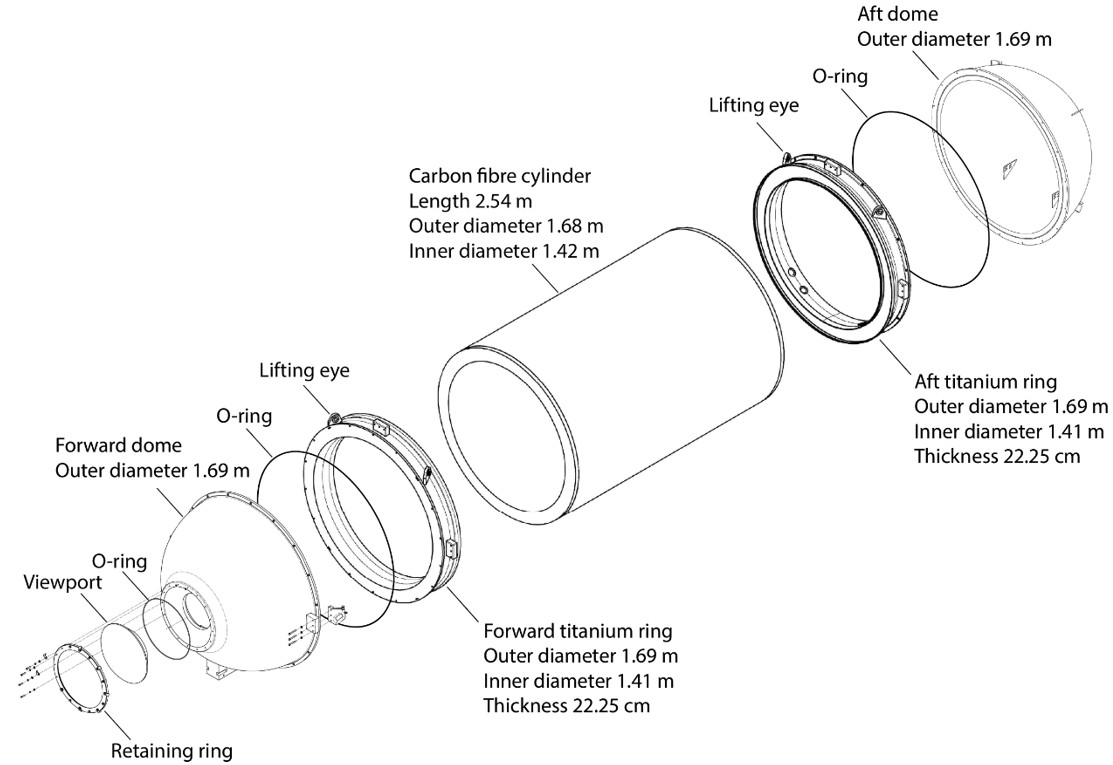
At either end of the carbon fibre cylinder were rings fabricated from grade 3 titanium. Each titanium ring had an annular channel where the cylinder was inserted and joined using an epoxy paste adhesive. The forward and aft rings each had 2 lifting eyes welded to the upper sections of them to facilitate lifting the submersible using a crane. The aft ring had 4 penetration plates that allowed for through-hull connections of wiring, tubing, and piping for electrical, air, and hydraulic components.
The hemispherical domes were also made of grade 3 titanium and were bolted to the titanium rings. The domes were 1.52 m in diameter and 8.26 cm thick. The forward dome had the viewport fitted into it. The viewport was made of manufactured acrylic that was 22 cm thick at its thickest point. The outer side of the viewport had a diameter of 58.42 cm and was convex. The viewport tapered to a diameter of 38.62 cm inside the cabin. The viewport was positioned in a machined seat and secured in place by an O-ring and a retaining ring. The viewport was rated for 6.516 MPa, which is equivalent to a depth of 649.08 m (see Section 1.12 for more details on the viewport).
The forward dome was connected to the titanium ring fitted at the forward end of the cylinder by a hinge. There were 18 holes that extended around the circumference of the dome for securing bolts.Up until 30 June 2021, OceanGate had generally been using 4 securing bolts to secure the forward dome. However, during a dive on 30 June 2021, the forward dome fell off the submersible during recovery. Following this dive, OceanGate began using 18 securing bolts. Each hole had a diameter of 1.04 cm. There was also an O-ring fitted in the forward dome as part of the sealing arrangement. The aft dome was bolted to the aft ring with an O-ring as part of the sealing arrangement.
1.10.2 Exterior framework
The Titan had a metal exterior framework that surrounded the pressure hull. The framework comprised 3 parts: the horizontal beam assembly, the landing gear assembly, and the tail assembly (Figure 7). The drop weight carriage was connected to the horizontal beam assembly.
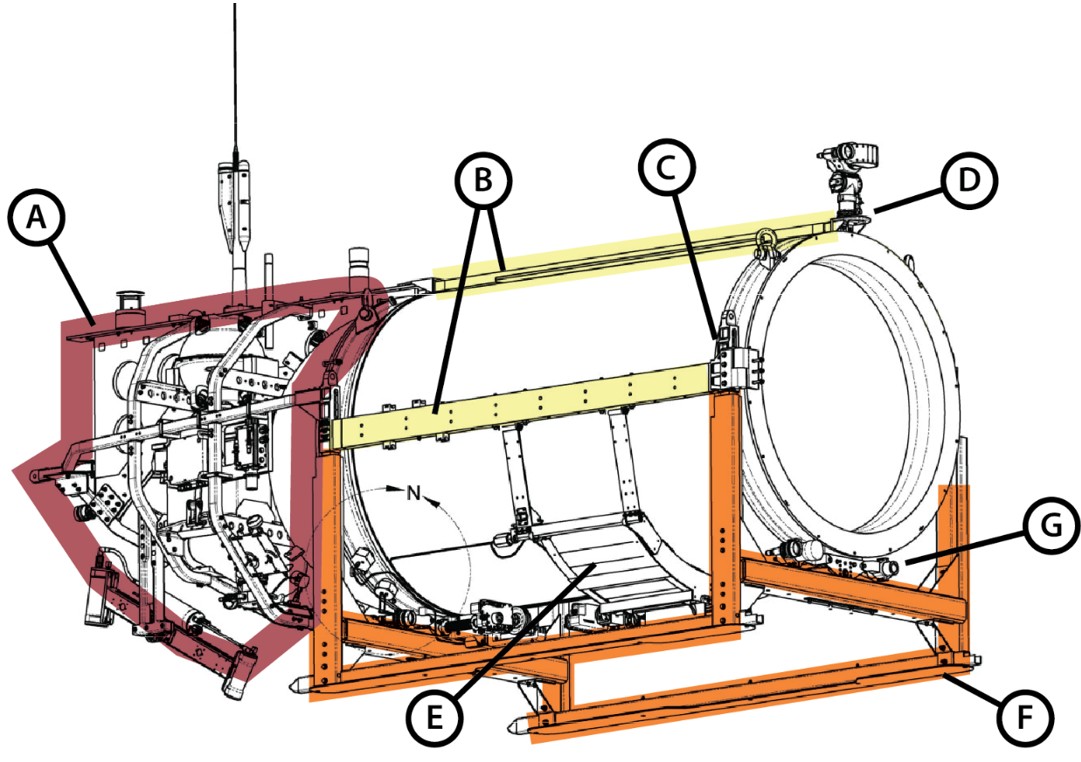
(A) tail assembly (B) horizontal beam assembly (C) side mount (D) top mount (E) drop weight carriage (F) landing gear assembly (G) bottom mount
The horizontal beam assembly consisted of 3 galvanized steel beams that ran longitudinally along the port, starboard, and top of the pressure hull. The beams were connected to the forward and aft titanium rings by side mounts located at the 90 and 270 degree positions on the rings, as well as a top mount at the 0 degree position. The drop weight carriage was connected to the port and starboard beams and could be released using a manually operated hydraulic pump located in the cabin.
The landing gear assembly included skids that were used for securing the Titan to the LARS and landing the submersible on the seafloor. The side mounts fitted into the landing skid’s vertical legs and held the pressure hull in the frame. The skids also held some of the weights to help the submersible descend. The landing gear assembly could be released in the event of an emergency (such as an entanglement) using the same manually operated hydraulic pump that was used to release the drop weight carriage.
There were bottom mounts below each titanium ring that held the rings in position on the forward and aft transverse beams of the landing gear assembly. The bottom mounts were connected to a release mechanism on each end of the landing gear assembly, and the 2 release mechanisms were connected by wire rope. The release mechanisms could be hydraulically operated from the same manually operated pump that was used for the drop weight carriage. A manually operated valve inside the cabin could be positioned to direct hydraulic pressure to either the drop weight carriage or the landing gear release mechanisms.
The tail assembly housed various components, including batteries, a high-pressure compressed air tank for the ballast bladder, and 2 control spheres made of glass. The tail assembly also housed electronic junction boxes, wiring, tubing, and piping that supported the Titan’s operating systems. The tail assembly was bolted to the aft titanium ring at the 0, 90, 180, and 270 degree positions via titanium tabs that were part of the titanium ring. The tail assembly was not watertight, and all external systems within the tail assembly that had pressure boundaries were either oil‑compensated, gel‑filled, or epoxy‑sealed.
The 2 glass control spheres in the tail framework were oil-filled and had precision‑drilled holes in them to allow wiring for communication and power to interface with external components. The spheres were rated by their manufacturer to a depth of 6000 m.
1.10.3 Computer systems
The majority of the Titan’s operating systems and components were controlled through a main control computer operated by the pilot from inside the cabin. The main control computer was used to operate the thrusters, internal and external lights, the ballast bladder system, the drop weight system, cameras, GPS, and a laser scanner. The communication and tracking systems were also routed through the main control computer. There were 2 other dedicated computers: 1 for multimedia and 1 for real-time monitoring of strain and acoustic emissions. Data from these dedicated computers interfaced with the main control computer.
1.10.4 System for descents, ascents, and neutral buoyancy
For descending, ascending, and achieving neutral buoyancy, the Titan used a system that involved drop weights,The drop weights used by OceanGate consisted of steel pipes and bags of steel shot with sacrificial links. The sacrificial links were made of magnesium and would dissolve in sea water through galvanic action after 12 to 16 hours, releasing the weight. lead ingots, and an air-operated ballast bladder.
To descend, a combination of lead ingots and drop weights were attached to the submersible. The lead ingots were placed on the landing skids, and the drop weights were placed on either side of the submersible in the drop weight carriage. Each lead ingot weighed 21.3 kg, and each drop weight weighed 15.4 kg. The amount of weight required for a descent was calculated before each dive, taking into account the combined weight of the people that would be boarding the submersible and their personal effects, as well as the desired speed of descent.
When the Titan was 50 to 75 m from the seabed, OceanGate procedures were for the pilot to use vertical thrust to estimate how many weights needed to be dropped for the submersible to achieve neutral buoyancy. Then, at a suitable distance from the seabed, the drop weights were released one at a time until the Titan was neutrally buoyant just above the seabed. In practice, some of the Titan pilots began using vertical thrust to slow the Titan’s descent when they were around 200 m from the seabed. Once the Titan was neutrally buoyant, the pilots would begin to navigate using the thrusters. To ascend, the pilots would release enough drop weights for the Titan to become positively buoyant, and the submersible would ascend to the surface.
The controls to release the drop weights were activated from the main control computer. The controls activated drop weight motors that rotated shafts within the drop weight carriage and released the drop weights one at a time.
The submersible had an air-operated ballast bladder located on top of the pressure hull between the carbon fibre cylinder and the fibreglass shell. The bladder was made of heavy vinyl and could be filled with or emptied of compressed air to assist the Titan with ascending and maintaining neutral buoyancy. The pilot could control the amount of compressed air in the bladder using the main control computer.
1.10.5 Navigation
The Titan’s propulsion and steering was provided by four 7.5 kW electric thrusters: 2 provided vertical movement and 2 provided horizontal movement. The thrusters were powered by two 150 V lithium-polymer batteries. The submersible could navigate underwater at a speed of approximately 3 knots. The pilot operated the thrusters using a handheld wireless controller that interfaced with the main control computer.
The submersible had 3 external video cameras to assist the pilot with navigation. The 1st camera was mounted on top of the forward dome and gave the pilot a view in front of the submersible. The 2nd camera was on the underside of the submersible and was used for navigating near the bottom and for monitoring the dropping of weights and the vent valve for the ballast bladder. This camera also allowed for a view of the underside of the submersible during launching and recovery using the LARS. Finally, there was a 3rd camera located aft, which gave the pilot a view behind the submersible. This camera was used when the submersible was reversing and manoeuvring.
The submersible had external lighting and a sonar system that allowed for detection of underwater objects. The submersible also had a doppler velocity logger that provided information about the submersible’s speed over ground and height above the seabed.
1.10.6 Communication and tracking equipment
In 2023, the Titan’s primary communication and tracking system was an ultra-short baseline (USBL) acoustic system. This system was new to the Titan at the start of the 2023 operating season. The 2nd communication and tracking system fitted on the Titan was an acoustic telemetry (ATM) system. The ATM system had been used in previous years and was original to the 2nd construction of the Titan. Both systems were commercially available and designed for a variety of applications, including navigating ROVs and tracking divers.
The USBL system operated with a transceiver that was lowered through the support vessel’s moonpool using the vessel’s crane. The system then used acoustic signals to send information back and forth between the transceiver and a transponder affixed to the Titan. The system sent speed, heading, and position information (coordinates and depth) from the Titan to the surface support team on average every 7.896 seconds.
For the ATM system, an acoustic modem was lowered through the support vessel’s moonpool. The system then sent information back and forth between this modem and another acoustic modem affixed to the Titan. The ATM system sent speed, heading, and depth information to both the Titan crew and the surface support team every 5 minutes.
When the submersible was within approximately 70 m of the surface, neither system could function reliably because there was no clear path for the acoustic signals between the submersible and the support vessel. A transceiver would therefore be deployed from one of the RIBs to maintain a clear path for signals.
When the Titan was on the surface, neither communication and tracking system could function, so the Titan carried a portable VHF (very high frequency) radiotelephone for communication between the submersible and the surface support team. The Titan also carried a satellite beacon to assist the surface support team with locating the submersible for recovery once the submersible was near or on the surface.
1.10.7 Cabin
The inner part of the Titan’s pressure hull had a cylindrical insert fitted into it that formed the interior of the Titan’s cabin. The cylindrical insert was made primarily of fibreglass. The pressure in the cabin was maintained at the average pressure at sea level (101.3 kPa) throughout dives.
The Titan’s cabin had an oxygen supply system and carbon dioxide scrubber system. The oxygen supply system consisted of 1 main oxygen cylinder and 4 emergency reserve cylinders that were stored within the cabin. These cylinders provided enough oxygen for 5 people for approximately 96 hours. There were oxygen sensors in the cabin to monitor the oxygen level; the sensors displayed oxygen level information on the main control computer. The main oxygen cylinder supplied oxygen through a flow meter that could be manually adjusted as required throughout dives.
The cabin had a carbon dioxide scrubber for regular use during dives and lithium hydroxide absorbent blankets for up to 96 hours of carbon dioxide scrubbing in an emergency. The cabin had carbon dioxide sensors, and the carbon dioxide level was also displayed on the main control computer. Both the oxygen and the carbon dioxide were also monitored by separate emergency monitors that displayed the gas levels in case of a failure of the main control computer.
The Titan’s cabin also had 2 water detection sensors. They were located beneath the floor portion of the hull insert. If the sensors detected water, they generated an alarm on the main control screen.
1.10.8 Power supply
The Titan had two 150 V lithium-polymer batteries that were located within the tail framework and were rated to 4000 m. One battery ran the port thrusters, and the other ran the starboard thrusters.
The Titan also had a 24 V lead-acid battery bank that powered the cabin components and all operating systems. The battery bank was located beneath the floor portion of the hull insert. The battery bank powered items such as the computers, the lights, the cameras, the motors for the drop weights, and the modem for the communication and tracking equipment.
1.10.9 Acoustic emission monitoring system
The Titan was fitted with a custom-built acoustic emission monitoring system that was intended to detect changes in the pressure hull structure in real time during dives.The concept of acoustic emission monitoring for composite structures has been used in the past. See for reference J.D. Stachiw and B. Frame, Graphite-Fiber-Reinforced Plastic Pressure Hull Mod 2 for the Advanced Unmanned Search System Vehicle (Naval Ocean Systems Center, August 1988), at https://apps.dtic.mil/sti/tr/pdf/ADA270438.pdf (last accessed on 19 September 2025). During dives, hydrostatic pressure applied on the exterior of the pressure hull would result in compressive stress in the hull and the resulting strain could cause some of the strands in the carbon fibre cylinder to break. Carbon fibre strands make noise (i.e., generate acoustic emissions) when breaking, and the acoustic emission monitoring system was intended to measure these acoustic emissions and provide enough advance warning for the submersible to resurface before a failure. Data from the acoustic emissions system was available to only the Titan crew during dives; it was not automatically transmitted to the surface support team.
The system included 8 audio sensors that were affixed to the interior of the pressure hull using a silicone glue. The system picked up acoustic emissions from the pressure hull using the audio sensors, amplified them, and digitized them to create a stream of data that was transmitted to the Titan’s main control computer through 8 separate channels. The acoustic emissions data was displayed in real time in a default window on the main control computer. The window displayed the amplitude of acoustic emissions over a moving 5-second period as a dive was progressing. The total number of acoustic emissions was also displayed as the dive progressed.
The acoustic emission monitoring system had green, yellow, and red thresholds that had been programmed by OceanGate. The number of “hits” accumulated on a given dive would determine the threshold reached. OceanGate had defined a “hit” as an acoustic emission that had an amplitude of 5000 or greater analog to digital units. The exact thresholds for yellow and red are not known, but it was reported that the yellow threshold would be reached if there were between 30 and 50 hits on a dive.
OceanGate used data obtained from testing of the one-third scale models and the full-scale pressure hulls when setting the thresholds, as well as data from the strain monitoring system. However, exactly how OceanGate determined the thresholds is not known (see Section 1.12 for more details on testing of the Titan). The thresholds remained the same throughout the operating life of the Titan, aside from a few minor adjustments. There was an understanding among the pilots that if the red threshold was reached, the dive had to be aborted. The system did not have audible alarms.
The acoustic emission system was used only during dives and was reset after each dive. The system was not used to monitor acoustic emissions from activities other than diving (e.g., towing, launching, recovery, or over-ground transportation of the submersible).
The investigation determined that acoustic emission data was downloaded following dives and that it was sometimes reviewed by OceanGate employees. However, in general, it was not possible to determine what was being analyzed during these reviews and what the outcomes of the reviews were.
The investigation determined that, in 2019, an employee added the ability for the amplitude of acoustic emissions to be correlated with time and depth, which then allowed for acoustic emission data to be compared against strain data. It was not possible to determine the extent of analysis that OceanGate conducted following this change. This employee left OceanGate in February 2023.
OceanGate had encountered interference problems with the acoustic emission monitoring system: the audio sensors picked up acoustic emissions from sources that were unrelated to the pressure hull (i.e., noise in proximity to the submersible, such as a tool being dropped on deck or the LARS making contact with the support vessel during launching and recovery). OceanGate also had no way to determine if the audio sensors were working during a dive; a non-functional sensor would just show no data on the channel. Once the audio sensors were glued onto the pressure hull, they remained there for the operational life of the Titan. It was not possible for OceanGate employees to access the sensors for inspection or maintenance without dismantling the Titan because the sensors were located in the space between the hull insert and the pressure hull, which had no access points. OceanGate employees sometimes tested the audio sensors by using a piece of equipment to create an impact on the forward and aft titanium rings, which they then expected to see reflected in the acoustic emission data.
No acoustic emissions data was available to the TSB for the occurrence dive because the computer within the Titan that was storing this data was compressed together with other components in the cabin during the failure of the pressure hull. This debris was retrieved, but the data was unrecoverable because of damage.
The TSB was, however, able to locate a limited set of acoustic emissions data from previously completed dives and pressure tests at the Deep Ocean Test Facility.The Deep Ocean Test Facility, located at the Penn State Applied Research Laboratory in Annapolis, Maryland, United States, has a pressure tank able to simulate ocean depths of up to 8229.6 m. This data spanned from February 2021 to 23 July 2022. There was no data available for the 2023 season.
1.10.10 Strain monitoring system
The Titan’s pressure hull was fitted with a custom-built strain monitoring system. This system was used to measure strain on the pressure hull, as well as depth, and time during dives and pressure tests to detect changes in the pressure hull structure. The strain monitoring system was not routinely used by OceanGate for real-time monitoring, although strain data could be called up by the pilot on the main control computer at any point in a dive. The strain data was intended to be downloaded and analyzed following each dive or pressure test.
The system contained 16 strain gauges that were grouped in pairs. In each pair, one gauge was oriented to measure strain in the axial direction and the other was oriented to measure strain in the circumferential direction. The strain gauges measured strain only in close range to their locations on the pressure hull. Five pairs of strain gauges were affixed to the interior of the carbon fibre cylinder, and 2 pairs were affixed to the interior of the forward dome. The final pair was located in the aft titanium ring.
During a dive, data from the 16 gauges was transmitted to a dedicated computer in the cabin that interfaced with the Titan’s main control computer. Strain gauge data on the main control computer had to be specifically selected to view; it was not present in a default window. There were no audible alarms for the strain gauge data, and the strain gauge data was not automatically transmitted to the surface support team during a dive.
Five of the 8 pairs of strain gauges were located in the space between the hull insert and the pressure hull, which had no access points. The strain gauge pair in the aft titanium ring was similarly inaccessible. This meant that these 12 gauges could not be accessed for testing, inspection, or maintenance without dismantling the Titan. After these gauges were installed, OceanGate relied on data provided during dives and pressure tests to determine if the gauges were working.
The 2 strain gauge pairs in the forward dome were not working properly before the occurrence. Three of the individual strain gauges on the carbon fibre cylinder were also not working properly. It is not known when these gauges stopped working, though it had been reported that the strain gauges might have become detached when the hull insert was fitted into the pressure hull during the construction process. These gauges were providing invalid data that may have resulted from a failure in the strain gauge itself, issues with the wiring to the data logger, or the presence of another factor influencing the data provided (e.g., partial de-bonding of the gauge or water infiltration).
Data from the strain gauges could be downloaded for analysis following dives. There was evidence indicating that after dives in 2021 and 2022, strain gauge data was downloaded and distributed to some employees at OceanGate and that it was sometimes reviewed. However, in general, it was not possible to determine what was being analyzed during these reviews and what the outcome of the reviews were.
There was no strain data available to the investigation for the occurrence dive because the computer within the Titan that was storing this data was compressed together with other components in the cabin during the catastrophic failure. Although the memory chip for this computer was also retrieved, the data on it was unrecoverable.
The TSB was able to locate a limited set of usable strain gauge data from previously completed dives and pressure tests. The data covered 11 dives conducted between 01 March 2021 and 05 August 2021 and between 15 July 2022 and 23 July 2022. These dives were done at, or around, depths equivalent to that of the Titanic. The rest of the data was from 3 pressure tests done at the Deep Ocean Test Facility.
1.10.10.1 Review of strain monitoring data by the TSB Laboratory
The TSB Laboratory used dataThe TSB Laboratory used data from operational dives and 3 pressure tests that simulated depths up to 4250 m. from the strain gauges fitted on the hull and forward dome of the Titan to determine whether there was any indication of damage accumulation. Strain levels for each gauge location were plotted against depth for each dive. When a material is undamaged by pressure, the plotted relationship (strain slope) should be linear. As well, strain levels should be similar at similar depths. When there is damage, the strain slope would be non-linear, and strain levels from the various gauge locations would likely differ at similar depths.
The TSB looked at the gauges that were providing valid strain data in both the axial and circumferential directions. When the data from each dive was plotted from 100 m to 4250 m (i.e. viewed from a macro level) to look at strain in relation to depth, the strain slopes for each dive were consistent with each other within a 7% range. This suggests that the functional strain gauges were accurately measuring the strain as the hydrostatic pressures increased with dive depth.
However, when the strain data for depths of 600 m or less was examined in more detail, there were considerable changes observed in the strain slopes for certain gauges. The strain gauge located on the centre top portion of the carbon fibre cylinder, was showing the most notable slope changes. In an attempt to understand these slope changes, the TSB compared the strain slope changes at different depths for this gauge over 2 dives (one on 05 August 2021 and one on 19 July 2022). Both dives went to 3840 m. When looking at the entire dive profiles (10 m to 3840 m) for these 2 dives, the strain slopes were nearly identical.
However, when looking at the gauge’s strain slope on the 05 August 2021 dive for the 10 m to 300 m range, the strain slope was found to be 21% greater than the slope for the entire dive profile. When looking at the gauge’s strain slope on 19 July 2022 dive for the 10 m to 300 m range, the strain slope was found to be 98% greater than the slope for the entire dive profile.
When looking at depths of 300 m to 600 m, the gauge’s strain slope for the 05 August 2021 dive was 8.5% greater than the slope for the entire dive profile, and the strain slope for the 19 July 2022 dive was 29% greater than the slope for the entire dive profile.
These changes in slope indicated non-linearity in strain at depths of 600 m or less, with the non-linearity decreasing as the depth increased.
In reviewing the strain data, the TSB identified that a notable event had occurred on a dive on 15 July 2022, 4 days before the dive on 19 July 2022 when non-linear readings were present. During the dive on 15 July 2022, a loud bang was heard by crew and passengers of the submersible while it was surfacing. OceanGate did not conduct a thorough inspection of the pressure hull following this event, so it cannot be determined whether this event precipitated the non-linear readings on 19 July 2022.
1.11 Detailed description of the launch and recovery system
The LARS essentially consisted of 2 pontoons with internal tanks that could be filled with controlled amounts of either compressed air or seawater, allowing the LARS to ascend, descend, or remain on the surface. There were 2 internal tanks in each pontoon. Each internal tank had 2 hatches, 1 on the top of the pontoon and 1 on the bottom.
The LARS had 4 propane tanks fitted to it that were repurposed to store compressed air. They were part of a compressed air system that was used to fill and vent the internal tanks. As air was introduced into the internal tanks, it displaced water through the open hatches on the bottom of the pontoons and caused the LARS to ascend or remain on the surface. As air was released from the pontoons, water was able to flood through the open hatches, filling the internal tanks and causing the LARS to submerge. The pontoon hatches were opened and closed by OceanGate divers.
The Titan was designed to be launched underwater. During launching, the LARS would be submerged to a depth of approximately 10 m with the Titan attached to it. The Titan was held onto the LARS by locking mechanisms that slid over the Titan’s landing skids. Once the LARS and the Titan were submerged and ready to launch, divers would manually release the locking mechanisms on the landing skids, and the submersible pilot would navigate the Titan off the submerged LARS using its thrusters. The Titan would then begin its descent.
During recovery, the LARS was again submerged, and the pilot would navigate the Titan over top of it. With the assistance of divers, the Titan would be repositioned back onto the LARS and reattached by its locking mechanisms. The LARS would then be raised back up to the surface, where the surface support team members on the LARS could unbolt the forward dome to allow the Titan crew and passengers to exit the submersible.
1.12 Design, construction, and testing of the Titan
The design, construction, and testing of the Titan was divided into 2 periods, the first of which spanned 2013 to 2019 and involved the 1st construction,OceanGate referred to the 1st construction of the Titan as Cyclops II up until some point in 2018, when the submersible was renamed Titan. and the second of which spanned 2020 to 2021 and involved the 2nd construction. The following sections provide a general timeline of events in the design, construction, and testing of the Titan during these periods.
Before designing and constructing the Titan, OceanGate had acquired and operated 2 other submersibles, the Antipodes and the Cyclops I.
1.12.1 First construction (2013–2019)
In 2013, OceanGate entered into a contract with the University of Washington’s Applied Physics Lab (UW-APL), located in Seattle, Washington state, United States, to begin designing a submersible made of carbon fibre. At some point in 2013, OceanGate also obtained design and analysis documents for a submersible made of carbon fibre from a U.S.-based aerospace and defence company. OceanGate then asked a 2nd aerospace company to review the documents provided by the 1st company. The 2nd company also took specific requirements from OceanGate and conducted a study to see if it was feasible to build a submersible made of carbon fibre that met certain parameters (e.g. a particular buoyancy level or safety factor.)
At some point before March 2015, OceanGate approached a company that fabricated composite products and asked about manufacturing a one-third scale model submersible built entirely of carbon fibre. On 25 June 2015, this company produced a design document that showed that OceanGate wanted a submersible made primarily of carbon fibre rated up to 6000 m, but that it was willing to accept a rating up to 3000 m. The document also identified that OceanGate had a goal of 2.25 for the safety factor, but that it was willing to accept 1.5.At the time, OceanGate was basing its safety factor on the American Society for Mechanical Engineers standard (PVHO-1 - Safety Standard for Pressure Vessels for Human Occupancy, 2012) that required a minimum safety factor of 1.5. Finally, the document identified that OceanGate had a goal for the submersible to have a life cycle of 10 000 dives to its maximum rated depth, but that it was willing to accept 1000.
The document provided a design for a carbon fibre cylinder that had a safety factor of 2.19 with grade 5 titanium end domes and a safety factor of 2.21 with carbon fibre end domes. The report indicated that the allowable compressive strain needed to be confirmed by further testing. At some point in 2015, this company manufactured a one-third scale model submersible with a carbon fibre cylinder and carbon fibre end domes for OceanGate.
In December 2015, OceanGate conducted a pressure test on this one-third scale model at the UW-APL (Figure 8). One of the carbon fibre end domes failed at pressures equivalent to depths of around 3000 m. On 23 December 2015, OceanGate sent a letter to stakeholders reporting on the one-third scale model test. The letter indicated that strain gauges were used during the test and that one of the hemispherical end caps had failed well short of the design operating depth of 6096 m. The letter noted that the failed end cap had been sent back for evaluation to the company that had manufactured it. It was believed that the end cap had buckled, which was the reason the strain gauges did not give any warning of the failure.
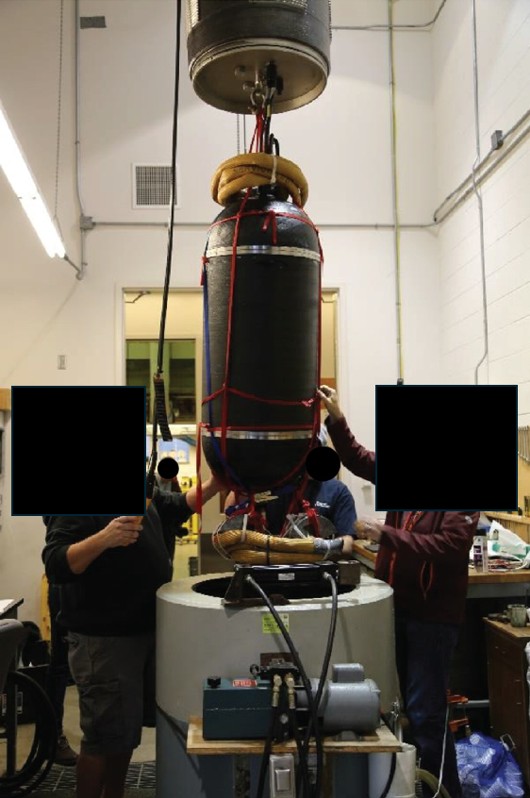
On 05 February 2016, OceanGate conducted a 2nd pressure test using the one-third scale model with aluminum plates on either end (Figure 9). The one-third scale model failed at a pressure equivalent to a depth of 4200 m (Figure 10). Strain gauges were used during this test.
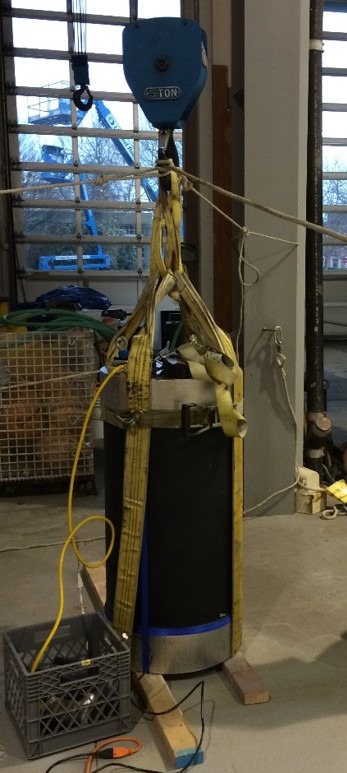
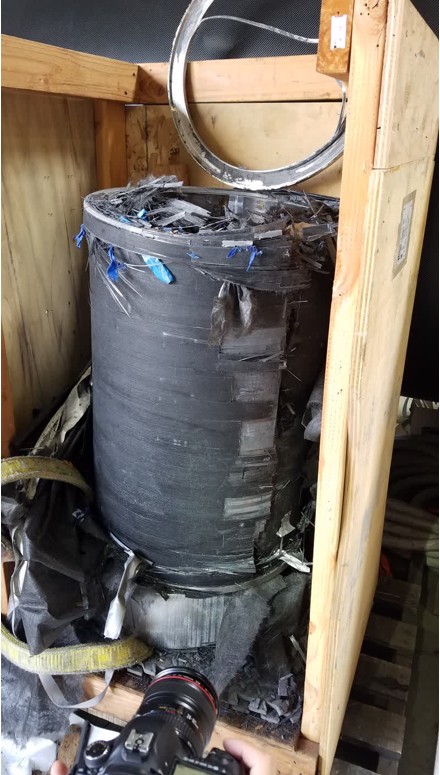
On 11 March 2016, OceanGate conducted a 3rd pressure test on a new one-third scale model, this one again with carbon fibre end domes (Figure 11). It failed at a pressure equivalent to a depth of 2754 m (Figure 12). This test was done with acoustic emission monitors to measure the effects of the pressure on the carbon fibre components.
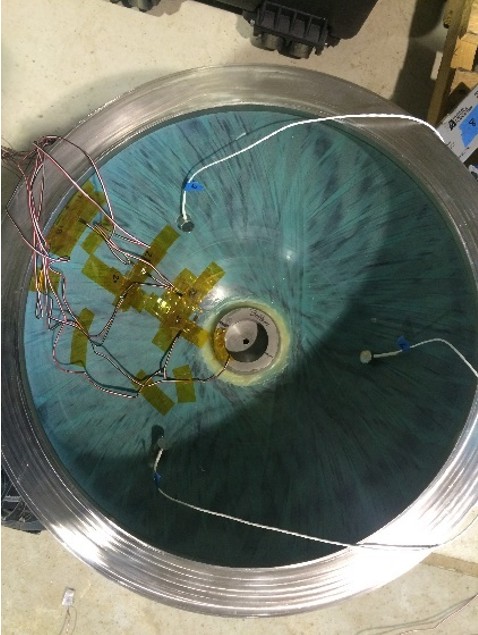
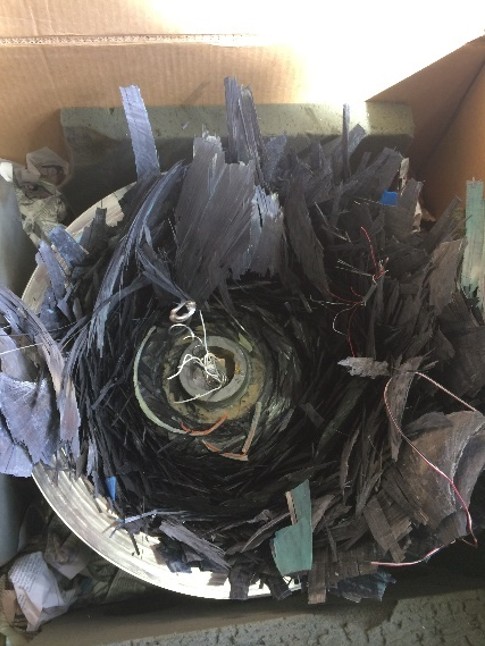
At some point after March 2016, UW-APL and the OceanGate engineering team began having conflict around the engineering of the submersible. The conflict centred on the use of titanium end domes and the use of glass spheres to interface with internal and external electronics and house the motor controllers. The conflict reached a point where OceanGate terminated the relationship with UW-APL. However, later on, OceanGate continued to use the UW‑APL testing facility.
On 07 July 2016, OceanGate conducted the 4th one-third scale model test at the UW-APL testing facility. This model had aluminum plates on either end. The model failed at a pressure equivalent to a depth of 4465 m. The acoustic emission monitoring was incorporated as part of this test.
Following this test, OceanGate began work to develop a full-scale submersible with a carbon fibre cylinder and titanium end domes (Figure 13). Over the course of 2017, the carbon fibre cylinder was manufactured through a process known as filament winding, which involved winding a continuous strand of carbon fibre on a mandrel. Before being wound on the mandrel, the carbon fibre passed through an epoxy resin bath. Once the entire cylinder was wound, it was cured. Some of the carbon fibre layers in the axial direction were hand laid and then coated with epoxy resin. Concurrently, a metal fabricator manufactured the titanium end domes using grade 3 titanium. Although the original design specifications were for grade 5 titanium, grade 3 titanium was easier to acquire and cheaper than grade 5 titanium, which were factors in why OceanGate decided to use it.
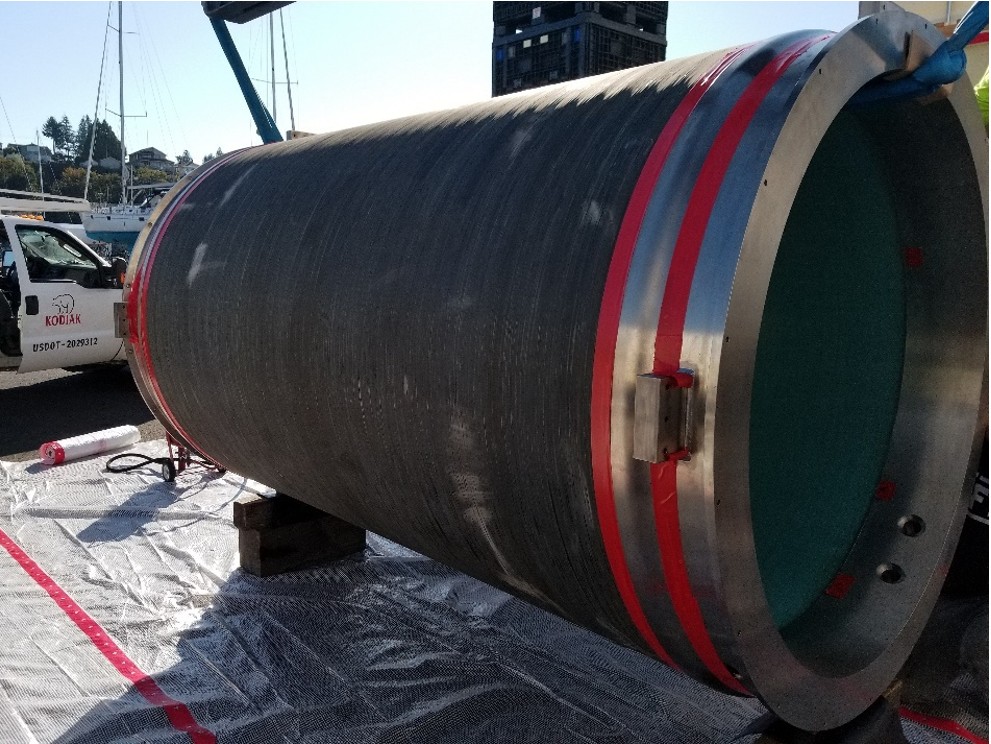
In the fall of 2017, OceanGate engaged a company that designed, fabricated, and certified components for subsea and medical applications about procuring an acrylic viewport for the submersible. OceanGate provided this company with a drawing for the design of the viewport: it was to be flat on the side facing the interior of the submersible cabin and convex on the side facing out. This geometry was non-standard for a pressure vessel for human occupancy (PVHO),The American Society for Mechanical Engineers has developed safety standards for pressure vessels for human occupancy. For more information on the American Society for Mechanical Engineers, see Appendix C. and the company considered it to be an experimental design.
The company took the initiative to contact an engineering firm for a 3rd-party assessment of the viewport’s design. In the first week of November, while the company was manufacturing the viewport requested by OceanGate, it contacted OceanGate to explain that additional testing would be needed for the viewport to verify the depths that the viewport was capable of reaching. The company also indicated that the viewport would have material certifications but would not have a PVHO fabrication certificate because of its non-standard geometry. The company recommended that OceanGate consider having an additional viewport manufactured that employed standard geometry, was PVHO-certified, and could be used for diving to 4000 m. OceanGate did not follow through with the company’s recommendations for an additional viewport with standard geometry and proceeded to use the viewport that it had requested in order to save money.
In December 2017, the company delivered the viewport built from OceanGate’s design (Figure 14). The company reiterated that the viewport was rated for 6.516 MPa, which is equivalent to a depth of 649.08 m, only a fraction of what OceanGate required for dives to the Titanic, where the pressure is 40 MPa. The company also reiterated that OceanGate would need to do further testing on the viewport. OceanGate opted not to do further testing on the viewport before installing it in the submersible in order to save money.
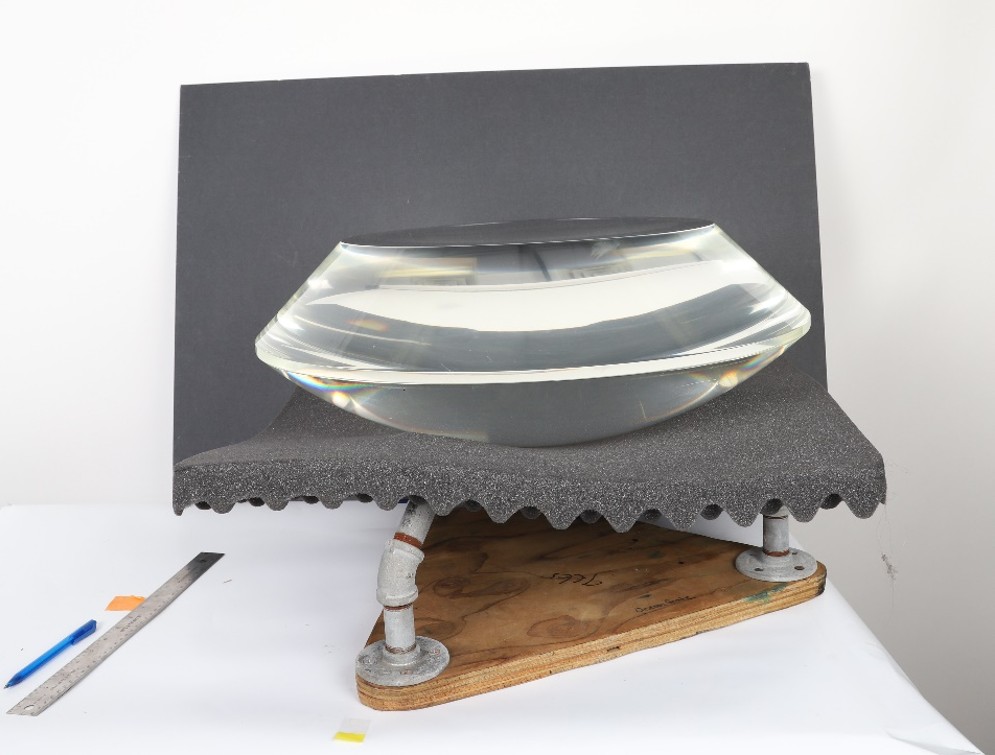
By December 2017, the major components of the submersible were complete, and OceanGate began assembling it. OceanGate employees also worked on the acoustic emission monitoring system to establish thresholds based on testing.
By mid-January 2018, the submersible was nearly complete, and OceanGate’s engineering department was preparing to hand it over to the operations department. In preparation for receiving the submersible, the director of operations at OceanGate conducted an inspection of the submersible and developed a quality control inspection report. The report identified a number of issues with the submersible, notably the following:
- The carbon fibre cylinder could not be inspected externally because the spray-on protective coating had already been applied, but visible voids and delaminations were present in the carbon fibre end segments that had been cut off after the manufacturing process. The report noted that a full inspection of the cylinder and the bond lines between the cylinder and the titanium rings was needed to verify their integrity. The report also noted that the results of this inspection needed to be provided to the director of operations before any dives were conducted with people on board.
- The viewport had been installed before the inspection, so no thorough inspection of the acrylic or the O-ring could be carried out. The director of operations requested that documentation be provided showing completed pressure test results and associated documentation from the viewport manufacturer.
- The titanium rings had grooves machined in them to accommodate O-rings. The diameter of the holes that were machined to begin the grooves was greater than the width of the groove for the O-ring, creating issues with the sealing face. The report also noted concerns with the type of O-ring groove, indicating that it did not meet standard design parameters. The report recommended re-machining of the sealing faces to correct both the plunge holes and the O-ring grooves.
The report also noted issues with the ballast bladder and the securing arrangements for various equipment (batteries, etc.) and requested a leak test of the high-pressure air system. Finally, the report noted that there were areas of the submersible that could not be accessed for inspection and other areas that were still being worked on and so the submersible would need a final inspection at a later date. In some cases, non-destructive testing was requested as well as further information from the director of engineering.
The following day, a meeting was held between the CEO, the director of operations, and 3 other OceanGate employees. The director of operations was then dismissed from his position at OceanGate because he held different opinions from the CEO on the safety of the Titan.
At the end of January, the company that manufactured the viewport contacted OceanGate with the results of the 3rd-party assessment on the design of the viewport. The 3rd-party assessment indicated that, based on the design of the viewport, it would encounter significant strain consistent with a possible cyclic failure at 40 MPa, which was equivalent to the depth of the Titanic. For a design review and performance prediction, the engineering firm noted that actual material data, the window seat design, and operational information would be needed.
By February, the submersible was fully assembled and OceanGate started testing the Titan and the LARS in the waters off Washington state. From February to April, OceanGate did 14 tests with people on board, reaching a maximum depth of 37 m during this testing. OceanGate also did 4 tests without people on board.
On 27 March, OceanGate was contacted by the chair of the manned underwater vehicles (MUV) committee, which is part of the Marine Technology Society.The Marine Technology Society is an industry group focused on marine technology and resources with members from countries around the world. For more information on the Marine Technology Society, see Appendix C. The MUV committee had drafted a letter to OceanGate’s CEO expressing concerns about the development of the Titan and OceanGate’s plans to dive it to the Titanic. The letter was not sent to OceanGate, but the MUV committee chair relayed the contents of the letter verbally to OceanGate’s CEO. The major concerns were that OceanGate’s experimental approach could result in negative outcomes that would have serious consequences for the MUV industry and that a single incident could ruin the industry’s safety track record. The letter recommended that OceanGate institute a prototype testing program that was reviewed and witnessed by a classification society.
At the end of April, OceanGate transported the submersible to The Bahamas. In the first week of May, OceanGate found that the Titan had sustained major damage to its electronics and wiring, which was attributed to lightning. Over the next few days, OceanGate staff not only rewired the submersible’s electrical system, but also replaced its hardware and software.
OceanGate then began conducting dives in The Bahamas. The dives spanned from May 2018 to April 2019. During this time, OceanGate conducted 20 dives with people on board, the deepest one being 3939 m. They also conducted 11 dives with no one on board, the deepest one being 4000 m.
On 13 May 2019, a crack was found in the carbon fibre cylinder after a dive. On 05 June, part of the hull insert was cut away to better expose the crack and allow further assessment to determine the extent of the crack. The crack was then inspected by an aerospace industry representative with experience in carbon fibre, as well as by a representative from the company that had manufactured the cylinder. The Titan was then transported back to Washington state.
On 20 June, a detailed inspection of the cylinder was carried out by OceanGate and a non-conformance report was created and signed off by the director of engineering and the director of system integration and marine operations. The report identified 3 interior cracks on the forward port side of the cylinder. Additional inspections were performed after rework on 28 June, and interior delamination of the carbon fibre was noted in 2 locations and potentially a 3rd location.
The non-conformance report recommended that the Titan be taken to a test facility for further cycle testing with the acoustic emission and strain gauge monitoring used to certify the extent of the cracking and delamination. On 07 August, a dive was attempted in Everett, Washington, United States, but the Titan reached only 1 m before the dive was aborted because of movement of the hull insert.
On 15 October, the Titan was tested in the Deep Ocean Test Facility to a maximum simulated depth of 4000 m. Following that test, further cracks and delamination were found in the carbon fibre cylinder. On 18 November, the Titan’s depth rating was reduced by OceanGate’s director of system integration and marine operations from 4000 m to 3000 m with an understanding not to dive below 2000 m. This carbon fibre cylinder was not subsequently used for any more dives. On 13 December, the viewport was being moved for cleaning when it was dropped, which resulted in the viewport getting scratched.
1.12.2 Second construction of the Titan (2020–2021)
In early 2020, OceanGate engaged a new company, Electroimpact Inc., to construct a replacement carbon-fibre cylinder. Around this same time, OceanGate was also working with a structural analysis contractor who conducted finite element analysis to evaluate stress and strain on the pressure hull. Strength and buckling were considered as part of the analysis. The contractor then created a solid finite element model to model stress and strain in the titanium, laminate composite, and acrylic parts, including motion of the viewport in the forward dome.
The contractor identified that the laminate composite being used for the carbon fibre cylinder was not a standard material for a human-occupied submersible, and so it needed to be tested for its actual compressive strength and stiffness to ensure that the pressure hull would be able to sustain the hydrostatic pressure at the desired water depth with a sufficient safety factor. The contractor recommended tests to demonstrate the actual propertiesThese properties include things such as strength, density, layer thickness, and ply stacking of the carbon fibre. of the laminate composite because the analysis that the contractor had done was based on theoretical properties; however, a review of documents indicates these tests were not performed.
When the contractor asked OceanGate about fatigue modelling for the pressure hull, OceanGate responded that the acoustic emission monitoring system would be used to detect damage in real time and that this capability had been demonstrated on the previous iteration of the pressure hull. OceanGate also changed its safety factor to 1.25, which aligned with the safety factor established by the International Organization for Standardization (ISO).International Organization for Standardization, ISO 21173:2019(E): Submersibles – Hydrostatic pressure test – Pressure hull and buoyancy materials (2019). For more information on the ISO, see Section 1.26.2.
In the first half of 2020, Electroimpact Inc. constructed 2 one-third scale model pressure hulls using carbon fibre that was pre-impregnated with epoxy resin. These scale models used a single-cure method. The scale models developed severe waviness in some of the carbon fibre plies (ply waviness) during the build process. Ply waviness reduces the compressive strength and buckling resistance of a laminate composite. OceanGate recognized that there was an issue with ply waviness and there was discussion about building a one-third scale model using a multi-cure method to try to mitigate the ply waviness,A multi-cure method allows for the layers of carbon fibre to be thinner, which reduces the probability of ply waviness. Ply waviness becomes a greater concern as the carbon fibre layer becomes thicker. The reduction in strength caused by ply waviness can only be determined through testing. but a multi-cure model was not built in order to save money.
In May 2020, OceanGate ordered a new viewport to replace the scratched one. This viewport was manufactured by a company in Germany and was identical to the old one.
In July and August of 2020, 6 tests were done on the one-third scale models at the UW-APL testing facility. One of the one-third scale models failed at 3000 m and the other failed at 3300 m.
OceanGate and its structural analysis contractor conducted a post-failure inspection and analysis and identified that ply waviness in localized areas in the carbon fibre cylinder was the cause of each failure. OceanGate had some discussions with the structural analysis contractor about what level of ply waviness the cylinder could tolerate without causing failure; however, no further testing was done.
After the tests with the one-third scale models in July and August, OceanGate began focusing on building the full-scale pressure hull. OceanGate and the structural analysis contractor performed a series of structural analyses based on the theoretical values of the laminate composite and calculated that the pressure hull would have a safety factor of 1.83 for going down to a water depth of 6000 m. Because this calculated safety factor was more than the safety factor of 1.25, the analysis suggested that the thickness of the carbon fibre cylinder could be reduced to decrease the weight of the submersible while still maintaining a safety factor above 1.25.
Electroimpact Inc. insisted that the full-scale carbon fibre cylinder be constructed using the multi-cure method because this method was considered to result in a stronger cylinder than the single-cure method. OceanGate initially rejected this recommendation because it would cost more, but Electroimpact Inc. insisted on it and agreed to cover the cost of it. The manufacturing process therefore involved Electroimpact Inc. creating the cylinder in 5 layers, each of which was cured separately. Once the 1st layer of the cylinder was created, peel plyPeel ply creates a roughened surface on a cured laminate to help with mechanical adhesion. was added to it. The first layer of the cylinder was then shipped to another company, Janicki Industries Inc., where it was vacuum bagged and cured. Once cured, it was shipped back to Electroimpact Inc. where the peel ply was removed and a layer of adhesive was applied. At this point, the next layer was added and the process was repeated.
In an effort to mitigate ply waviness, the layers were limited to 25.4 mm in thickness before curing. The layers were made using a unidirectional carbon fibre tape that was pre-impregnated with epoxy resin and wound onto a carbon steel mandrel by an automatic fibre placement machine. Each layer contained 133 fibre plies. The thickness of each ply was 0.1905 mm. The laminate stacking sequence was 2 cylindrical plies first, followed by 1 longitudinal ply. The sequence was repeated until a total of 133 plies were applied. The laminate of such stacking sequence would be orthotropic in nature in accordance with laminate theory and its key mechanical properties, the strength and stiffness (elastic modulus), would be much stronger in the circumferential direction than in the axial direction because the ratio of the plies in the circumferential direction to that in the axial direction was 2 to 1. This laminate structural design is typically seen in the literature as a way to deal with different stress levels in those 2 directions in a pressure hull when it is operated under water.
While the layers of the cylinder were being manufactured, some of the carbon fibre plies developed waviness that resulted in raised areas where the plies deviated from the design curvature of the cylinder. The carbon fibre plies in these areas were ground down by OceanGate to make them flush with the rest of the outer surface before the next layer was added. Grinding down the carbon fibre severed some of the fibres and introduced defects on the surface. Grinding did not mitigate ply waviness below the outer surface of each layer of the cylinder.
By January 2021, the new cylinder was completed, and the submersible was assembled. Some components from the 1st construction, such as the titanium rings and domes, were reused to save money. The titanium rings had been taken to a machine shop where they had been machined to clean them for reuse. The new viewport from Germany was installed in this construction, and the original scratched one was kept as a spare. New strain and acoustic emission monitoring sensors were added.
Once the submersible was assembled, the director of engineering reached out to some contacts about the possibility of conducting non-destructive testing on the pressure hull, but none of them had a method for it.
In February and March 2021, the pressure hull was tested at the Deep Ocean Test Facility. Four tests were done. The strain and acoustic emission monitoring systems were employed for these tests. The strain data from the tests was linear, and the acoustic emissions were less than OceanGate had expected. Table 2 contains more details on these tests.
Date (YYYY-MM-DD) | Maximum test depth reached (m) | Duration of test (hours) | Duration at maximum test depth (hours) |
|---|---|---|---|
2021-02-26 | 4000 | 9.5 | 1.32 |
2021-03-01 | 4200 | 10.3 | 0.61 |
2021-03-02 | 3850 | 8 | 4.23 |
2021-03-03 | 3850 | 7.75 | 4.09 |
Between 29 April and 25 May, OceanGate conducted 11 dives with people on board in the waters off Washington state. The maximum depth reached during these dives was 170 m.
In June 2021, the submersible was transported to St. John’s, and OceanGate continued diving with it there. See Appendix B for dives conducted by the Titan at the Titanic wreck site, in Canadian waters, or in Canada’s EEZ between June 2021 and the occurrence.
1.13 Carbon fibre pressure hulls
Carbon fibre is widely used in commercial aviation because of its high strength, low weight, and ability to be moulded. Carbon fibre composites, which are made from a mixture of carbon fibre and other materials, have been used in the aerospace and defence industries for over 25 years.
Classification societies do not generally approve carbon fibre as a material for the pressure hull of a submersible; however, some do have rules for the use of alternative materials, such as carbon fibre.DNV and the American Bureau of Shipping are examples of classification societies that have rules for the use of alternative materials. The DNV rules are not publicly available, but the American Bureau of Shipping rules can be accessed at https://ww2.eagle.org/content/dam/eagle/rules-and-guides/current/generic/generics-2024/00-part-1D-alternative-jan24.pdf (last accessed 03 March 2026). The use of carbon fibre in a pressure hull for a human-occupied submersible intended to conduct deep-ocean diving is novel;The first pressure hull for deep-ocean diving that used carbon fibre in its construction was a scale-model prototype fabricated in 1988 by the U.S. Navy. It was not intended for human occupancy. It was similar in design to the Titan, in that it had a carbon fibre cylinder, titanium coupling rings, and titanium end caps. The pressure hull was capable of operating at depths of up to 6096 m. With the exception of the Titan, the TSB is not aware of any other carbon-fibre pressure hulls for human occupancy used for deep-ocean diving. submersibles used for deep-ocean diving are typically constructed of steel or titanium,At September 2024, there was 1 submersible built using a spherical acrylic pressure hull; it was manufactured to meet the requirements of a classification society. It was capable of operating at depths up to 4000 m. and the pressure hull for human occupancy is typically spherical in shape because this is the best shape for resisting external pressure and allowing even distribution of stresses.
The use of carbon fibre in the construction of a pressure hull allows for a submersible to be lightweight, which creates cost savings when it comes to systems for transporting and launching and recovering the submersible. Carbon fibre also provides an advantage over other materials such as steel or titanium in that it allows for a low weight-to-displacement ratio. A cylindrical pressure hull allows for more usable space for accommodating people on board, as compared to a spherical pressure hull of the same volume. OceanGate’s decision to use carbon fibre in the construction of the Titan was largely based on these factors.
The use of carbon fibre in a pressure hull for human occupancy requires an extensive knowledge of the properties of carbon fibre. It also requires an extensive test program to validate that the properties of the material are suitable for the intended application. Once the pressure hull is constructed, testing must also be conducted to confirm that the as-built properties correspond to those set out in the original design.DNV has 2 documents with class rules that reference testing and validation guidance that could be applied to carbon fibre materials: “Rules for Classification: Ships” (July 2021) and “Rules for Classification: Underwater technology” (July 2023). The American Bureau of Shipping does not have class rules specifically for carbon fibre materials, but it does have class rules for testing of submersibles with metallic or acrylic pressure boundaries. These rules are set out in the following document: “Rules for Building and Classing Underwater Vehicles, Systems, and Hyperbaric Facilities” (January 2025). The American Bureau of Shipping also has guidance on class approval for alternative and novel concepts in the following document: “Rules for Alternative Arrangements, Novel Concepts, and New Technologies” (January 2024).
In addition to testing and validating the properties of carbon fibre in use, there are also considerations related to manufacturing. When carbon fibre, in particular, is used to create a cylindrical component of a pressure hull on a mandrel, there are a number of factors that need to be considered:
- Properties of the carbon fibre (type, dimensions, etc.)
- Number of carbon fibre layers to be applied
- Orientation of the carbon fibres (axial, circumferential, etc.)
- Carbon fibre placement method (hand laid, filament wound, advanced fibre placement)
- Tension applied during winding of the carbon fibre
- Type of epoxy resin
- Application method for the epoxy resin (manual application, wet bath, use of carbon fibre that is pre-impregnated with epoxy resin)
- Number of cures and the cure rate (how long the curing process takes)
- Special considerations such as vacuum bagging to remove air between layers when using a multi-cure method
- Environment in which carbon fibre is laid (humidity, temperature, cleanliness)
- Curing process (pressure, temperature, and time)
It is essential that adequate processes be put in place to control for these factors. The process has to be done in such a way as to prevent manufacturing defects such as ply waviness, delamination, porosity, blisters, voids, and inclusions.
Building a pressure hull from a novel material such as carbon fibre also necessitates an extensive testing program to establish the operating limits of the pressure hull. Normal engineering practice would be to expose full-scale models to a very significant number (hundreds, possibly thousands) of test cycles, at representative pressures and loads, either at a test facility or during dives with no one on board.
Once the final pressure hull is constructed, it must be inspected and tested to determine its condition and identify any defects that may have been introduced during manufacturing or through testing. Samples of the final pressure hull materials also need to be tested to confirm that the as-built properties, such as strength and stiffness, meet the intended specifications. Testing is also needed to prove that the pressure hull meets the required safety factor.
Carbon fibre composites have low resistance to impact loads, such as those that may be imparted during transportation or during operations. They may also be damaged by prolonged exposure to ultraviolet radiation. Storage of carbon fibre composites outdoors where it is exposed to the elements in below-freezing temperatures is also a concern. If water is able to ingress into the carbon fibre composite and freeze, it will expand and may cause damage.
For these reasons, when a pressure hull incorporates carbon fibre, it is important to conduct regular inspections of the pressure hull. This may involve disassembly and visual and ultrasonic examinations to verify the condition of the pressure hull.
1.14 Testing data from Titan’s carbon fibre cylinder
During the 2nd construction of the Titan, there was excess material at either end of the carbon fibre cylinder that was trimmed off. The TSB Laboratory was able to obtain a trimmed-off end piece that came from the 2nd construction of Titan’s carbon fibre cylinder and that was used for testing. The TSB Laboratory also obtained data from a second trimmed-off end piece that the National Transportation Safety Board had tested.
1.15 Examination of trimmed-off end piece from the Titan’s carbon fibre cylinder by TSB Laboratory
The TSB Laboratory examined the trimmed-off end piece it had obtained to determine the properties of the as-built cylinder. A visual examination of the end piece showed that the plies in the axial direction were basically straight along the axial direction without obvious waviness (Figure 15a). The plies in the circumferential direction, however, appeared not to conform to the cylinder’s design with respect to curvature, because there was a general waviness in the plies. This waviness is known to cause a reduction in the strength and stiffness of the laminate composite.
The TSB Laboratory cut and machined the end piece into 18 samples, 9 in the axial direction and 9 in the circumferential direction. Three of the samples in the axial direction contained the adhesive bonding layer between the 3rd and 4th layers and 1 of these samples displayed visible porosity (Figure 15b). Eight of the 9 samples machined in the circumferential direction showed a generally mild waviness of the plies (Figure 15c). One of the samples in the circumferential direction containing the adhesive bonding layer between the 3rd and 4th layers showed severe ply waviness (Figure 15d).
The visual examination also showed evidence of some plies having been ground down to make the raised areas that were created by ply waviness flush with the rest of the outer surface during the manufacturing process (Figure 15d). Grinding down the plies did not address ply waviness below the surface of the cylinder.Ply waviness can be mitigated in the manufacturing process. It is easier to mitigate when the layers of carbon fibre are thinner.
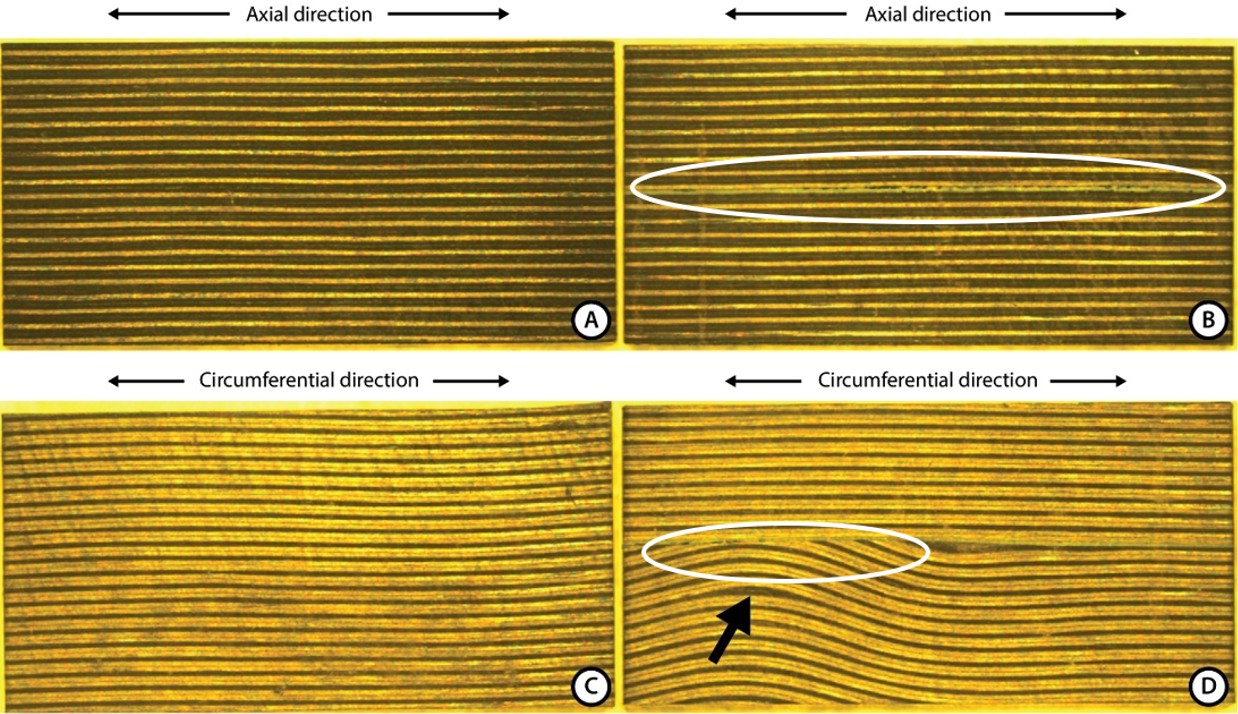
The TSB Laboratory testing showed that the laminate composite material’s allowable strength in the axial direction was sufficient, as evidenced by the calculated safety factor of 3.05, which was greater than the required 1.25. However, this was not the case for the allowable strength in the circumferential direction: the calculated safety factor was 1.11, which did not meet the required safety factor of 1.25.
Assuming that the test results from the samples are representative of the properties of the carbon fibre cylinder used in the Titan, the fact that the required safety factor for the strength in the circumferential direction was not met meant that it was unsafe for the Titan to have been repeatedly exposed to pressures equivalent to the depth of the Titanic or deeper (which occurred during pressure tests). This may explain why the Titan had 4 successful pressure tests at the Deep Ocean Test Facility and subsequent successful dives to depths at or near that of the Titanic but ultimately failed on its 14th dive to the Titanic.
1.16 Damage accumulation analysis by the TSB Laboratory
Damage accumulation analysis is a form of fatigue analysis that uses an accumulation of stress‑induced damage to determine the remaining useful life that the structure may have. Every time a structure is stressed, small damages may accumulate. The higher the imposed stress on the structure, the more quickly these damages will accumulate. A component stressed to a higher level will have a shorter life than one stressed to a lower level.
Damage accumulation analysis by the TSB Laboratory showed that a defect-free carbon fibre cylinder of the Titan’s design that met all of the properties set out by the carbon fibre manufacturer was unlikely to have failed at depths equivalent to that of the Titanic. Analysis indicates that the cylinder would have used less than 0.00001% of its life over the 24 divesThis analysis includes the tests at the Deep Ocean Test Facility but excludes dives of less than 70 m. that the Titan was subjected to preceding the occurrence dive.
Further analysis was conducted using data from samples of the 2nd trimmed-off end piece that the National Transportation Safety Board had tested. The testing established the compressive strength value of the samples. The TSB Laboratory’s analysis showed that the as-built cylinder would reasonably have been expected to survive based on the sample with the highest compressive strength value, but that it could have used more than 82% of its fatigue life in the time up to the occurrence dive based on the sample with the lowest compressive strength value.
The TSB identified that some of the processes used in the manufacturing of the cylinder may have allowed defects to be introduced into the pressure hull. For example, the process of vacuum bagging and curing the hull introduced the potential for delamination and porosities. Additionally, the previously cured layers could have created a gas‑impermeable layer that impeded the migration of micro‑bubbles out of the cured material during subsequent vacuum bagging.
As well, the process of grinding down the raised areas of the cylinder to make them flush with its design curvature potentially introduced defects on the surface of the cylinder.
Defects introduced during manufacturing can lead to quicker crack propagation and can isolate layers from each other, which prevents them from sharing the applied hydrostatic loads effectively. The isolated layers are left to resist the entirety of the stress placed on them alone, considerably reducing the effectiveness of the laminate.
1.17 OceanGate documents relating to Titan’s operations in 2023
OceanGate had multiple documents that related to the Titan’s operations in 2023, as follows:
- An operations manual for the Titan
- A piloting manual for the Titan
- A mission director checklist
- A project execution plan for the 2023 expeditions
- A dive operations risk assessment for 2023
- A health and safety manual
- An incident response communications plan
- An OceanGate employee handbook
- A dive and maintenance log that included a wide variety of information on maintenance and modifications, as well as a dive log and data on performance
Individual dive plans were also created for each dive. See Section 1.17.12 for more information on dive plans, including the dive plan for the occurrence dive.
1.17.1 Operations manual
The operations manual included pre- and post-dive checklists; emergency procedures; launch, tow, and recovery procedures; surfacing procedures; system descriptions; and rules for underwater communications. The version of the operations manual that was on board the Polar Prince for the 2023 season was dated 24 May 2021.
1.17.2 Piloting manual
The piloting manual included information on the operation of the Titan, including how to power up the submersible and how to use the programs on the main computer that controlled the Titan’s various systems. The piloting manual also included pre- and post-dive checklists that were similar to the ones in the operations manual, as well as an emergency procedure for how to use the emergency back-up battery in the event of a loss of internal power.
The piloting manual had been developed by the OceanGate engineering team members who were on staff in 2020 and 2021. The manual appeared to be incomplete.
1.17.3 Mission director checklist
The mission director checklist contained
- descriptions of the roles and responsibilities of the mission director, submersible pilot, support vessel captain, LARS operator, and other OceanGate personnel;
- definitions of OceanGate dive terminology, such as stopski, anomaly, and strike;
- some safety limits regarding maximum allowable hours of work before dives;
- the order in which operations were to be conducted during dives;
- a checklist of minimum requirements that must be met for the Titan to commence a dive;
- the LARS configuration and protocol;
- the towing configuration and protocol;
- a section on dive execution and communications and tracking of the Titan;
- information about LARS recovery without the Titan and LARS launch with and without the Titan;
- LARS operations for the Horizon Arctic;
- post-deep-dive ballast operations;
- post-dive tasks;
- an emergency checklist for use in the event of a loss of power and thruster malfunction and no ballast bladder system control;
- a section regarding operations with the Horizon Arctic (there were no specific sections relevant to the Polar Prince); and
- a description of the mission director’s responsibilities with respect to managing risk during dives.
The mission director checklist was not dated.
1.17.4 Project execution plan for 2023
The project execution plan for 2023 included information on employee health and safety and training. It provided an overview of the Titan’s specifications, systems, and procedures. It also set out a project schedule and roles for various personnel and provided information on mobilization, demobilization, and onboard set-up. It also provided a list of emergency contacts, including some ROV rescue operators who could potentially assist with a subsea rescue. The last version of the project execution plan for 2023 was dated 02 June 2022, but some parts of the plan appeared to have been revised after this date.
1.17.5 Dive operations risk assessment for 2023
The dive operations risk assessment contained a description of goals and scope of work for the 2023 season. It also contained a risk assessment of the following tasks associated with dive operations:
- Mobilization of the Titan and supporting equipment
- Mobilization of OceanGate personnel and 3rd-party personnel
- Vessel preparation, deck layout, sea fastening, and crewing of the support vessel for missions
- Transit of the support vessel to and from the dive site
- Towing of the Titan and the LARS to and from the dive site with the support vessel
- Small boat operations around the support vessel, the Titan, and the LARS
- Launching and recovery of the Titan with the LARS
- Diving operations to the Titanic or to other sites of interest and data collection
- Submersible tracking
- Demobilization of personnel and equipment
The dive operations risk assessment for 2023 was dated 25 March 2023.
1.17.6 Health and safety manual
The health and safety manual contained general information on employee safety and covered topics such as confined space entry, electrical safety, fire and fall protection, personnel transfers, workshop safety, welding and cutting safety, and water survival. The health and safety manual was dated 2019.
1.17.7 Incident response communications plan
The incident response communications plan contained information about how specific individuals within the OceanGate team were to communicate information in the event of an incident involving dive operations. The incident response communications plan was dated 2022.
1.17.8 OceanGate employee handbook
The OceanGate employee handbook contained information about OceanGate’s employment policies, work environment, benefits, leave, and other policies. The OceanGate employee handbook was dated 15 January 2019.
1.17.9 Dive and maintenance log
OceanGate maintained a dive and maintenance log. The log was in a spreadsheet format and included tabs for a dive log, regular and preventative maintenance records, modifications, as well as vehicle and performance data. The log was updated regularly to track dive and maintenance activities.
1.17.10 Documents referencing communication between the Titan and the surface support team during dives
OceanGate had multiple documents that referenced communication between the Titan and the surface support team during dives. The operations manual for the Titan contained a section on underwater communications that specified the following:
An underwater communications log is to be constantly maintained between the MOSHIP [surface support team] and Titan when in water. Communications are to be kept to an absolute minimum to enable the Titan crew to devote their full attention to the designated work task.
Every 5 minutes the onboard acoustic communications system will send depth, heading and speed data to the surface. At least once every hour the sub will send a manual message to the surface.
In the event of no surface communication via acoustic modem of more than 1 hour, the submersible pilot will initiate surfacing procedure in accordance with the Loss of Communications Procedure.OceanGate, “Titan Crewed Submersible Operations Manual,” p. 32.
The project execution plan contained a procedure for loss of communications. The stated action was as follows: “The submersible sends status data continuously to the surface. If the connection with surface is lost for more then [sic] 60 minutes, sub will resurface.”OceanGate, “Project execution plan: Titanic Survey Expedition 2023,” Rev B., p. 22.
The mission director checklist and the health and safety manual also contained a missed communications protocol. According to this protocol, communications checks were to be done every 15 minutes. The missed communications protocol was as follows:
Missed communications protocol
15-minute comm. Check missed (note as missed comm.)
30-minute comm. Check missed (note as lost comm.)
45-minute comm. Check missed (note as lost sub) additional 15 minutes will be given for appropriate action to be taken.
Internal contacts and backup personnel will be called following 1 hour of no communication plus required surface time from last known or assumed bottom depth of location.
Additional 3 hours of local surface search will be done before contacting outside emergency personnel, unless circumstances merit a shorter delay.
A grid search pattern will be done by surface vessels as directed by MD [mission director].OceanGate, “Operations Mission Director Checklist,” p. 6.,OceanGate, “Health, Safety and Environment (HSE) Manual,” Revision 3 (2019), p. 148.
The circumstances that would merit a shorter delay in contacting emergency personnel were not defined further in OceanGate documentation.
OceanGate’s acoustic communication systems were the only way for the crew in the submersible to communicate with the surface support team and warn them of emergencies that required external assistance. Over the years, the Titan’s various communication and tracking systems did not always operate reliably. However, OceanGate had never before lost communication and tracking at the same time, as on the occurrence dive.
Using the data available in OceanGate’s dive and maintenance log, as well as other sources, the TSB compiled information on dives where there were issues with the communication and tracking systems (Table 3).
Date (YYYY-MM-DD) | Depth of dive (m) | Issue |
|---|---|---|
2018-10-10 | 504 | ATM system was not functioning below 200 m |
2018-11-14 | 720 | ATM system was not functioning below 200 m |
2019-03-14 | 130 | ATM system was not receiving data |
2019-04-10 | 991 | Tracking transducer was lost |
2019-04-17 | 3760 | Electronic problems caused the ATM system to shut down, requiring it to be restarted. The Titan was not receiving ATM transmissions after it began its ascent |
2021-05-20 | 170 | ATM system communications were intermittent when the Titan was on the bottom using its thrusters |
2022-06-18 | 1380 | Communications sent from the Titan were not consistently being received by the surface support ship due to an error in coding |
2022-06-20 | 3840 | ATM system was not functioning consistently |
2022-07-14 | 3840 | ATM system was not functioning at depth and the Titan was unable to determine its own location |
1.17.10.1 Loss of communication procedures for submersibles
When there is a loss of communication between a submersible and the surface support team and there is no other method for the surface support team to rapidly ascertain the status of the submersible, the loss of communication must be treated as an emergency. Not treating a loss of communication with a submersible as an immediate emergency can decrease the time available for a SAR response. Time is especially critical for SAR responses involving submersibles given that submersibles have only finite life support.
Finding: Other
OceanGate’s missed communications protocol allowed time for communication problems to be fixed or resolve on their own and did not require emergency procedures to be initiated immediately.
1.17.11 Operational risk management
The mission director checklist contained procedures for managing risk during a given mission. The checklist specified that the mission director was responsible for tracking anomalies from the beginning of a dive. An anomaly was defined as any deviation from procedure, or any performance or system set-up that would not be expected in a “perfect” situation. The checklist specified that anomalies could be as minor as a dive member showing up late to a dive or a delay of more than 15 minutes in any planned step. The checklist stated that if there were more than 15 anomalies, this was to be considered a “strike”. Strikes and anomalies were reviewed as part of pre- and post-dive briefings in order to improve operations.
A strike was defined as a major deviation or major problem encountered before or during a dive that was significant, but not by itself worthy of cancelling the dive. The checklist gave examples of strikes as follows:
- Weather being worse than forecast
- Delays of more than 1 hour from schedule
- Last-minute changes in key dive personnel
- Failures of certain types of equipment
- Last-minute configuration changes
If there were a total of 3 or more strikes, the checklist instructed the mission director to cancel the dive.
The checklist also indicated that the mission director was to cancel a dive when it was determined that an unsafe situation existed or was likely to occur. The checklist did not define unsafe situations or when they were likely to occur.
The checklist described OceanGate’s practice of incorporating 5-minute pauses into operations. These pauses, referred to by OceanGate as “stopskis,” were intended to allow time for everyone involved to stop what they were doing and consider the safety of a particular action or event. The checklist indicated that a stopski was to be done before a major action was taken, such as commencing dive operations, lifting of the RIBs, or other activities that involved safety of human life. The checklist indicated that any mission participant could also call for a stopski, and that the mission director could delay the stopski only if introducing a pause in the process would in itself cause a safety problem.
Finally, the mission director checklist indicated that the mission director was responsible for recording all maintenance issues that arose during the execution of a dive. The health and safety manual indicated that these maintenance issues were to be recorded in the dive log.
1.17.12 Dive plans
OceanGate required a dive plan to be developed at least 8 hours before each dive. OceanGate had a template that was used for creating dive plans. The template was to be filled out with the following information:
- A list of participants for the dive and their roles
- The VHF radio operating frequency
- Weather conditions
- Dive schedule
- Dive payload
- Weight added for the dive
- A risk assessment
- Emergency contact information
The dive plan template included a list of all tasks to be completed as part of a dive. Each dive plan was discussed with everyone involved in a dive on the evening before the dive and then reviewed again on the morning of the dive.
1.17.12.1 Risk assessment
The risk assessment conducted as part of the dive plan had a numerical formula built into it that automatically calculated a risk index using numbers entered for each item being assessed. The investigation was not able to obtain the numerical formula that was used to calculate the risk index but was able to obtain final risk index scores.
The mission director checklist specified that a risk index of greater than 48 was considered to be a strike. The risk assessment for the occurrence dive (Figure 16) had a risk index of 35.
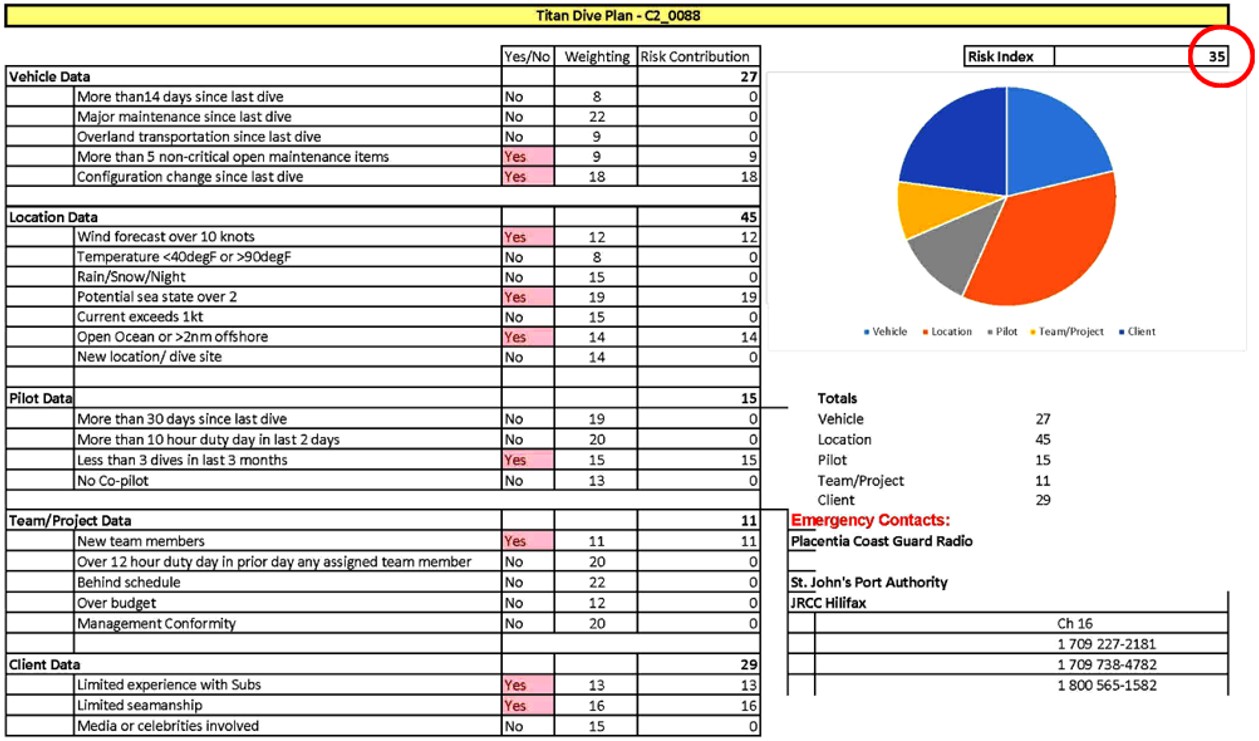
1.18 Titan emergency procedures
OceanGate had emergency procedures for a variety of scenarios. The majority of the emergency procedures were contained in the operations manual, but some procedures were also contained in the mission director checklist, the piloting manual, and the project execution plan. The emergency procedures covered the following scenarios:
- Power failure of internal batteries
- Power failure of external high-voltage batteries
- Emergency surfacing
- Failure of the carbon dioxide scrubber or excessive carbon dioxide in the cabin
- Uncontrolled release of compressed air within the cabin
- Excessive oxygen in the cabin
- Smoke or fire
- Loss of communications
- Emergency deballasting
- Distressed submersible (defined by OceanGate as a situation in which the submersible is unable to surface without external assistance because of entanglement, flooding into the cabin, loss of ballast bladder system and thruster control, loss of ability to release drop weights)
- Malfunction with the buoyancy of the LARS while under tow
- Loss of power preventing the Titan from being able to navigate into position on the LARS during recovery
1.18.1 Emergency contacts
OceanGate had a list of emergency contacts in the project execution plan for the 2023 Titanic dives. The list included JRCC Halifax, RCC Boston, and a private helicopter company based out of St. John’s. It also included contact information for emergency medical facilities and for 7 organizations with ROVs that could potentially be called to assist with rescue at deep-ocean depths. The dive plans also had a list of emergency contact numbers for quick reference that included Placentia Coast Guard Radio, the St. John’s Port Authority, and JRCC Halifax. The investigation found no evidence that OceanGate put potential ROV rescue operators under contract when conducting operations with the Titan.
The project execution plan for 2023 included a section on emergency response, which stated that the greatest risk to the submersible and crew was the potential for entanglement with a foreign object (e.g., nets, cables, underwater wreckage) or the submersible becoming disabled at depth. The plan stated that if the submersible were at depths greater than those that could be reached by scuba divers, an ROV, if on board, would be used. In the event an ROV was not on board, the plan stated that OceanGate had contact information for ROVs capable of reaching 4000 m and that these, along with other subsea operators, would be contacted to find the fastest available response for rescue.OceanGate, “Project execution plan: Titanic Survey Expedition 2023,” Rev B., pp. 20–21.
1.19 Titan maintenance and inspections
OceanGate kept a record of maintenance for the Titan in the dive and maintenance log. The maintenance tab of the log listed issues that had occurred on or between dives and any resulting maintenance. Issues were logged in a format that included the date, dive number, issue encountered, person reporting the issue, and whether or not the issue was severe enough to result in cancellation of the mission. Completed maintenance was logged in a format that included the name of the person who performed the maintenance and the date it was completed. There were also fields for the name of the person who inspected the completed maintenance work and the date of that inspection.
The dive and maintenance log also contained a tab with a list of preventative maintenance tasks that were to be completed regularly on the Titan. These included tasks such as removing and inspecting various submersible components, charging batteries, completing leak tests, testing the alarm systems, and cleaning and greasing various components. There were no dated records to indicate how often these tasks were completed.
The log also included a tab with a list of modifications that had been made to the 1st and 2nd construction of the Titan and to the LARS. These included modifications such as installing new components, making changes to controls, configuring software, and adding buoyancy. Modifications were logged in a format that included a description of the modification, the name of the person who had requested it, the date, and the status and any additional details about the modification. The log also included the name of the person assigned to work on the modification and the name of the person who was responsible for inspecting the modification.
Finally, the log contained a tab with information regarding the weight and balance of the Titan, including basic net buoyancy, any configurations or changes to the submersible, and any relevant notes regarding the weight and balance.
Aside from the dive and maintenance log, there were also references to maintenance and inspection activities in other OceanGate documents. For example, the operations manual included a checklist of items to be verified before and after dives. The dive plan risk index calculation contained a field for vehicle data that included 3 maintenance-related fields: major maintenance since the last dive, more than 5 non-critical open maintenance items, and configuration changes since the last dive.
1.20 Support vessels
The Titan was dependent on a support vessel for its operations. In 2021 and 2022, OceanGate had entered into a charter agreement with Horizon Maritime Services Ltd. for the use of the Canadian-flagged vessel Horizon Arctic as its support vessel. The Horizon Arctic is an anchor-handling tug supply vessel that is 93.6 m long with a gross tonnage (GT) of 8143 (Figure 17). It is equipped with a dynamic positioning system.
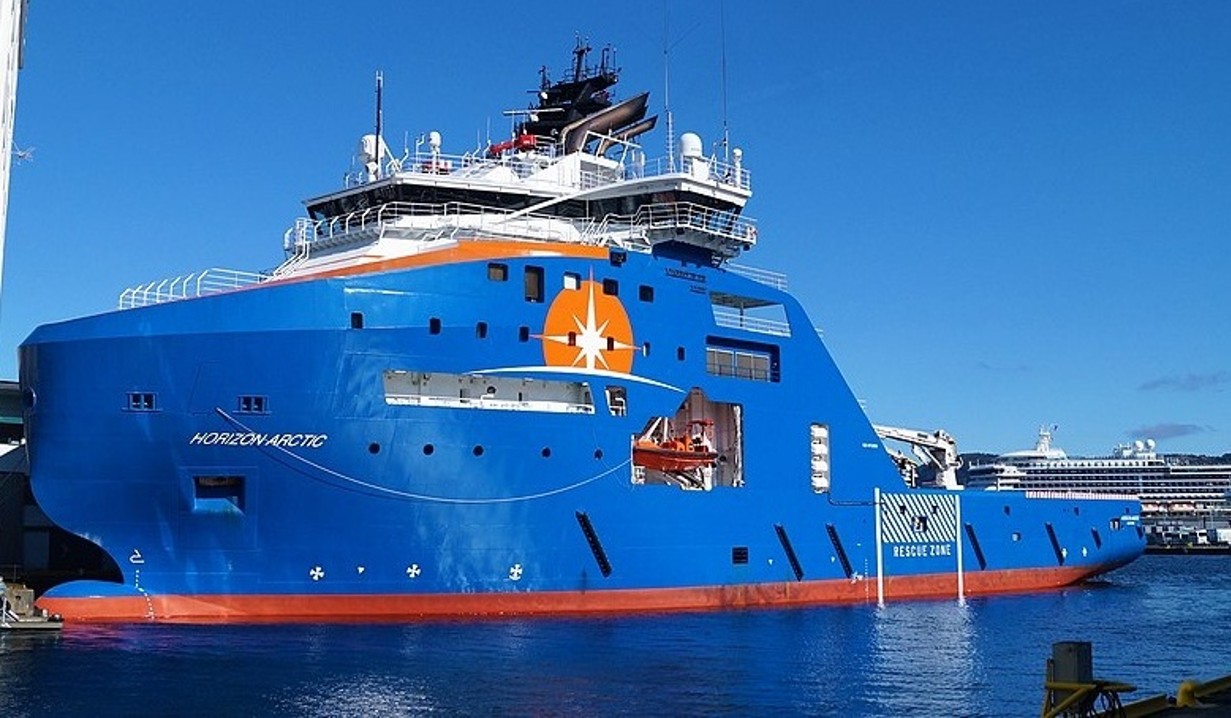
In 2023, OceanGate changed the support vessel that it was using to the Canadian-flagged vessel Polar Prince, also managed by Horizon Maritime Services Ltd.
OceanGate’s operations depended on a support vessel to transport the Titan, the LARS, and OceanGate personnel and passengers to and from dive sites. The support vessel was also used to position the LARS for launching and recovery activities, and the LARS remained connected to the support vessel at all times during dives. In addition, the OceanGate surface support team used the support vessel as the control centre from which to carry out operational activities during dives, such as communication and tracking of the Titan.
OceanGate personnel and passengers resided on the support vessel for multiple days during missions. OceanGate used the support vessel to store, launch, and recover the RIBs, as well as store spare equipment and gear. The support vessel was also the base for all of OceanGate’s scuba dive operations. In 2023, OceanGate had 3 shipping containers on the deck of the support vessel, 1 of which was a workshop and 2 of which were for storage. OceanGate also used the vessel’s compressed air (service air) to supply the LARS tanks and used the vessel’s electrical system to charge the Titan’s batteries.
1.20.1 Charter of the Polar Prince
The charter agreement between OceanGate and Miawpukek Horizon Maritime Services Ltd. for the use of the Polar Prince in 2023 was finalized on 27 March 2023. The agreement was valid only until 25 June 2023, because the Polar Prince was booked by another client after that date.
The charter agreement made use of a standard chartering template (BIMCO SUPPLYTIME 2017). The agreement specified that OceanGate would have the use of the Polar Prince for “Transportation and hosting of Charterers Employees and Barge Towage and general duties as directed by Charterers, but always within the safe capacities and capabilities of the Vessel and at Master’s discretion”Time charter party between Miawpukek Horizon Maritime Services Ltd. and Ocean Gate Expeditions, Ltd. (27 March 2023), Part 1, Section 17. for the duration of the charter period.
The agreement modified the standard chartering template’s definition of “employees” by appending “For greater certainty Charterers [sic] Employees includes [sic] any mission experts or trainees on board.”Ibid., Part 2: Definitions. The agreement was also modified with additional clauses, including one that read in part:
… the Charterers may instruct the Vessel to carry fare paying passengers. For the avoidance of doubt, Charterers ratify that such passengers shall be part of Charterers Group, and Charterers shall be responsible and liable for such passenger as a member of Charterers Group….Ibid., Clause 45.
The agreement included a standard clause from the charting template stating that
…[i]f the Charterers have reason to be dissatisfied with the conduct of any member of the Crew, the Owners on receiving particulars of the complaint shall promptly investigate the matter and if the complaint proves to be well founded, the Owners shall as soon as reasonably possible make appropriate changes in the appointment.Ibid., Clause 7(d).
1.20.1.1 Definition of passengers
With regard to vessels certified under the International Convention for the Safety of Life at Sea, 1974 (SOLAS), such as the Polar Prince, the Canada Shipping Act, 2001 defines passengers as people carried on a vessel, excluding
- the master,
- crew members,
- people employed or engaged in any capacity on board the vessel on the business of that vessel, and
- children under 1 year of age.Government of Canada, Canada Shipping Act, 2001 (as amended 22 June 2023), Part 1, Section 2.
This definition is consistent with the definition of passengers under Chapter 1, Part A, Regulation 2 of SOLAS.
There were 2 types of people on board the Polar Prince when it departed on the occurrence voyage:
- The crew of the Polar Prince
- Passengers, who consisted of
- OceanGate personnel whose duties on board were in regard to the preparation, support, and execution of submersible operations; and
- OceanGate passengers, who consisted of the Titan passengers and their family members. Although OceanGate encouraged these passengers to take part in the preparation and maintenance of the submersible, they had no regular duties on board.
1.20.1.2 Carriage of more than 12 passengers
The Polar Prince was certified as a cargo vessel, which meant that under Canadian regulations, it was permitted to carry up to 12 passengers. When the vessel was chartered by OceanGate, it was routinely carrying more than 12 passengers. For example, on the occurrence voyage, it was carrying 24 passengers.
In order to carry more than 12 passengers, the vessel was required to be certified as either a passenger vessel or a special purpose ship. Alternatively, the owners could have applied for an exemption from the Marine Technical Review Board (MTRB) and, if granted an exemption, operate with the vessel’s existing certification.
The MTRB, established under the Canada Shipping Act, 2001, comprises Transport Canada (TC) employees with expertise in marine matters. The MTRB is empowered to make decisions on “applications for equivalencies to safety requirements or exemptions from non-safety ones. These applications concern individual Canadian vessels or the issuance of Canadian maritime documents to persons.”Transport Canada, “Marine Technical Review Board,” at https://open.canada.ca/data/en/dataset/e7bd909b-b794-4437-ae79-1a1116c4c7ef (last accessed on 11 May 2026).
In the past, the Polar Prince had obtained an MTRB exemption to carry more than 12 passengers for a charterer unrelated to OceanGate; however, there had been no application for an MTRB exemption submitted for the charter with OceanGate.
1.20.1.3 Master’s authority
The master’s authority is integral when it comes to the safety of the vessel and those on board. When one or more groups are working on board a vessel for certain types of operations, as in the case of Horizon Maritime Service Ltd. and OceanGate, the master may have to interact with differing and often ambiguous instructions from the different parties. For this reason, the master’s authority needs to be clearly defined in the SMS and supported by management, especially in the context of decisions relating to vessel operations and charter considerations. The master’s authority should be recognized as the last in a series of several safety barriers and not the only one.International Maritime Organization, MSC 107/17/14, “Work Programme - Proposal for a new output for development of an MSC circular to address time pressure and related organizational factors,” 27 February 2023.
Section 5.2 of the ISM Code states that
The company should ensure that the safety management system operating on board the ship contains a clear statement emphasizing the master’s authority. The company should establish in the safety management system that the master has the overriding authority and the responsibility to make decisions with respect to safety and pollution prevention and to request the company’s assistance as may be necessary.International Maritime Organization, International Safety Management Code (2018 edition), Section 5.2.
Horizon Maritime Service Ltd.’s SMS contained a statement that set out the authority of masters on Horizon Maritime Services Ltd. vessels in accordance with Section 5.2 of the ISM Code.
Subsection 109(1) of the Canada Shipping Act, 2001, states that “the master shall take all reasonable steps to ensure the safety of the vessel and of persons who are on board or are loading or unloading it while using equipment on it.”Government of Canada, Canada Shipping Act, 2001 (S.C. 2001) (as amended 30 July 2019). TC’s interpretation is that the master’s authority extends to the interaction of a submersible with the support vessel, such as when the submersible is being loaded or unloaded, but not to the diving operations of the submersible.
1.20.1.4 Bridging document
When one or more groups are working on board a vessel for a certain type of operation (e.g., transportation of passengers, subsea construction, operation of ROVs), there will be interactions between the vessel’s SMS and the various systems used by other groups to manage safety. A bridging document is a written document that states how these safety systems will be coordinated and how operations will be conducted. A bridging document also initiates an analysis of gaps or inconsistencies between the systems.
A bridging document is intended to
- define the roles and responsibilities of all persons in charge of activities,
- ensure that appropriate procedures are in place for all operations,
- clarify whose procedures take precedence when procedures overlap,
- ensure that all operations are risk assessed as effectively as possible, and
- ensure that effective emergency response arrangements are in place.
Bridging documents are common in certain industries, such as the oil industry.The International Association of Oil & Gas Producers has guidance on bridging documents (https://www.iogp.org/bookstore/product/guide-to-preparing-hse-plans-and-bridging-documents-supplement-to-report-423/, last accessed on 12 May 2026). The Canadian oil and gas industry, in general, follows the guidance set out by the International Association of Oil & Gas Producers. In Norway and the Netherlands, there are requirements for bridging documents in the offshore oil and gas industry. However, for operations like those being undertaken by the Polar Prince and OceanGate, there was no external requirement for a bridging document to be developed.
The Polar Prince did have a vessel emergency response plan that covered typical vessel emergencies: fire and explosion, collision, grounding, person overboard, severe weather, flooding, etc. Horizon Maritime Services Ltd. also had an emergency response plan that described the internal and external resources required for managing emergencies of varying scales. The Horizon Maritime Services Ltd. emergency response plan noted that specific customer requirements for emergency response should be addressed in a bridging document and respective joint emergency response plan.Horizon Maritime Services Ltd., “Horizon Maritime Emergency Response Plan,” Revision 13 (13 July 2022), Section 1.2: Scope, p. 6.
During the charter of the Polar Prince to OceanGate, no bridging document was developed. There was an understanding among both the Polar Prince crew and OceanGate personnel that submersible operations and vessel operations were to be treated separately in all respects. This understanding extended to some senior management at Horizon Maritime Services Ltd. The rationale for this was that the submersible operations were outside the realm of expertise of the Polar Prince crew.
1.20.2 Transporting the Titan and the LARS to and from dive sites
OceanGate designed the Titan and the LARS so that they could be transported over land on a flat-deck truck, as well as towed at sea by various types of support vessels, from small vessels such as RIBs to large commercial vessels. The LARS could come apart in 2 pieces to facilitate transport over land. It could also be transported on the deck of a vessel along with the Titan or used to tow the Titan through the water.
In 2021 and 2022, when OceanGate was using the Horizon Arctic as its support vessel, the LARS and the Titan were transported to dive sites on the Horizon Arctic’s aft deck and launch and recovery was done via a ramp off the Horizon Arctic’s stern. This arrangement allowed for easy access to the Titan and LARS while the Horizon Arctic was transiting; however, OceanGate experienced problems with launching and recovering the Titan from the aft deck of the Horizon Arctic and had concerns about the potential for damage to the Titan and the LARS.
In 2023, when the Polar Prince was chartered, OceanGate changed its method for transporting the Titan and the LARS because the Polar Prince did not have equipment to lift the Titan and the LARS on and off the deck. Initially, OceanGate and Horizon Maritime Services Ltd. explored the possibility of equipping the Polar Prince with a crane. Preliminary engineering studies were done to install a crane, but the decision was later made to tow the LARS and the Titan behind the Polar Prince (Figure 18).
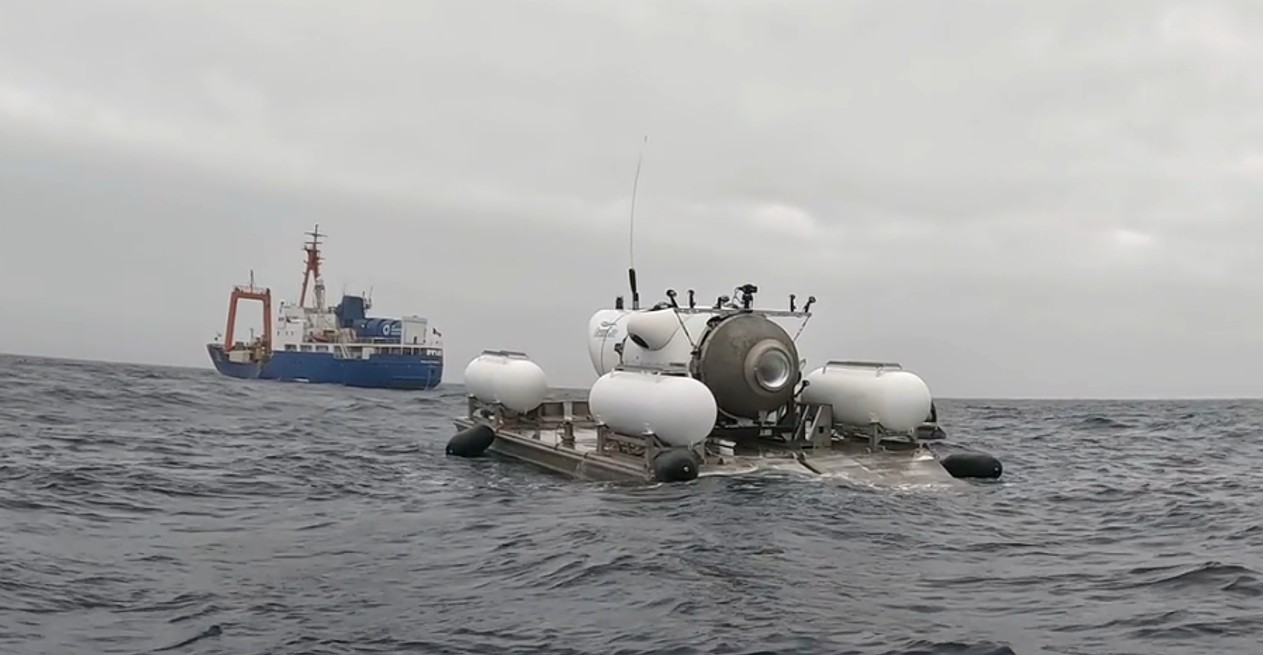
1.20.2.1 Tow plan
For the operation that involved towing the Titan on the LARS in 2023, Horizon Maritime Services Ltd. created a tow plan. The tow plan included specifications for the towing arrangement and general guidance for towing limits, including maximum sea height, wind speed, etc. The tow plan was revised following an occurrence where the Titan and the LARS partially submerged while under tow on 24 May 2023.
1.20.2.2 Tow suitability study
The TSB Laboratory commissioned a tow suitability study to determine the following:
- Whether the tow plan that had been revised after the incident on 24 May 2023 was consistent with formal industry guidance.The formal industry guidance referenced included IMO’s MSC/Circ. 884 - Guidelines for Safe Ocean Towing (21 December 1988) and DNV’s standard DNV-ST-N001 - Marine operations and marine warranty (December 2023).
- Whether any of the loading conditions experienced as the Titan was towed on the LARS to its dive locations in 2023 may have contributed to the Titan’s failure.
The study determined that there were areas in which the revised tow plan was not consistent with industry guidance. For example, the towline was considerably shorter than the length recommended by DNV. Also, there was no indication that an analysis had been conducted to identify whether the Titan and the LARS would be capable of withstanding the loads caused by the most adverse environmental conditions expected for the season and area of operation or the weather criteria identified in the tow plan.
The Titan had been towed by or tethered to, via a towline, the Polar Prince in the North Atlantic for approximately 950 hours in the 2023 season. The study identified that the Titan and the LARS were subjected to considerably higher accelerations than those recommended by DNV for deep‑ocean tows. The Titan was also towed through significant wave heights of up to 3.35 m on the LARS and, at one point, was partially submerged while under tow on the LARS. The aft end of the Titan was submerged by approximately 2 m.
The study concluded that the stress levels in the Titan’s pressure hull due to towing alone were not high enough to have reasonably caused static damage or significant damage due to fatigue and therefore were not likely a contributing factor to the failure of the Titan. Even when the Titan was partially submerged while under tow, the stress levels in the pressure hull were not high enough to have reasonably caused damage.
1.21 2023 operating season
OceanGate’s 2023 operating season with the Titan began in May. The season was divided into 5 missions, each approximately a week long. All of the voyages departed from and returned to port in St. John’s. OceanGate had completed 4 of these missions before the occurrence, but none had involved dives to the Titanic. The occurrence dive, during the 5th mission, was the Titan’s first dive of 2023 to the Titanic. See Appendix B for further details on dives made at the Titanic wreck site, in Canadian waters, or in Canada’s EEZ from 2021 to 2023.
1.21.1 First mission
The first mission took place from 11 to 19 May 2023. For this mission, there were 36 people on board the Polar Prince (17 crew and 19 people associated with OceanGate). During the mission, OceanGate conducted various trials and prepared the Titan and the LARS for the season. They made 1 dive on 16 May with the Titan in Spaniards Bay, Newfoundland and Labrador, during which the Titan was submerged but not disconnected from the LARS. The purpose of this dive was to test the Titan and its systems. No one was on board the Titan during the dive.
1.21.1 Second mission
The 2nd mission took place from 20 to 28 May. For this mission, there were 40 people on board the Polar Prince (17 crew and 23 people associated with OceanGate). The Polar Prince departed St. John’s on 20 May and, on 22 May, a dive was conducted at Spaniards Bay with no one on board the Titan. During the dive, the Titan and the LARS descended to a depth of 8 m, and the Titan was disconnected from the LARS. The purpose of this dive was to enable OceanGate divers to practise recovery of the Titan in the event it was disabled.
The Polar Prince then departed Spaniards Bay for the Titanic wreck site. On the morning of 24 May, while en route to the wreck site, the LARS and the Titan partially submerged while under tow. The LARS was refloated with the Titan still on it, and the Polar Prince began returning to St. John’s with both in tow. The Titan and the LARS partially submerged again on the return to St. John’s. The LARS was again refloated with the Titan still on it.
1.21.3 Third mission
The 3rd mission took place from 29 May to 06 June. For this mission, there were 44 people on board the Polar Prince (17 crew and 27 people associated with OceanGate). The Polar Prince departed St. John’s on 29 May and anchored in St. Mary’s Bay off Branch, Newfoundland and Labrador, on 30 May. On 31 May, a dive with 5 people on board the Titan was attempted, but the dive was aborted when the LARS and the Titan were 10 m below the surface. The Titan did not disconnect during this dive.
On the evening of 31 May, the Polar Prince departed for the Titanic wreck site. On 02 and 03 June, the weather was unfavourable at the wreck site and no dives were conducted. On the evening of 03 June, the Polar Prince departed for St. John’s. On 05 June, a dive was attempted with 5 people on board the Titan approximately 120 nautical miles from Cape Race, Newfoundland and Labrador. The dive was aborted when the LARS and the Titan were 10 m below the surface. The Polar Prince returned to St. John’s with the LARS and the Titan in tow.
1.21.4 Fourth mission
The 4th mission took place from 07 to 15 June. For this mission, there were 42 people on board the Polar Prince (17 crew and 25 people associated with OceanGate). On 07 June, the Polar Prince departed St. John’s with the Titan and the LARS in tow, en route to Sable Island, Nova Scotia. OceanGate made a request to the Department of Fisheries and Oceans (DFO) for permission to dive in the Gully Marine Protected Area, an area east of Sable Island that encompasses a deep underwater canyon. On 08 June, while OceanGate was conducting work on the LARS, the towline became entangled in the Polar Prince’s port propeller. OceanGate divers cleared the entangled towline, and a spare towline was installed.
On 10 June, DFO denied OceanGate’s request for permission to dive in the Gully Marine Protected Area. On 13 June, the Polar Prince arrived at a location northeast of and outside the Gully Marine Protected Area, and the Titan attempted a dive. The dive was aborted at a depth of 10 m. The Titan did not disconnect from the LARS on this dive. The Polar Prince returned to St. John’s with the Titan and the LARS in tow.
1.21.5 Fifth mission
The 5th mission was the occurrence mission. The mission departed from St. John’s on 16 June, and the occurrence dive was on 18 June.
1.22 Previous operating seasons with the Titan
In April and May of 2021, OceanGate had made 11 divesThe enumeration of dives within this section includes dives where there were people on board the submersible with the submersible on life support, even if the dives were aborted at shallow depth or the submersible did not detach from the platform. Dives without people on board are not included. with the Titan in the United States. These dives were done primarily from Everett, Washington. In June 2021, OceanGate transported the Titan into Canada and began operations using St. John’s as its home port.
From 30 June 2021 until the end of the operating season in 2022, the Titan made 23 dives, 17 of which were at the Titanic wreck site and 1 of which was at an oceanographic feature near the wreck site. Of the remaining 5 dives, 4 were done at various locations in Canadian waters and 1 was done in Canada’s EEZ.
Of the 23 dives, 4 happened without the Titan disconnecting from the LARS, 2 were shallow-depth tests, and 2 were aborted during the descent to the Titanic. Therefore, 14 of the 23 dives reached the seabed in the vicinity of the Titanic, and 1 reached the oceanographic feature near the wreck site at a depth of 2954 m. Appendix B contains further information on each dive.
At the end of the operating season in 2022, OceanGate opted to keep the Titan and the LARS in St. John’s because OceanGate did not have enough money to transport them back to Everett. They were stored outdoors from the end of July 2022 until 06 February 2023 at a marine base in St. John’s harbour. The average high temperature in St. John’s between December 2022 and February 2023 was -0.5° and the average low was -5.5°. The city has a maritime climate and experiences snow, strong winds, freezing rain, and hail.
1.23 OceanGate
OceanGate was first established as a limited liability company in 2009 and was incorporated in 2011. By 2023, it consisted of a number of entities, including at least 2 U.S. companies, a Bahamian corporation, and a non-profit foundation. OceanGate was headquartered in Everett, Washington, and its employees were based there.
At the beginning of the 2023 operating season, OceanGate had 15 employeesOceanGate had people working under contract at times; they are not included in this employee count. and was operating under a Board of Directors. Table 4 shows the status of the senior-level positions at OceanGate at the time of the occurrence and whether the positions were filled or vacant.
Position | Status |
|---|---|
CEO | Filled |
Chief Operating Officer | Filled |
Director of Engineering | Vacant |
Director of Communications | Filled |
Operations Manager | Filled |
Director of Logistics and Quality Assurance | Filled |
Expedition Manager | Filled |
Director of Administration | Filled |
OceanGate’s funding came primarily from shareholders and sales to the public for dives. For dives to the Titanic in 2023, the cost for 1 passenger to join was up to 250 000 U.S. dollars.
There were a variety of factors that limited the time in which OceanGate could offer dives. Missions could be undertaken only in the late spring and summer months and depended on the availability of a support vessel. Dives were also dependent on OceanGate’s operational readiness and on environmental conditions being right, which sometimes resulted in unexpected cancellations. Refunds were not issued for dives that were cancelled; instead, Titan passengers were given credit for a future dive. On some missions, such as the occurrence mission, there was a lineup of Titan passengers waiting to participate in dives.
OceanGate experienced some financial challenges over its operating history. From 2017 to 2018, issues with company finances meant that there was not enough money to pay employee wages. At this time, the CEO had provided personal loans to the company that were then paid back. As well, at certain times in 2022 and 2023, OceanGate employees were asked to volunteer to defer their pay because of issues with company finances.
1.23.1 Corporate culture
OceanGate prioritized innovation and viewed the design, development, and operation of the Titan as being experimental. There was no precedent for diving a human-occupied carbon fibre submersible to the deep ocean, and the company acknowledged both internally and publicly that its operations involved risk.
OceanGate primarily used a trial-and-error approach to operations and had encountered a number of situations during dives where things had gone wrong (see Appendix B). On each occasion, OceanGate had been able to recover the Titan. OceanGate discussed operational challenges and problems with staff and Titan passengers in varying levels of detail before, during, and after dives, sometimes troubleshooting on the fly how to resolve issues and making spontaneous changes to address problems and adapt to different situations and constraints.
To generate interest in the company, OceanGate carried out a range of promotional activities, such as posting videos on social media, writing blogs, and inviting members of the media on dives. OceanGate’s promotional activities were aimed at attracting Titan passengers who were a large source of funding for operations.
As a small company, OceanGate was led primarily by the CEO. The company was largely a reflection of his idea, and he was highly motivated to manifest it into a successful entrepreneurial venture. The CEO was integrated into all aspects of the company, including human resources, finance, operations, and submersible design and construction. Major decisions were also centralized with him. Although external experts were consulted at times, they were typically consulted for specific issues and were not involved through the entire evolution of the Titan.
Leadership of the engineering department at OceanGate changed between 2016 and 2023. There were 3 different directors of engineering throughout this period, each with different areas of expertise:
- The director of engineering from 2016 to 2019 had a degree in material science and engineering. He had experience in the navy and in the fields of aerospace and electronics.
- The director of engineering from 2019 to 2021 had an electrical engineering degree. He had experience in subsea and marine operations, hydro-acoustics for submarines, and the development of various subsea tools.
- The director of engineering from 2021 to early 2023 had an associate degree in electronic technology and a degree in computer science. He had experience in medical technology and software engineering.
The director of engineering from 2021 to early 2023 did not have a background in mechanical engineering or materials. When he took over the position, there was an agreement with the CEO and chief operating officer that they would handle these aspects of the position and that the director of engineering would handle only the software and electrical aspects. When this director of engineering left in early 2023, the responsibilities of the position were assumed by the remaining OceanGate employees, and there was no one formally in the position of director of engineering for the remainder of the 2023 season.
Over the course of OceanGate’s operating history, some OceanGate employees with expertise in specific areas left the company or were dismissed after raising safety-related concerns or expressing differing perspectives from the CEO. For example:
- The former director of operations was dismissed in 2018 after raising safety concerns. He then filed a complaint regarding OceanGate with the United States Occupational Safety and Health Administration.
- The director of finance and human resources left at the same time as the director of operations, also because of concerns about safety.
- In 2021, the director of engineering was dismissed after he had disagreements with the CEO on a number of issues related to the engineering and operation of the Titan.
- In 2022, an employee involved in communication and tracking for dive operations left after raising concerns about safety.
1.24 Submersible industry context
At April 2025, there were 10 submersibles in the world capable of diving to the depth of the Titanic (3800 m) or beyond. These consisted of military, government, and privately owned submersibles.
Most submersibles operate at depths of less than 1000 m. At November 2023, there were 149 active submersibles operating in these depths. These submersibles were used for a variety of purposes, including military operations, tourism, exploration, research, subsea SAR, and commercial activity.There are also 2 submersibles that can operate at depths beyond 1000 m but less than 3800 m. At November 2023, there were fewer than 10 large companies worldwide operating in the commercial submersible sector.
The submersible industry in Canada is largely concentrated on the west coast and consists of companies involved in the manufacture, operation, and export of a variety of submersibles. At April 2025, there were 3 well-established submersible companies operating out of British Columbia, Canada. These companies had each been in operation for over 40 years.
The investigation identified that both domestic and foreign submersibles have operated in Canadian waters or in Canada’s EEZ before and after the occurrence. These include submersibles carried on foreign-flagged passenger vessels and on domestic cargo vessels.
1.24.1 Submersible dives to the Titanic
At April 2025, aside from the Titan, 5 other submersibles had made dives to the Titanic, as follows:
- The U.S. submersible Alvin,More information on the Alvin is available at Woods Hole Oceanographic Institution, “HOV Alvin,” https://www.whoi.edu/what-we-do/explore/underwater-vehicles/hov-alvin/ (last accessed on 13 May 2026). which is operated by Woods Hole Oceanographic Institution and owned by the U.S. Navy.
- The French submersible Nautile,More information on the Nautile is available at Ifremer, “Nautile: The manned deep-sea submarine,” https://www.ifremer.fr/en/flotte-oceanographique-francaise/decouvrez-les-navires-de-la-flotte-oceanographique-francaise/le-nautile (last accessed 13 May 2026). which is owned by Ifremer, the French national institute for ocean science and technology.
- The Russian submersibles MIR I and MIR II,More information on the MIR I and MIR II is available at D. Walsh, “Oceans – The Bear is Diving: Russia’s Manned Submersibles,” U.S. Naval Institute, https://www.usni.org/magazines/proceedings/2013/may/oceans-bear-diving-russias-manned-submersibles (last accessed on 13 May 2026). which were government-owned. Both of these submersibles were decommissioned in 2017.
- A private submersible, known as Limiting Factor,More information on the Limiting Factor is available at R. Morelle, “Titanic sub dive reveals parts are being lost to sea,” British Broadcasting Corporation (published 21 August 2019), https://www.bbc.com/news/science-environment-49420935 (last accessed on 13 May 2026). which was owned by a U.S. citizen and has since been sold.
1.25 Maritime safety at the international level
1.25.1 International Maritime Organization
The IMO is an agency of the United Nations established in 1948 that sets international standards on safety, security, and environmental performance in international shipping.International Maritime Organization, “Introduction to IMO,” at https://www.imo.org/en/about/pages/default.aspx (last accessed on 13 May 2026). The IMO is headquartered in the United Kingdom and is made up of approximately 170 member states, including both Canada and the United States.
The IMO develops conventions, other treaty instruments,Examples of other treaty instruments include resolutions and protocols, among other things. and recommendationsRecommendations consist of codes, guidelines, or recommended practices. on a wide range of subjects. IMO conventions and other treaty instruments are not binding unless a member state is signatory to them. Recommendations are not usually binding, but they provide guidance that member states can use in developing regulations and requirements. Many member states incorporate IMO recommendations into regulation.
TC has a permanent representative at IMO who represents Canada as a member state.
1.25.1.1 The International Convention for the Safety of Life at Sea
SOLAS is an IMO instrument that specifies minimum safety standards for the construction, equipment, and operation of ships. The first version of SOLAS was adopted in 1914 in response to the Titanic disaster.International Maritime Organization, International Convention for the Safety of Life at Sea (SOLAS), 1974, at https://www.imo.org/en/about/conventions/pages/international-convention-for-the-safety-of-life-at-sea-(solas),-1974.aspx (last accessed on 13 May 2026). Member states are responsible for ensuring that ships under their flag comply with SOLAS requirements, and a number of certificates are set out under SOLAS to demonstrate that requirements are being met.
1.25.1.2 The International Safety Management Code
The ISM Code was introduced by the IMO in 1993 following a number of major marine accidents, notably the capsizing of the ferry Herald of Free Enterprise in 1987. The ISM Code governs almost all of the international shipping community and provides an international standard for the safe management and operation of ships and for pollution prevention. Its main objectives are to ensure the safe operation of the vessel, to prevent injury or loss of life, and to avoid damage to property and the environment.International Maritime Organization, International Management Code for the Safe Operation of Ships and for Pollution Prevention (2018 Edition), section 1.2.1.
In order to comply with the ISM Code, a vessel must have an SMS, which is an internationally recognized framework that allows companies to identify hazards, manage risks, and make operations safer—ideally before an accident occurs. Risk management under an SMS is an ongoing cycle that helps vessel operators identify, analyze, mitigate, and follow up on existing and potential risks. It involves individuals at all levels of an organization identifying operational hazards so that these hazards can be assessed for risk and mitigations can be implemented. Additionally, given that operational hazards are not static but change over time, it is crucial that risk assessments be regularly re-evaluated and updated. Each stage of the risk-management cycle should be documented to enable tracking and to allow past risk assessments and mitigation strategies to be analyzed for effectiveness.Ibid., section 11.
The ISM Code also specifies the need for a designated person who has direct access to the highest level of management.Ibid., section 4. This person is responsible for monitoring safety in the operation of the ship and ensuring that adequate resources and shore-based support are applied, as required.
1.25.2 Requesting search and rescue assistance
At sea, when there is a potential or immediate need for help, it is best practice to notify SAR authorities as soon as possible. Doing so gives responders early and direct notice that their assistance may be required. The IMO, the International Telecommunications Union, the International Chamber of Shipping, the Canadian Coast Guard, and TC all recommend that such a report be made to a radio ship reporting station by radio without delay when a situation has the potential to constitute a danger to life. The TSB has reported on a number of recent occurrencesTSB marine transportation safety investigation reports M22A0258, M22A0312, M17C0179, and M15A0009; and TSB Marine Transportation Occurrence M20A0048. in which a delay in reporting an incident had an actual or potential impact on the response.
The U.S. Coast Guard Marine Board of Investigation conducted an investigation into the occurrence involving the Titan and issued a recommendation that resulted in the 32nd meeting of the International Civil Aviation Organization (ICAO)/IMO Joint Working Group on harmonization of aeronautical and maritime search and rescue conducting discussions on the following:
- Providing guidance regarding prior notification of dive operations and emergency response plans, in line with the Report of the thirty-second meeting of the ICAO/IMO Joint Working Group on Harmonization of Aeronautical and Maritime Search and RescueInternational Maritime Organization, Sub-committee on Navigation, communications and search and rescue, NCSR 13/7, “Report of the thirty-second meeting of the ICAO/IMO Joint Working Group on Harmonization of Aeronautical and Maritime Search and Rescue” (19 November 2025). and with Recommendation 8.1.14 of the U.S Coast Guard Marine Board of Investigation.
- Expanding guidance in the International Aeronautical and Maritime Search and Rescue Manual to include limited instructions for deep-water submersible craft rescue, referencing military capabilities and North Atlantic Treaty Organization standards.
- Clarifying terminology by distinguishing between “submarine” and “submersible” and simplifying references by removing unnecessary qualifiers.
- Providing operational guidance for rescue coordination centres, including notification before dives, emergency planning, and use of submarine-ejected floating emergency position-indicating radio beacons transmitting 406 MHz or 121.5 MHz signals.
At 14 May 2026, the ICAO/IMO Joint Working Group continues to work on these initiatives.
1.26 Guidance and standards for submersibles
1.26.1 International Maritime Organization
In 2001, the IMO published MSC circular 981 – Guidelines for the Design, Construction and Operation of Passenger Submersible Craft.International Maritime Organization, MSC/Circ. 981 – Guidelines for the Design, Construction and Operation of Passenger Submersible Craft (29 January 2001). The guidelines provide an international standard to facilitate the safe operation of passenger submersibles.
The guidelines set out a process for flag state administrations to follow for surveying and certifying passenger submersibles. With respect to surveying, the guidelines recommend an initial survey for certification, followed by annual surveys and dry-docking surveys at intervals not exceeding 3 years. The guidelines also recommend that passenger submersible operations comply with the ISM Code, which requires the implementation of an SMS.
The guidelines recommend that passenger submersibles be designed, constructed, and maintained in compliance with the requirements of a classification society or to the applicable standards of the flag state administration. The guidelines specify that passenger submersibles should only operate to a depth not greater than the submersible’s rated depth and, in the event of any single failure, the submersible must be designed so that it can return to the surface without external assistance.
The guidelines indicate that all materials used in the pressure hull, including welding materials and procedures, design criteria, permissible stresses, and all test procedures, should meet classification society requirements. The guidelines provide details on requirements for a variety of components used in the design and construction of a passenger submersible, including hatches,The guidelines specify that hatches are important for evacuation in emergency situations and should be arranged in a manner that considers all relevant risks. The guidelines specify that provisions must be made so that the hatches are clear of water before opening and that pressure on either side of the hatch is equalized. The guidelines also specify that hatches should be outward opening and that they should be capable of being operated by a single person in all anticipated conditions. Finally, the guidelines specify that hatches should be capable of being opened and closed from both sides. viewports,In December 2004, the IMO published MSC circular 1138 that provided clarification on viewports in passenger submersible craft. The circular indicated that acrylic viewports should be designed, fabricated, and maintained in accordance with specification of the American Society of Mechanical Engineers Safety Standard for Pressure Vessels for Human Occupancy. penetrations, and piping. The guidelines also provide details on requirements for a variety of systems, including hydraulic, mechanical, and electrical systems. The guidelines also cover life support, fire protection, navigation, communications, control and instrumentation, lifesaving appliances, and considerations around buoyancy, stability, and emergency ascent.
The guidelines provide requirements for personnel qualification, management of passengers, and contingency planning for emergencies. The guidelines specify that passenger submersibles should have an operating manual describing normal and emergency procedures, including the following:
- Operational checklists, including pre- and post-dive checklists
- Emergency procedures for situations such as power failure, deballasting/jettisoning, loss of communications, life support system malfunction, fire, entanglement, high hydrogen level, high oxygen level, internal and external oxygen leaks, stranded on the bottom, and minor flooding
- Operational mission/time and depth capabilities
- Sea state capabilities
- Geographical dive site limitations
- Launch and recovery operation procedures
- Liaison with support vessels
- Special restrictions based on uniqueness of design and operation conditions
- Crewing levels
The guidelines also recommend that emergency drills be performed on a regular basis to validate the effectiveness of the procedures.
The guidelines recommend that a maintenance manual be kept that contains procedures for periodic inspections and preventative maintenance techniques. The manual should include the expected service life of the pressure hull and other vital components and equipment (e.g., viewports, batteries).
The guidelines indicate that incidents with the potential to cause injury, casualties, damage to the craft or equipment failure should be collected and analyzed by the operator and incidents affecting the safety of passengers or the submersible should be reported to the flag state administration.
The IMO guidelines provide some guidance on emergency planning, they do not specifically address issues such as surface support and dive site, nor do they address the need for detailed emergency response plans to manage all possible emergency scenarios and the need for readily available and proven rescue resources.
1.26.2 International Organization for Standardization
ISO is a worldwide federation of national standard bodies. At March 2025, 173 countries were members of ISO. ISO standards are normally developed through ISO technical committees, which consist of experts with specialized knowledge related to each standard.
ISO has 2 standards that relate to submersibles. The 1st standard,International Organization for Standardization, ISO 21173:2019(E): Submersibles – Hydrostatic pressure test – Pressure hull and buoyancy materials (2019). published in 2019, provides a unified specification for the hydrostatic pressure test method applicable to submersibles to confirm that their pressure resistance performance is normal prior to assembly. The 2nd standard,International Organization for Standardization, “ISO/CD 24037: Requirements and guidance for training, qualification and competency of submersible system crew and other key personnel,” under publication at May 2026. Abstract available at https://www.iso.org/standard/87666.html#:~:text=Abstract.%20To%20provide%20a%20Standard%20for%20the,operating%20untethered%20manned%20submersible%20vehicle%20systems%20(MSVS) (last accessed on 14 May 2026). which is in the process of being published at May 2026, will cover competence standards for submersible crew and key personnel.
The standard for hydrostatic pressure testing applies to the pressure structure of submersibles that carry people as well as those that do not, and includes the pressure hull, its accessories (such as viewports, hatches, and connectors), and buoyancy materials. The standard does not apply to submersibles that remain subsea for more than 1 week. The standard outlines a number of general elements related to testing, including preparation for testing, manufacturer requirements to be met prior to testing, test equipment and instruments, the test environment, the test sequence, and the test record.
The test sequence requirements dictate that a tightness test of the pressure hull must be conducted prior to the hydrostatic pressure test. During a tightness test, the maximum working pressure is applied to check for leakage. The pressure hull must pass this test before proceeding to the hydrostatic pressure test, which is a more significant evaluation than the tightness test. The standard also sets out optional testing, which includes strain measurement tests and continuous pressurization and depressurization tests.
The standard specifies that, for a submersible that is intended to carry people and that has a maximum working depth of not more than 6000 m, the pressure hull and its accessories are to be tested at a test pressure that is 1.25 times the maximum working pressure.
It was not possible to determine if any of the pressure tests that OceanGate conducted followed this standard.
1.26.3 Classification societies
Classification societies are private organizations that set standards for the design, construction, maintenance, and inspection of vessels and other marine-related facilities. Classification societies also conduct fee-based surveys of vessels to verify adherence to rules set out by the classification society. These rules provide standards for the structural strength of a vessel’s hull and appendages, as well as for the suitability of the propulsion and steering systems, power generation, and other vessel features and systems. A vessel that meets class rules is issued a certificate of class and is noted in the classification society’s Register of Ships.
Once a vessel is classed, surveyors from the classification society continue verifying the vessel’s compliance with class rules. A vessel’s owner needs to inform the classification society about any damages, repairs, or modifications that may affect the vessel’s class certification. Classification surveyors may also be invited on board for specific requests. The classification society has the right to refuse or withdraw from class any vessel that does not continue to meet class rules.
There are a number of classification societies that operate internationally, and of these, some have standards for submersibles, including the following:
- American Bureau of Shipping, “Rules for Building and Classing Underwater Vehicles, Systems, and Hyperbaric Facilities”These rules are available at https://ww2.eagle.org/content/dam/eagle/rules-and-guides/current/special_service/7-rules-for-building-and-classing-underwater-vehicles,-systems-and-hyperbaric-facilities-2025/7-uwvs-rules-jan25.pdf (last accessed on 14 May 2026).
- Lloyd’s Register, “Rules and Regulations for the Construction & Classification of Submersibles & Diving Systems”These rules are available at https://www.lr.org/en/knowledge/lloyds-register-rules/rules-for-submersibles/ (last accessed on 14 May 2026).
- DNV, “Rules for Classification: Underwater technology”To access these rules, DNV requires users to create an account at https://www.dnv.com/ca/rules-and-standards/ (last accessed on 14 May 2026).
- China Classification Society, “Rules for Classification of Diving Systems and Submersibles”These rules are available at https://www.ccs.org.cn/ccswzen/file/download?fileid=201950000000002432 (last accessed on 14 May 2026).
- Korean Register, “Rules and Guidance for the Classification of Underwater Vehicles”These rules are available at https://www.krs.co.kr/KRRules/KRRules2019/data/DATA_OTHER/ENGLISH/rb05e000.pdf (last accessed on 14 May 2026).
- Class NK, “Rules for the Survey and Construction of Steel Ships”These rules are available at https://www.classnk.or.jp/hp/en/rules/tech_rules.aspx (last accessed on 14 May 2026).
- Russian Maritime Register of Shipping, “Rules for the Classification and Construction of Manned Submersibles, Ship’s Diving Systems and Passenger Submersibles”These rules are available at https://rs-class.org/upload/iblock/898/89898a255ffa405ede564077a6e59f45.pdf (last accessed on 14 May 2026).
These standards provide detailed specifications on design, construction, and operation of submersibles. Different countries have different requirements for the classification of submersibles. For example, The Bahamas, the Cayman Islands, and Japan require submersibles to be classed in order to operate in their waters. Canada requires commercial passenger submersibles engaged solely on domestic voyages to be classed under TC’s Policy for Passenger Submersible Craft (see Section 1.27.1.1.3 for more details on this policy). Regardless of whether or not a country requires classification, it is available to any submersible operator who voluntarily pursues it.
1.26.3.1 OceanGate’s history with classification of submersibles
In 2009, OceanGate purchased its first submersible, the Antipodes. Its maximum operating depth was approximately 300 m. The Antipodes was originally classed with the American Bureau of Shipping but was not maintained in class by OceanGate.
Beginning in 2016, OceanGate engaged DNV in discussions about class certification for another submersible that OceanGate had purchased, the Cyclops 1, as well as class certification for the 1st construction of the Titan, which was in the development phase at this time. The Cyclops 1 was not subsequently classed. The Cyclops 1 had a maximum operating depth of 500 m.
On 21 February 2019, OceanGate posted a blog entitled “Why Isn’t Titan Classed?”. In the blog, OceanGate acknowledged that classing vessels helps ensure that vessels are designed, constructed, and inspected to accepted standards. However, OceanGate also argued that
innovation falls outside of the existing industry paradigm. While classing agencies are willing to pursue the certification of new and innovative designs and ideas, they often have a multi-year approval cycle due to a lack of pre-existing standards, especially, for example, in the case of many of OceanGate’s innovations, such as carbon fiber pressure vessels and a real-time (RTM) hull health monitoring system. Bringing an outside entity up to speed on every innovation before it is put into real-world testing is an anathema to rapid innovation.OceanGate, “Why Isn’t Titan Classed?” (21 February 2019).
In April 2019, OceanGate asked a surveyor from Lloyd’s Register to witness a dive with the first construction of the Titan to 4000 m in The Bahamas and to provide a statement of fact attesting to completion of the dive. Lloyd’s Register attended, but there was nothing to indicate that Lloyd’s Register had issued a statement of fact, nor was the Titan subsequently classed with Lloyd’s Register.
In August 2019, OceanGate initiated a process to register the 1st construction of the Titan with The Bahamas Maritime Authority. The Bahamas Maritime Authority informed OceanGate of what was required for the submersible under The Bahamas’ Merchant Shipping (Submersible Craft Operations) Regulations 1987. These requirements included registration, operation, construction and survey of submersible craft. OceanGate was also informed that the Titan would be required to be classed to operate in Bahamian waters. OceanGate did not further pursue registration with The Bahamas Maritime Authority.
1.26.4 Industry guidance
There are a variety of industry groups that provide guidance for submersibles. These include the Marine Technology Society, the American Society of Mechanical Engineers, the Society of Naval Architects and Marine Engineers, the Submersible Operator’s Group, and the recently formed World Submarine Organization. See Appendix C for more details on these industry groups and the guidance they provide.
1.27 Maritime safety in Canada
1.27.1 Transport Canada
TC is the regulator for the maritime industry in Canada. TC has a mission to ensure the Canadian transportation system is safe, secure, efficient, and environmentally responsible. TC is organized into several branches, including Policy, Programs, and Safety and Security. The branches are multi-modal and cover the marine, air, and surface (rail and road) industries. TC also has 5 regions (Atlantic, Quebec, Ontario, Prairie and Northern, and Pacific). Within each region, TC personnel have different areas of responsibility and expertise.
The TC Policy branch is responsible for leading research and analysis and for providing advice to develop and support TC’s policy frameworks, funding programs, and regulatory regimes.Transport Canada, “Policy Group,” at https://tc.canada.ca/en/corporate-services/transparency/briefing-documents-transport-canada/2024/transport-canada-structure-portfolio/tc-groups/policy-group (last accessed on 26 May 2026). As part of its mandate for the marine industry, the policy branch is responsible for protecting Canada’s economic interests by enforcing the Coasting Trade Act,Government of Canada, Coasting Trade Act (S.C. 1992, c. 31). The Coasting Trade Act adopts the Canada Shipping Act, 2001 definition of a vessel for its definition of a ship. among other things. The TC Programs branch is responsible for managing programs and services related to infrastructure, the environment, Indigenous relations, innovation, and waterways.Transport Canada, “Programs Group,” at https://tc.canada.ca/en/corporate-services/transparency/briefing-documents-transport-canada/2025/transport-canada-structure-portfolio/tc-groups/programs-group (last accessed on 26 May 2026). Within the TC Safety and Security branch, TC Marine Safety and Security (TCMSS) is responsible for maintaining and enhancing marine safety and working to protect life, health, property, and the marine environment.Transport Canada, “Marine Safety and Security,” at https://tc.canada.ca/en/marine-transportation/marine-safety/marine-safety-security (last accessed on 15 May 2026). This responsibility includes providing services that are mandated by acts and regulations.
1.27.1.1 Transport Canada Marine Safety and Security
Commercial vessel operations in Canada, whether domestic or foreign, are governed by various acts and regulations that provide a guiding framework and stipulate minimum levels of safety. One of TCMSS’s responsibilities is to oversee compliance with regulations, while owners and operators of commercial vessels are responsible for managing risks within their operations. Other Canadian government departments may have involvement in commercial vessel operations depending on the type of vessel and its operations.
As part of its regulatory activities, TCMSS maintains a register of domestic vessels (the Canadian Register of Vessels). The register tracks vessel ownership and vessel characteristics such as name, type, and tonnage. The onus for registering a vessel lies with the vessel’s authorized representative. Registering a vessel makes TCMSS aware of its existence and enables TCMSS to prioritize the vessel for the appropriate level of regulatory oversight.
Registration in Canada is permitted if the authorized representative of a vessel is a qualified person, defined as a Canadian citizen, a permanent resident, or a Canadian corporation. Registration in Canada is not permitted for vessels owned by foreign citizens. TCMSS does not seek out vessels that are unregistered, but it may use enforcement instruments if an unregistered vessel is identified in the course of other regulatory oversight activities.
As part of its regulatory oversight of both domestic and foreign vessels, TCMSS conducts vessel inspections under the framework of the Canada Shipping Act, 2001. At 18 July 2025, there were approximately 55 000 domestic vessels registered in Canada and, on average, 17 844 foreign-flagged vessels entering Canadian waters annually. Because TCMSS is not capable of inspecting them all, it prioritizes and categorizes these vessels according to various factors and applies oversight accordingly. TCMSS sometimes also carries out compliance inspectionsCompliance inspections include complaint-based inspections and unscheduled inspections for reasons that might cause TCMSS to board a vessel. and enforcement activities.
1.27.1.1.1 Domestic vessel inspections
As the flag state administration for Canada, TCMSS routinely conducts inspections on certain domestic vessels. TCMSS retains the authority to inspect all Canadian-flagged vessels. Registration is the legal mechanism that brings a vessel into the regulatory system.
Approximately 25% of the domestic fleet, including vessels of more than 15 GT or carrying more than 12 passengers, require a certificate to operate.This percentage is based on information obtained from the Canadian Register of Vessels. To receive the required certificates, vessels must be inspected by TCMSS or a TC-authorized recognized organization. The remaining vessels, which account for 75% of the Canadian fleet, do not require a certificate to operate and are hereafter referred to as uncertified vessels.
Uncertified and unregistered fishing vessels,TSB marine transportation safety investigation reports M21A0315, M20A0160, M19A0090, and M16A0327. uncertified tugs,TSB marine transportation safety investigation reports M21P0030, M20P0230, M17P0244, and M15P0037. and other vesselsTSB Marine Transportation Safety Investigation Report M20A0258. may receive limited or no oversight from TC throughout their life cycle. They can be subject to compliance inspections, concentrated inspection campaigns (CICs),These are inspection campaigns that target specific areas of safety on selected domestic vessels. TCMSS is responsible for the regulatory oversight of uncertified vessels but does not routinely inspect them. and enforcement activities. Uncertified vessels may also voluntarily enroll in the Small Vessel Compliance Program.
The TSB has investigated a number of occurrences involving such uncertified vessels. However, even vessels requiring certification may not be the subject of oversight from TC, as was the case in the TSB’s investigation of an occurrence involving the fishing vessel Arctic Fox II: because the authorized representative had not proactively asked TC to conduct an inspection for certification, no such inspection was conducted and, consequently, the vessel operated without being certified. In this investigation, the Board found that
If TC’s regulatory oversight continues to be reactive and reliant on ARs [owners] to understand regulations and ensure compliance with them, there is a risk that vessels and crews will continue to operate without the minimum defences provided by meeting regulatory requirements, leading to unsafe conditions and potentially fatal accidents.TSB Marine Transportation Safety Investigation Report M20P0229.
The Titan was not registered in Canada and TCMSS had not verified its registration status. Although TCMSS was aware of the Titan’s operations out of St. John’s from 2021 to 2023, the Titan did not undergo any domestic regulatory inspections. The investigation determined that it was not clear to TCMSS that the Titan was a vessel under the Canada Shipping Act, 2001, so there was confusion as to whether the Act applied to the submersible. Section 1.27.1.1.4 provides more details on the information TCMSS had about OceanGate’s operations.
1.27.1.1.2 Foreign vessel inspections
Foreign vessels arriving in Canada may undergo inspections by TCMSS.These inspections verify that the condition of a foreign vessel and its equipment comply with international instruments (e.g., SOLAS and the ISM Code) and that the vessel is crewed and operated in compliance with these instruments. TCMSS monitors the entry of foreign vessels sailing into Canadian waters using data from pre-arrival notification systems. In the Atlantic region, foreign vessel arrival notifications are used as an input to determine which vessels to inspect. Under the Eastern Canada Vessel Traffic Services Zone (ECAREG)More information on ECAREG is available at https://e-navigation.canada.ca/topics/traffic/cvms/eastern-en (last accessed on 26 May 2026). advance reporting requirements, vessels of 500 GT or greater are required to report their arrival. TCMSS identifies which vessels to inspect according to the targeting list under the Paris and Tokyo memorandums of understanding on port state control, among other factors. Smaller foreign vessels under international tonnage thresholds (500 GT), vessels carried as cargo, and other smaller vessels are not captured under the port state control ship inspection program.
The Titan was not a Canadian vessel. It did not appear on the targeting list TCMSS uses to identify foreign vessels for inspection, as it was either on the deck of a Canadian vessel or was towed by a Canadian vessel when it entered Canadian waters. For the operations that involved the Polar Prince and Horizon Arctic, it was TC’s interpretation that the submersible was part of the cargo carried by the vessel and therefore was not a vessel considered to be subject to inspection. The Titan was therefore never subject to a foreign vessel inspection.
1.27.1.1.3 Oversight of domestic passenger submersibles
In 2005, TCMSIn 2005, TCMSS was referred to as TCMS. There are therefore some references to TCMS in the description of this policy. developed a policy on domestic passenger submersibles. The objective of the policy was to implement the IMO’s guidelines for passenger submersibles (MSC/Circ. 981) as an alternative to domestic regulations. The policy, which came into effect on 13 July 2005, applied to all non-pleasure passenger submersibles engaged solely on domestic voyages.
Post-occurrence, the TSB established that current knowledge of this policy on domestic passenger submersibles within TC was limited and the policy was not applied to the Titan. Some TC policies are publicly available on the TC website, but this policy was not.
The policy included some background information that dated back to 2005 indicating that passenger submersibles were being constructed in Canada but were exclusively for export. The policy indicated that although it was not expected for a large number of passenger submersibles to be operating in Canada, it was anticipated that there would be some use of them commercially. The policy referenced a submersible being operated by Haliburton Forest and Wildlife Reserve Ltd.From 2004 to 2006, a company known as Haliburton Forest and Wildlife Reserve Ltd., based in Haliburton County, Ontario, owned and operated a submersible known as Pat Waddell. The submersible was used to provide passengers with underwater tours in the lakes within Haliburton Forest during the summer. The submersible made over 600 tours with passengers on board and around 1000 tours in total. The submersible was not registered with TC. While in operation, the submersible was visited by TC and later shut down by the Ontario Ministry of Labour. in Ontario as an example.
The policy included an appendix that set out the requirements for the design, construction, operation, and inspection of passenger submersibles. The appendix specified that
- All passenger submersibles must comply with the IMO’s MSC/Circ. 981.
- Passenger submersibles must be designed, constructed, and maintained in compliance with the requirements of an RO (classification society) as defined in the MSC/Circ. 981.
- Plans, calculations, and data must be submitted to the RO as required.
- Passenger submersibles must be surveyed per MSC/Circ. 981, including undergoing an initial inspection, annual inspection, and a 3-year dry-docking schedule by a TCMS inspector.
- A test dive and satisfactory life support system test must be carried out per the requirements of the RO.
- Passenger submersibles shall generally only operate at depths not greater than the submersible’s rated depth. TCMS may consider operation in areas with a greater depth on the basis of safety evaluations demonstrating the adequacy of provisions and procedures.
- The pilot and crew of the passenger submersible must be trained and certified to the satisfaction of TCMS and must generally comply with crewing regulations.
- The operator has ultimate responsibility for the inspection and maintenance of the passenger submersible and for maintaining safe operating procedures, emergency procedures, and maintenance routines.
- Operators are to investigate potential dive sites for hazards and document them.
- The passenger submersible’s surface support vessel must always be within 1 hour of access by shore-based divers.
- Handling systems for the passenger submersible are to be designed, constructed, and certified in accordance with the RO requirements.
- The operator must provide TCMS with operational manuals relating to sea state capabilities, handling operating procedures, maintenance, and emergency procedures (including for loss of communications). The operator must also provide any special restrictions based on the uniqueness of the design and operating conditions.Transport Canada, Tier 1 – Policy: Passenger Submersible Craft, 2005, Appendix A (RDIMS #733500).
The policy also set out lifesaving and firefighting requirements applicable to the passenger submersible and the dive station. TCMSS relies on the Canadian Register of Vessels to identify submersibles operating in Canada. The investigation determined that the Canadian Register of Vessels does not accurately capture the number of passenger submersibles that are registered and operating in Canada.
On 13 June 2024, the TSB sent a safety information letter to TCMSS regarding submersible operations in Canadian waters. The letter identified that there have been other submersibles with people on board operating within Canadian waters and the Canadian EEZ, both before and after June 2023.
TCMSS requested clarification from the TSB on which submersibles it was referring to. The TSB investigation identified that 6 submersibles were registered in the Canadian Register of Vessels. The submersibles were registered in different categories in the system, ranging from “workboat/submersible,” “workboat/research/survey,” “submarine,” to “special purpose vessel.” The Canadian Register of Vessels does not have a category for “submersible” as a type of vessel. The categories that some of the submersibles were registered in had changed over the years.
The investigation also obtained publicly available information about one other submersible that had operated from a foreign vessel in Canadian waters.The TSB investigation obtained information indicating that more than 6 submersibles had operated in Canada, but further details cannot be released because the data is protected. The TSB provided TCMSS with the names of these 7 submersibles.
TCMSS verified the names of the 7 submersibles provided by the TSB and responded that 6 of these submersibles were registered in the Canadian Register of Vessels primarily as workboats and were not intended to carry passengers. TCMSS indicated that they were therefore not subject to the TC policy on passenger submersibles.
1.27.1.1.4 Transport Canada’s awareness of the Titan and its operations
Prior to the occurrence, different branches within TC’s head office and TC’s Atlantic officeTC’s head office is located in Ottawa, Ontario, and TC Atlantic has various offices throughout Atlantic Canada. had received various information about the Titan and its operations as a result of external inquiries or internal discussions.
In 2019 and 2020, the TC Marine Policy branch was part of discussions with the U.S. National Oceanic and Atmospheric Administration (NOAA)NOAA has specific guidelines for activities directed at the Titanic, available at https://www.noaa.gov/gc-international-section/rms-titanic-noaa-guidelines (last accessed 19 May 2026). and Parks Canada about what permissions OceanGate would need to conduct expeditions with the Titan to the Titanic and whether OceanGate’s support vessels would invoke the Coasting Trade Act.The Coasting Trade Act limits commercial marine activity in Canadian waters to Canadian-registered duty-paid vessels, with a few exceptions. To determine whether the Coasting Trade Act would apply, the TC Marine Policy branch requested that OceanGate provide information about its operations. As part of this request, the TC Marine Policy branch was informed that OceanGate personnel were either paid employees of OceanGate or paying passengers. The TC Marine Policy branch was also informed that the Titan’s support vessel was unlikely to be a Canadian-flagged vessel. However, because using a foreign vessel as a support vessel would invoke the Coasting Trade Act, OceanGate subsequently decided to use a Canadian-flagged vessel as its support vessel.
In May 2021, a month before OceanGate began conducting expeditions from St. John’s, there was an internal exchange of emails between TCMSS employees at TC head office about whether TCMSS Atlantic should be made aware of OceanGate’s activities. The emails were limited in scope and concerned procedural sharing of information. The conclusion at TC head office was that there was not much of relevance to TCMSS Atlantic because OceanGate’s support vessel (at that time, the Horizon Arctic) was Canadian-registered and held the necessary certificates for its operations, but an email was sent from head office to make TCMSS Atlantic aware of OceanGate’s operations out of St. John’s.
In July 2021, there was an email exchange between TC departments and the Marine Security Operations Centre (MSOC) in HalifaxSee Section 1.28.4 for more information on Maritime Security Operations Centres. in which MSOC asked TCMSS whether TCMSS was planning to put any sailing restrictions on the Horizon Arctic. There was also an exchange about whether OceanGate’s personnel identified as mission specialists were considered passengers. These email exchanges took place after OceanGate was denied a marine scientific research (MSR)UNCLOS gives coastal states the right to regulate, authorize, and conduct marine scientific research in their territorial sea, EEZ, and on their continental shelf. Foreign researchers wishing to conduct marine scientific research in areas under Canadian jurisdiction or sovereignty must receive approval from Global Affairs Canada through the application process for marine scientific research (MSR). application that it had submitted to Global Affairs Canada (GAC). The MSR application requested permission for OceanGate to conduct MSR at the Titanic and in coastal areas en route to the wreck site and named the Horizon Arctic as the vessel from which the research was going to be conducted. TCMSS concluded that the Horizon Arctic was a Convention vessel that could carry 12 passengers, and the operation of the submersible was outside of TC’s jurisdiction. TCMSS responded to MSOC in Halifax that it had no plans to put any sailing restrictions on the Horizon Arctic.
In October 2021, OceanGate submitted another MSR application to GAC. The MSR application again requested permission for OceanGate to conduct MSR at the Titanic and in coastal areas en route to the wreck site. This MSR application also named the Horizon Arctic as the vessel from which the research was going to be conducted. GAC contacted TC Other government departments contacted included Parks Canada, DFO, MSOC, Environment and Climate Change Canada, Natural Resources Canada, the CBSA, the Department of National Defence, and the Royal Canadian Mounted Police. to request that it provide an assessment of and feedback on the application based on their departmental mandates. One of a number of government departments TC contacted was DFO. DFO’s role in the MSR application process is to determine whether a proposed vessel is undertaking MSR. In November 2021, TC responded to GAC that the Coasting Trade Act did not apply. TC informed DFO that since the vessel was Canadian-flagged, coasting trade would not be a factor and an exemption from the Coasting Trade Act for MSR would not be necessary.
In February 2022, MSOC in Halifax sent a security briefing email regarding the same MSR to a distribution list of MSOC employees in other government departments, including an MSOC employee at TC.
In August 2022, TCMSS Atlantic contacted the TC Marine Policy branch to ask whether a coasting trade licence was required for the Horizon Arctic, noting that it was operating under an MSR and the submersible was carrying paying passengers. The TC Marine Policy branch responded that the Coasting Trade Act did not apply, but that the MSR did raise some questions and that the TC Marine Policy branch was following up with GAC and DFO. This was the last information that TC exchanged on OceanGate’s operations before the occurrence.
1.28 Other Government of Canada departments involved in commercial vessel operations
Canadian government departments other than TC may sometimes be engaged by commercial vessel operators depending on the type of vessel and its activity. These departments may collect information that is relevant to TC’s mandate.
OceanGate initiated interactions with a number of Canadian government departments and shared information about its operations as requested. The following sections provide an overview of these departments and their interactions with OceanGate.
1.28.1 Global Affairs Canada
GAC has a mandate to advance Canada’s international relations, including
- developing and implementing foreign policy
- fostering the development of international law, international trade and commerce
- providing international humanitarian, development, and peace and security assistance
- providing consular services for Canadians
- overseeing the Government of Canada’s global network of missions abroad.Global Affairs Canada, “Mandate: Global Affairs Canada,” at https://international.canada.ca/en/global-affairs/corporate/mandate (last accessed on 19 May 2026).
GAC has responsibilities primarily in the areas of trade, foreign affairs, and international development. One of GAC’s functions is to facilitate the review and approval of MSR applications by foreign researchers wishing to conduct research in areas under Canadian jurisdiction or sovereignty.
OceanGate submitted MSR applications to GAC in 2021 and 2022. The applications requested permission for OceanGate to conduct MSR at the Titanic and in coastal areas en route to the wreck site and named the Horizon Arctic as the vessel from which the research was going to be conducted. Additionally, the applications were submitted to facilitate the entry of foreign persons into Canada with an exemption to the COVID-19 restrictions that were in effect at the time.Because of COVID-19 restrictions and emergency orders, only authorized MSR vessels were being permitted to conduct expeditions in areas under Canadian jurisdiction or sovereignty. In 2021, OceanGate’s MSR application for the Horizon Arctic was not approved because OceanGate did not have a state sponsor; in 2022 it was approved after The Bahamas became OceanGate’s sponsor. In 2023, OceanGate did not submit an MSR application for the Polar Prince.
As part of its review of OceanGate’s application in 2022, GAC contacted TC and a number of other government departmentsThe other government departments contacted were Parks Canada, DFO, MSOC, Environment and Climate Change Canada, Natural Resources Canada, the CBSA, the Department of National Defence, and the Royal Canadian Mounted Police. to request that they provide an assessment and feedback on the application based on their departmental mandates.
1.28.2 Department of Fisheries and Oceans
DFO has a mandate to ensure that “Canada’s oceans and other aquatic ecosystems are protected from negative impacts.”Department of Fisheries and Oceans, “Mandate and role,” at https://www.dfo-mpo.gc.ca/about-notre-sujet/mandate-mandat-eng.htm (last accessed on 20 May 2026). DFO has responsibilities primarily in the areas of fisheries, aquaculture, science, and ocean protection.
In early 2021, OceanGate initiated exploratory discussions with DFO about the potential for a partnership that could lead to scientific research in conservation areas off Canada’s east coast, such as the Gully Marine Protected Area. OceanGate requested that DFO write a letter of support to formalize OceanGate’s collaboration with DFO to assist OceanGate with getting various approvals, such as those required from Canada Border Services Agency (CBSA) and GAC. DFO accepted and wrote a letter of support. OceanGate then submitted the letter as part of its 2021 MSR application and named DFO as its state sponsor.
In June 2021, DFO clarified to OceanGate and GAC that DFO was interested in collaborating with OceanGate but was not going to be a state sponsor, and that DFO’s intention was never to sponsor missions to the Titanic, because this activity fell outside DFO’s mandate.
In July 2021, a DFO representative went out on a mission with OceanGate as an observer. This representative identified that
- the Titan had not been approved or certified by any regulatory body;
- the Titan was constructed from a material not widely used for submersibles that carry people; and
- OceanGate was not carrying insurance.
These observations were reported back to DFO.
In 2022, OceanGate submitted another MSR application, this time with The Bahamas named as OceanGate’s state sponsor. When GAC was soliciting feedback from various government departments on OceanGate’s MSR application, DFO did not state any reservations but did set the condition that OceanGate provide DFO with any scientific information collected during dives.
1.28.3 Canada Border Services Agency
The CBSA has a mandate to provide “integrated border services that support national security and public safety priorities and facilitate the free flow of persons and goods, …”Government of Canada, Canada Border Services Agency Act (S.C. 2005, c. 38), subsection 5(1). The CBSA has responsibilities primarily in the areas of border security and the import and export of goods.
In 2021 and 2022, OceanGate applied to the CBSA for permits to import the Titan and the LARS into Canada. The CBSA gathered the following information about the Titan:
- An explanation of the purpose of the mission
- A detailed list of equipment and tools
- Certificates and permits from other government departments
- A crew list declaration
- A ship store declaration
- A freight and cargo manifest
Both years, the CBSA granted OceanGate temporary permits to import the Titan and the LARS, and both entered into Canada via road. The temporary permits specified that the Titan and the LARS were only to transit through Canadian waters and that no work was to be performed in Canadian waters.
In 2023, although OceanGate was not importing the Titan and the LARS because both had remained in St. John’s over the winter, OceanGate again applied to the CBSA for permits to import the Titan and the LARS. At OceanGate’s request, the CBSA changed OceanGate’s importation permit from a temporary transit permit to a scientific expeditions permit. A scientific expeditions permit allowed the Titan and the LARS to be used in Canadian waters.
1.28.4 Marine Security Operations Centres
MSOCs operate cross-departmentally with staff from TC, the Department of National Defence, the Royal Canadian Mounted Police, the CBSA, DFO, and the Canadian Coast Guard. MSOCs allow government departments and agencies to “work together and share intelligence, surveillance and reconnaissance information…which in turn allow the MSOCs to support an organized response to potential marine threats and avoid duplication to both efforts and resources.”Transport Canada, “Maritime Security Operations Centres,” at https://tc.canada.ca/en/marine-transportation/marine-security/marine-security-operation-centres (last accessed on 20 May 2026).
The MSOC in Halifax became aware of OceanGate’s operations in Canada and, in 2021, created a briefing note that identified the following:
- OceanGate’s activities were scheduled to take place in both Canadian waters and in waters close to the Canadian EEZ.
- The Titanic expedition was not being conducted in Canadian waters and did not require an MSR or a coastal trading licence.
- The operation involved a submersible that would carry adventure tourism passengers.
- The operation would run from 27 June 2021 to August or September 2021.
The briefing note contained some erroneous information, namely that
- the Titan was flagged in the United States (in fact, it had no flag), and
- OceanGate had conducted similar adventure tourism expeditions to the Titanic in 2018 and 2019 (in fact, OceanGate had planned expeditions to the Titanic in 2018 and 2019 but had not actually conducted them).
The briefing note was shared with a TC MSOC contact in Halifax, as well as with other government departments.
1.28.5 Information sharing between Transport Canada and other government departments
The more information that TC has about an operation, the better TC’s ability to assess risk and determine the appropriate level of oversight. In this occurrence, both DFO and the CBSA had information about the Titan that TC was not aware of.
Previous investigations have identified issues with information sharing between TC and other government departments. For example, during an investigation into an occurrence involving a fishing vessel that was overdue to arrive in port,TSB Marine Transportation Safety Investigation Report M20A0160. it was found that thousands more commercial fishing vessels were registered with DFO in the Atlantic Region than were registered with TC. That is, DFO was issuing licenses to harvest marine resources commercially without first verifying that the vessels were registered with TC. In response to this absence of information sharing between TC and DFO, the Board recommended that
the Department of Fisheries and Oceans require that any Canadian vessel that is used commercially to harvest marine resources have a current and accurate Transport Canada registration.
TSB Recommendation M22-01
In its March 2025 response to the recommendation, DFO stated that it was continuing to work closely with TC to address registration gaps, for example by exchanging registration and licensing data. DFO’s overall response to Recommendation M22-01 was assessed as Satisfactory in Part,Transportation Safety Board of Canada, Recommendation M22-01, Requirement for Transport Canada vessel registration prior to Fisheries and Oceans Canada issuance of fishing licence (March 2025), at https://www.tsb.gc.ca/eng/recommandations-recommendations/marine/2022/rec-m2201.html (last accessed 20 May 2026). and the TSB continues to monitor actions taken by DFO. In other investigations, the TSB has identified that DFO observers often collect safety information relevant to TC’s mandate, but that there are no information-sharing processes for TC to collect this information.TSB marine transportation safety investigation reports M21A0065 and M18A0454.
Finding: Other
Limited information-sharing between TC and other government departments results in TC missing opportunities to access information that could be useful in assessing risk in commercial vessel operations and determining the appropriate level of oversight.
1.29 Risk management
Effective risk management is an ongoing process involving individuals at all levels of an organization. It entails identifying hazards, analyzing and evaluating the risk associated with those hazards, and putting mitigating measures in place to reduce the risk. Given that operational risks are not static but emerge and change over time, it is crucial that risk assessments be regularly evaluated and updated in order to address new hazards or identify existing hazards that may have been initially overlooked. It is also important that any mitigating measures put in place are monitored for effectiveness.
1.30 Social construction of safety risk
Safety risk is commonly defined as: “…the quantification—expressed in terms of predicted probability and severity—of the potential consequence(s) of a hazard taking as reference the worst foreseeable (but credible) situation.”D. Maurino, “Why SMS: An Introduction and Overview of Safety Management Systems (SMS),” International Transport Forum (04 August 2017), pp. 16–17. Whether through formal or informal assessments, any organization operating in a high-risk, safety-critical industry is trying to understand and manage the risk inherent in its operations at any given time to avoid a potential accident.
One of the main challenges in accurately assessing risk for a given operational context involves the inputs to the risk assessment process. Risk is not something that can be found; rather, it is constructed by the individuals involved in the risk assessment process.S. Antonsen, Safety Culture: Theory, Method and Improvement (CRC Press, 2009), p. 6. When multiple people are involved in this process, it becomes evident that risk is an inherently social construct, subject to discussion and disagreement just like any other organizational issue. This makes the determination of risk susceptible to the various influences and cognitive biases that exist for other similar decision-making situations.
Important to developing a robust and accurate understanding of an organization’s risk is including in the process experienced and knowledgeable individuals with different areas of expertise.S. Dekker, Foundations of Safety Science: A Century of Understanding Accidents and Disasters (CRC Press, 2019), p. 238. Doing so helps to counteract the influence of potential decision-making errors and biases.
1.30.1 Effects of groupthink on risk perception
Groupthink describes how the informal desire and pressure for harmony within a team can lead to consensus-based decisions that minimize consideration of other options as a result of an absence of critical and objective evaluation.Ibid., pp. 240–243. A primary driver of this phenomenon is a lack of conflicting viewpoints within a team. Some characteristics that suggest a team is being affected by groupthink include the following:
- Overestimation of the team’s power. The team may have “[a]n illusion of invulnerability, shared by most or all of the team members, which creates excessive optimism and encourages taking risks.”Ibid., p. 242.
- Closed-mindedness. The team may demonstrate “[c]ollective efforts to rationalize in order to discount warnings or other information that might lead the members to reconsider their assumptions…”Ibid.
- Pressures toward uniformity. The team may exert “[d]irect pressure on any member who expresses […] arguments against any of the group’s stereotypes, illusions, or commitments…”Ibid.
When groupthink affects risk assessment within an organization, the result may be a belief that risks have been adequately assessed and managed, when in fact they have been explored only superficially.
Ways to mitigate groupthink include prioritizing input from team members expressing objections or doubts, being open to and accepting of critical feedback to guide decisions, and seeking out external expertise to challenge internal assumptions. For these mitigations to succeed, it is important that they be supported and demonstrated by leadership and encouraged at all levels of an organization.
1.30.2 Resource scarcity and safety trade-offs
Drift into failure is a pattern that can lead to accidents in complex systems. It occurs when components (e.g., people, organizations, technology) in these complex systems interact, evolve, and adapt to new situations in ways that cause operations to drift outside of safe limits, often because of a scarcity of resources.S. Dekker, Drift into Failure: From Hunting Broken Components to Understanding Complex Systems (CRC Press, 2011), pp. 36–39.
Resource scarcity can arise in a variety of ways: for example, from financial constraints, a shortage of qualified employees, or an absence of available tools or equipment. Resource scarcity exerts pressure on operations that results in trade-offs between options that are cost-effective or efficient and options that are safe. Managing this pressure is challenging because of a feedback imbalance between these elements: it is often easy to quantify cost savings or efficiencies gained by a given option, but harder to quantify how safety might be compromised by that same option.Ibid.
The management of such pressures is an ongoing reality for most companies, especially small companies, which tend to be more affected by financial constraints. A company operating in the face of such pressures may make decisions that enable operations to continue even when they involve taking safety risks.
If operational decisions that prioritize other factors over safety are followed by successful performance, this can reinforce the belief that the decision was a good one and that there was no obvious impact to safety. However, past success is not a guarantee of future success, and decisions that continually prioritize other factors over safety in this manner will result in increasing levels of risk. In addition, because this drift occurs gradually, it is not easily identifiable and may go unnoticed as risk levels grow over time.Ibid., pp. 39–42.
There is also a tendency for organizational performance to be judged by the success of the most recent change and not by the overall distance from the original design. In other words, organizations take a short-range view of an individual decision and whether or not it resulted in an immediate consequence, rather than a long-range view of the number of decisions made over time and how they are cumulatively affecting risk levels.
1.30.3 High reliability organizations and deference to expertise
High reliability organizations are organizations that operate in high-risk, safety-critical systems while also achieving and maintaining high levels of safety and reliability in their operations. Through studying how these organizations function, it is possible to identify features that contribute to positive safety-related outcomes.S. Dekker, Foundations of Safety Science: A Century of Understanding Accidents and Disasters (CRC Press, 2019), pp. 285–288.
One of the key features identified in research on high reliability organizations is the organization’s deference to expertise. In high reliability organizations that have typical hierarchical structures, this means being able to prioritize and elevate expertise when resolving problems or making decisions, as opposed to relying on rank.K. E. Weick and K. M. Sutcliffe, Managing the Unexpected: Sustained Performance in a Complex World (Wiley, 2015), pp. 112–128. Specifically, high reliability organizations seek out input from individuals in subordinate and lateral positions, with the focus being on leveraging the individuals who are best suited to speak to the problem or issue as opposed to relying solely on the formalized organizational leaders. High reliability organizations also tend to be flexible in adapting to and prioritizing the knowledge of those with expertise of the operation in situations where that knowledge is of most use. Not deferring to expertise is often viewed as a major safety deficiency in high reliability organizations.
1.30.4 Power and safety culture
The concepts of power and organizational culture are inextricably linked: “Organizational culture is never politically neutral; it is likely to be biased in reflecting the values and world-views of dominant groups in the organization.”S. Antonsen, Safety Culture: Theory, Method and Improvement (CRC Press, 2009), p. 54. Without taking into account how power can shape organizational culture and, in this case, safety cultureSafety culture relates to the basic assumptions, values, norms, and knowledge that are shared by members of a particular organization regarding the idea of safety (Ibid.). more specifically, an assessment of a company’s safety culture is limited and represents a simplified model of organizational life.
There are 3 different ways in which power can be understood within the dynamics of an organization:
- The first is a more overt form of power, relating to the ability of one actor to get another actor to do something that they may not otherwise do.
- The second is a more covert manifestation of power, where actors implicitly control the organizational plan in a way that determines what items are included or excluded from decision-making processes (i.e., those selected to be part of the decision-making processes are the ones that select which alternatives are considered viable.) This dynamic creates the possibility that the concerns of those who are not part of the decision-making processes will be overlooked.Ibid., p. 50.
- The third is latent power, and it relates to a broader concept of how social systems are predisposed to be biased toward “the values of a few groups at the expense of others. The creation and re-creation of this bias is neither consciously chosen nor the intended result of any individual’s choices.”Ibid., p. 51.
These ways in which power can influence an organization should not be viewed as mutually exclusive; they represent a complex interaction of how different actors within a system can influence the underlying safety culture.Ibid., pp. 51–52.
1.30.5 Confirmation bias
Once individuals have established a mental model of a situation, they tend to focus on information that confirms or matches their interpretation and disregard or downplay information that is inconsistent with it. This tendency is called confirmation bias. It results in a form of cognitive tunnelling, whereby individuals struggle to process, or find ways to rationalize, information that is inconsistent with or contradictory to the initially held interpretation.
Confirmation bias can make it less likely for individuals to reassess their initial interpretation and update it when new information arises. It can also lead individuals to seek out information that supports their current interpretation, while dismissing information that does not.A. Tversky and D. Kahneman, “Judgment under uncertainty: Heuristics and biases,” in D. Kahneman, P. Slovic, and A. Tversky (eds.), Judgment under uncertainty: Heuristics and biases (Cambridge University Press, 1982).,A. Tversky and D. Kahneman, “Causal schemas in judgments under uncertainty,” in D. Kahneman, P. Slovic, and A. Tversky (eds.), Judgment under uncertainty: Heuristics and biases (Cambridge University Press, 1982). In many circumstances, we hear what we expect to hear and see what we expect to see.
1.31 Previous recommendation
1.31.1 Knowledge of the role and the scope of responsibilities of authorized representatives
Following the TSB’s investigation into an occurrenceTSB Marine Transportation Safety Investigation Report M22A0258. on 22 July 2022, in which the roll‑on/roll-off ferry Holiday Island sustained an engine fire off Wood Islands, Prince Edward Island, the Board issued a recommendation regarding authorized representatives’ knowledge of their role and scope of responsibilities. Specifically, the investigation identified that TC expects authorized representatives to understand their role—that is, to take proactive measures to learn which regulations apply to their vessel and how to follow them. However, the investigation into the Holiday Island, as well as many others, demonstrate that the role of the authorized representative is not clearly understood across many parts of the industry. If authorized representatives do not have a clear understanding of the scope of their responsibilities with respect to safety, vessels may operate without the minimum defences provided by meeting regulatory requirements, increasing the risk of incidents and accidents. For this reason, the Board recommended that
the Department of Transport provide comprehensive guidance for authorized representatives, outlining the full scope of their responsibilities. This guidance should support authorized representatives in understanding and complying with applicable regulations, thereby reducing the risk of vessels and crews operating without the minimum safety defences afforded by regulatory compliance.
TSB Recommendation M25-01
In October 2025, TC responded to Recommendation M25-01, stating that TC will develop and share high-level guidance that outlines the core legal obligations and underlying principles of the responsibilities of authorized representatives, owners, operators, and others. The Board considers the response to this recommendation to show Satisfactory Intent.TSB Recommendation M25-01: Guidance to authorized representatives (issued December 2025), at https://www.tsb.gc.ca/eng/recommandations-recommendations/marine/2025/rec-m2501.html (last accessed 21 May 2026).
1.32 Previous occurrences
A review of the public record identified that there have been other occurrences involving commercial submersibles diving to the Titanic, as well as other occurrences involving fatalities on commercial submersibles.
1.32.1 Occurrences on commercial submersibles diving to the Titanic
1.32.1.1 MIR I / MIR II
In 1991, one of the MIR submersibles became entangled in a wire from the Titanic. The 2nd MIR submersible was called in, and the pilot of the 2nd submersible advised the pilot of the entangled submersible on how to manoeuvre so that the entangled submersible was able to free itself and return to the surface.
1.32.1.2 Nautile
In 1994, the submersible Nautile was pushed into the Titanic’s hull by the current. The crew used the Nautile’s robotic arms to free the submersible and then navigated away from the wreck.
1.32.1.3 MIR I / MIR II
In 1995, one of the MIR submersibles encountered reduced visibility on the seabed. A decision was made to abort the dive, but the submersible did not have enough battery power to resurface. The thrusters had been used earlier and had reduced the battery power. When the submersible attempted to resurface, it could rise only 25 m. The submersible waited on the bottom for 30 minutes and reattempted surfacing but again could rise only 25 m. On the 3rd attempt, the submersible was able to rise beyond 25 m, and it resurfaced 5 hours later.
1.32.1.4 MIR I / MIR II
In 2000, one of the MIR submersibles became entangled with one of the Titanic’s propellers. The submersible was stuck for about 1 hour before the crew were able to free it.
1.32.2 Occurrences involving fatalities on commercial submersibles elsewhere in the world
1.32.2.1 Sindbad
On 27 March 2025, the tourist submersible Sindbad, with 45 passengers and 5 crew on board, sank in the Red Sea, off Hurghada, Egypt. There were 6 fatalities.
1.32.2.2 Johnson Sea Link
In June 1973, the submersible Johnson Sea Link, with 4 people on board, became entangled in a cable from the wreckage of the scuttled destroyer U.S.S. Fred T. Berry near Key West, Florida. The submersible was recovered more than 33 hours later, by which time 2 of the 4 people on board had died of carbon dioxide poisoning. A lack of suitable rescue equipment was identified as a factor in the inability to provide a timely rescue.
Data on submersible occurrences should not be considered comprehensive because submersible operators do not always report incidents and accidents to external authorities. It is therefore possible that there have been more occurrences than are recorded here.
1.33 TSB Watchlist
The TSB Watchlist identifies the key safety issues that need to be addressed to make Canada’s transportation system even safer.
Regulatory surveillance is a Watchlist issue. Transport Canada’s (TC) regulatory surveillance, which includes inspections to verify compliance and audits to assess whether operators are effectively managing risk, has not always been effective. Registration is the legal mechanism that brings a vessel into the regulatory system. As this occurrence demonstrates, regulatory oversight that relies on owners to voluntarily register their vessels and prioritizes certified vessels for inspection can lead to missed opportunities for safety oversight for the majority of vessels.
ACTION REQUIRED The issue of regulatory surveillance in marine transportation will remain on the Watchlist until TC
|
Safety management is a Watchlist issue. As this occurrence demonstrates, safety management processes are not always being applied to identify and mitigate risk. Although Horizon Maritime Services Ltd.’s emergency response plan stated that specific customer requirements for emergency response shall be addressed in a bridging document, as part of its SMS, no bridging document was developed with OceanGate.
ACTION REQUIRED The issue of safety management in marine transportation will remain on the Watchlist until operators that do have an SMS demonstrate to TC that it is working—that hazards are being identified and effective risk-mitigation measures are being implemented and then validated for effectiveness. |
1.34 TSB laboratory reports
The TSB completed the following laboratory reports in support of this investigation:
- LP163/2024 – VDR Electronic Data Recovery
- LP103/2024 – Titan Support Systems Field Examination
- LP171/2023 – Titan Systems Analysis and Testing
- LP061/2024 – Titan Hull Structural Analysis
2.0 Analysis
On 18 June 2023, the submersible Titan catastrophically failed during a dive to the Titanic, fatally injuring all 5 people on board. The analysis will discuss the factors leading to the pressure hull’s structural failure, risk management at OceanGate, oversight of submersibles, emergency response preparedness for submersibles, and safety management as it relates to groups working on a vessel.
2.1 Submersible implosion
The occurrence dive followed the typical pattern of the Titan’s previous dives to the Titanic up to the point where the Titan crew informed the surface support team that they had dropped 2 weights at 3350 m, when the Titan was 500 m from the seabed. The general practice was for the pilot to use thrust to slow the descent of the submersible at around 200 m and then release the drop weights once on or near the seabed. Dropping the 2 weights earlier than normal suggests that the Titan crew was attempting to slow the submersible’s descent, but the reason for this is unknown. The pressure hull’s structural failure happened 5.397 seconds after the text message about dropping the 2 weights appeared on the surface support team’s computer.
Given the nature of the occurrence and the fact that not all of the debris could be recovered, it was not possible for the TSB to examine all of the components that made up the Titan. Therefore, the TSB could not conclusively determine the exact point of failure on the submersible.
The TSB was, however, able to make some observations based on recovered debris. While the viewport was not recovered, observation of the recovered retaining ring for the viewport showed that it was deformed in a manner that indicated that the viewport had blown outward. Although the viewport design had undergone a 3rd-party assessment indicating that it would encounter significant strain consistent with a possible cyclic failure at a depth equivalent to that of the Titanic, the manner in which the retaining ring was deformed suggested that the viewport had not failed.
Observations of debris, as well as data gathered about the design, construction, and testing of the Titan’s pressure hull, suggested that the pressure hull’s carbon fibre cylinder was the likeliest point of failure. The Titan’s cylindrical shape and the use of carbon fibre were novel for a human-occupied submersible intended for deep-ocean diving. Submersibles used for deep-ocean diving are typically constructed of steel or titanium, and the pressure hull for human occupancy is typically spherical in shape because this is the best shape for resisting external pressure and allowing even distribution of stresses.
Initial calculations done by OceanGate and its contractors when designing the Titan pressure hull indicated that, based on the theoretical values of the carbon fibre laminate composite and the theoretical pressure hull design, it was possible for the pressure hull to reach depths of 6000 m with the required safety factor of 1.25. However, this conclusion was premised on the development of a defect-free carbon fibre cylinderThe carbon fibre cylinder formed the midsection of the submersible’s pressure hull. See Figure 6 for details. that met all of the propertiesThese properties include things such as strength, density, layer thickness, and ply stacking of the carbon fibre. set out by the carbon fibre manufacturer.
In practice, it was not possible for OceanGate to construct the cylinder in a way that met the carbon fibre manufacturer’s properties given the nature of carbon fibre and limitations in the manufacturing process. Winding of the carbon fibre on the mandrel introduced ply waviness and porosity. The investigation also identified that some of the processes used in the manufacturing of the cylinder may have introduced defects into the pressure hull.
It is incumbent on those who are using unconventional materials in a given application to assess the properties of the materials they are using and ensure that the materials are appropriate and safe for the application being considered. The use of carbon fibre in a submersible pressure hull used for deep-ocean diving requires extensive knowledge and testing of the properties of carbon fibre, as well as an extensive testing program to validate that the as-built properties correspond to those published by the manufacturer.
Normal engineering practice would be to expose full-scale models of the pressure hull to a very significant number (hundreds, possibly thousands) of test cycles, at representative pressures and loads, either in the ocean or at a test facility. However, such an extensive test program was not completed for the Titan.
OceanGate built 2 one-third scale models of the pressure hull using a single-cure process. Six tests were done on these scale models. One of the one-third scale models failed at 3000 m and the other failed at 3300 m.
OceanGate and its structural analysis contractor identified that the one-third scale models that were tested to failure had severe ply waviness that was exacerbated by their small diameter and was unrepresentative of the full-scale pressure hull. Therefore, these one-third scale tests could not be used to draw useful conclusions about the consequences of defects in the full-scale pressure hull. Measuring the magnitude of the defects on the full-scale pressure hull would have required testing or disassembly of it, neither of which were done.
After testing the 2 one-third scale models, OceanGate changed the method of construction to a multi-cure build and created the full-scale pressure hull without having built and tested any one-third scale models using the multi-cure method. While the layers for the multi-cure build were being manufactured, Electroimpact and OceanGate found that there were raised areas on the cylinder that deviated from the design curvature and were indicative of ply waviness. Testing by the TSB Laboratory of an end piece from the multi-cure identified that there was a general waviness in the plies in the circumferential direction that appeared not to conform with the design curvature of the cylinder. This waviness caused a reduction in the strength and stiffness of the laminate composite. The material’s allowable strength in the axial direction was found to be sufficient, but it was far less than required in the circumferential direction in the areas where severe ply waviness existed.
The raised areas with ply waviness were ground down by OceanGate during manufacturing to make these areas flush with the rest of the outer surface of the cylinder before the next layer was added. The overall extent of the grinding was not documented and therefore could not be determined. However, it is known that grinding down of the plies severs the carbon fibre strands and potentially introduces defects on the surface, reducing the overall strength of the structure.
OceanGate tested the full-scale pressure hull 4 times in the Deep Ocean Test Facility at depths of between 3875 m and 4250 m. Although these tests represented successful dives to depths equivalent to the Titanic and deeper, there was no further testing or analysis to gain a full understanding of when the pressure hull would fail over time with repeated use. The number of cycles at extreme pressure that the full-scale pressure hull could withstand was therefore unknown.
During the design, construction, and testing of the Titan, operational decisions were influenced disproportionately by measurable outcomes such as cost savings related to testing and validation of the submersible’s design. Considerations that were less tangible, such as how safety was being compromised to achieve those savings, tended to be undervalued or overlooked.
Finding as to causes and contributing factors
The as-built properties of the Titan’s carbon fibre cylinder were never validated to ensure they met the theoretical values used in the design process, and the construction and testing of the Titan did not follow standard engineering practices. As a result, OceanGate did not know for how long the pressure hull would remain safe when used repeatedly for dives to the depth of the Titanic.
To mitigate the risk of diving with a pressure hull that had an unknown lifespan, OceanGate had custom built 2 systems that were intended to monitor the integrity of the pressure hull: the acoustic emission monitoring system and the strain monitoring system. Of these 2 systems, only the acoustic emission monitoring system provided real-time feedback, meaning that it was the only means to warn the Titan’s crew of an impending failure of the pressure hull when on a dive.
Both systems had shortcomings that limited their usefulness, and they had not been sufficiently tested to demonstrate that they could consistently provide enough advance warning for the submersible to surface in the event of a failure. These systems are discussed in more detail in the following sections.
2.1.1 Strain monitoring system
Strain gauges are commonly used to monitor the health of a structure, and OceanGate used them on the Titan in order to detect changes in the pressure hull. The strain monitoring system was based on the premise that if no damage was accumulating in the pressure hull, the data from every dive should exhibit linear behaviour (i.e., the pressure hull was experiencing the same strain level at equivalent depths). If the data collected by the strain monitoring system showed non-linear behaviour, this might signify abnormal changes to the pressure hull.
OceanGate had used the strain monitoring system during testing of the one-third scale models and the full-scale pressure hulls to obtain data on strain observed at different depths. During this testing, the strain monitoring system typically showed non-linearity before failure. However, there was insufficient testing conducted to determine how long it would take for a failure to occur once non-linearity had begun, and whether it would take the same amount of time to fail in each failure case. During testing, non-linearity developed at different depths for the various one-third scale models and full-scale pressure hulls. There were also differing amounts of time between the initiation of non-linearity and a failure. As well, the full-scale pressure hulls were never tested to destruction, so the relationship between the initiation of non-linearity and when a pressure hull failure occurs was not determined.
The investigation determined that, before the occurrence, some strain gauges were not operational and therefore were not providing readings to the strain monitoring system. It is not known when these strain gauges stopped working, though it had been reported that the strain gauges may have become detached when the hull insert was fitted into the pressure hull during the construction process. The strain gauges that were functional could also measure only within an area proximate to them and were not capable of measuring strain on all areas of the pressure hull in the way that they were configured. The strain gauges were also not likely capable of measuring certain types of defects, such as localized small-scale failures occurring over time.
The investigation determined that strain data was being downloaded by OceanGate, but the analysis of the data and its results were both inconsistent and OceanGate had no defined course of action to address anomalies. The TSB’s examination of the available strain data showed significant non-linearity in one of the strain gauges at depths of 600 m or less that may have been indicative of damage to the structural integrity of the carbon fibre cylinder sometime before a dive on 19 July 2022. The significant non-linearity was most pronounced in the range of 10 m to 300 m depths, returned closer to the full dive profile average between 300 m and 600 m, and then returned to the normal profile after 600 m. This suggests that the non-linearity was the result of defects in the carbon fibre layers making up the cylinder. As the hydrostatic pressure increased on the carbon fibre layers, the layers began to press together and behave as a single unit. Until the defects closed, non-linearity was observed. Once any defects had been pressed together, the readings returned to average.
A notable event had occurred on a dive on 15 July 2022, 4 days before the subsequent dive on 19 July 2022 when non-linear readings were present. During the dive on 15 July 2022, a loud bang was heard from inside the submersible while it was surfacing. OceanGate did not conduct a thorough inspection of the pressure hull following this event, so it cannot be determined whether this event precipitated the non-linear readings on 19 July 2022.
Finding as to causes and contributing factors
OceanGate had developed the strain monitoring system to provide data for post-dive analysis to identify potential problems with the pressure hull that could lead to failure on a subsequent dive. However, OceanGate’s analysis of the strain data was inconsistent and did not result in the pressure hull being removed from service before its failure.
2.1.2 Acoustic emission monitoring system
The acoustic emission monitoring system was the only system available to the Titan crew to warn them of an impending failure of the pressure hull while on a dive. The system was intended to provide enough advance warning in the event of a failure for the submersible to be able to surface. At depths equivalent to the Titanic, the submersible would need upwards of 3 hours and 30 minutes for it to surface and its crew and passengers to be extricated.
The acoustic emission monitoring system was primarily intended to monitor the carbon fibre cylinder and was premised on the concept that breakage of carbon fibre strands would provide warning of the cylinder’s failure. This system was not necessarily capable of detecting other possible types of failure in the cylinder, such as gradual small-scale failures over time. The acoustic emission monitoring system was also subject to interference: the sensors picked up acoustic emissions from sources that were unrelated to the pressure hull.
OceanGate programmed the acoustic emission monitoring system to have green, yellow, and red thresholds. However, given the limited testing on the submersible, there was not enough data to allow for programming of the thresholds with a full knowledge of when the carbon fibre cylinder would fail and what level of acoustic emissions there would be before a failure, if any. Without this information, it was not clear on what basis the limits for the yellow and red thresholds were programmed.
There was an understanding among the pilots that if the red threshold was reached, the dive had to be aborted, but there was no knowledge of how much advance warning a red threshold would provide for resurfacing and exiting the submersible. The investigation did not find any guidance about what was to be done in the case the yellow threshold was reached. In addition, the acoustic emission monitoring system did not have audible alarms, which meant that the pilot might not be immediately aware of time-critical situations in which the yellow or red thresholds were reached.
There had been various incidents on dives that resulted in major acoustic events, such as the loud bang when the Titan was surfacing from the dive on 15 July 2022, but these incidents did not prompt OceanGate to conduct a thorough inspection of the pressure hull. There was also no easy way to inspect the carbon fibre cylinder for damage; doing so would have required it to be disassembled, taking time and money.
Finding as to causes and contributing factors
The acoustic emission monitoring system was being relied upon to provide enough advance warning for the submersible to surface in the event of an impending hull failure. However, this system had not been tested to demonstrate that it would consistently provide enough advance warning, and it did not function as intended during the occurrence.
2.1.3 Damage to the carbon fibre cylinder
The Titan’s carbon fibre cylinder was accumulating damage as it was cyclically exposed to extreme pressures on deep-ocean dives over time. The TSB Laboratory was able to obtain the highest and lowest compressive strength values of samples from the second trimmed-off end piece. Assuming that the trimmed-off end piece samples were representative of the compressive strength values for the entire cylinder, analysis by the TSB Laboratory determined that the cylinder would reasonably have been expected to survive with the highest compressive strength value, but that it could have used more than 82% of its fatigue life in the time up to the occurrence dive with the lowest compressive strength value.
There were a few factors identified as contributing to the reduced compressive strength of the cylinder, including the presence of severe ply waviness in localized regions of the carbon fibre laminate, as well as visible porosity. It was also identified that some of the processes used in the manufacturing of the cylinder may have allowed defects to be introduced. For example, the process of vacuum bagging and curing the hull introduced the potential for delamination and porosities. The process of grinding down the raised areas of the cylinder to make them flush with the cylinder’s design curvature potentially introducing defects on the surface of the cylinder, reducing the overall strength of the structure.
In addition to the ply waviness, porosity, and potential defects introduced during manufacturing, it is also possible that the cylinder had sustained damage from other sources, including the following:
- Forces imparted on the cylinder during recovery and deployment of the Titan to and from the aft deck of the Horizon Arctic in 2021 and 2022
- Forces imparted on the cylinder from transporting the Titan by road back and forth from the company headquarters in Everett, Washington, United States, to St. John’s, Newfoundland and Labrador
- Damage to the cylinder from the elements as a result of storing it outside in St. John’s from the end of July 2022 until 06 February 2023
- Damage from incidents that took place during operations (see Appendix B), such as the Titan colliding with the port bow of the Titanic on 03 July 2022 and the loud bang when the Titan was surfacing from a dive on 15 July 2022.
The investigation could not conclusively quantify the extent of damage, if any, from these other sources; however, each introduced the potential for the cylinder to have sustained damage.
Lastly, the Titan was towed on the launch and recovery system (LARS) through the Atlantic Ocean in significant wave heights of up to 3.35 m which subjected it to higher accelerations than those recommended by industry guidance. The tow suitability study commissioned by the TSB concluded that the stress levels in the pressure hull due to towing alone were not high enough to have reasonably caused static damage or significant damage due to fatigue and, therefore, were not likely a contributing factor to the failure of the pressure hull. Even when the Titan was partially submerged under tow, the stress levels in the pressure hull were not high enough to have reasonably caused damage. However, the tow suitability study did not take into account scenarios where there was pre-existing damage to the pressure hull, which leaves the possibility that towing the Titan and submerging it while under tow may have exacerbated existing damage.
Given the factors that were identified as contributing to the reduced compressive strength of the Titan’s pressure hull, as well as the potential for other defects to have been introduced during manufacturing, operations, storage, and transport of the Titan, it is likely that the cylinder failed progressively with damage accumulating during each dive cycle until it imploded.
Finding as to causes and contributing factors
The reduced compressive strength of the Titan’s carbon fibre cylinder, as well as defects that were potentially introduced during manufacturing, operations, storage, and transport of the Titan, likely led the cylinder to fail progressively with damage accumulating during each dive cycle until it imploded, fatally injuring all 5 people on board.
It is important to note that the submersible involved in this occurrence was an outlier. The investigation did not identify any other human-occupied submersibles intended for deep-ocean diving that incorporate carbon fibre in their pressure hulls.
2.2 Risk management at OceanGate
Risk management in an organization is often influenced by various organizational factors. Rather than providing an exhaustive account of all the factors affecting risk management at OceanGate over the years, this section is focused primarily on those factors that offer learning opportunities for similar-sized organizations in the marine industry.
2.2.1 Inputs into the risk assessment process
Although OceanGate did not have a formal safety management system (SMS), informal risk assessments were still conducted for many aspects of operations, from the design and testing of the submersible to daily operations at headquarters and on missions. These informal risk assessments influenced OceanGate employees’ perception of risk, determining what they believed to be safe or unsafe elements of their operation and their approach to mitigating that risk.
An important part of the risk assessment process is the inclusion of individuals with differing perspectives. This helps to mitigate a scenario where too many people with the same experience or knowledge provide a limited critical view of the risk being assessed. The inclusion of and deference to subject-matter experts (SMEs) in the risk assessment process is also important. Prioritizing the input of those who have expertise in a given area and elevating them in the decision-making process is a key feature of the success in managing safety of high reliability organizations (see Section 1.30.3).
In the case of OceanGate, which was a relatively small company, there was a limited pool of SMEs to draw from when conducting risk assessments. Although individuals with engineering and marine expertise did work at OceanGate at various times over its history, these SMEs encountered pushback when trying to voice their perspectives when risk was being assessed. Their perspectives tended to be marginalized as opposed to elevated. This was also the case when OceanGate met with external industry experts early in the company’s history for feedback on ideas and plans—guidance cautioning or countering OceanGate’s preferred approach was typically rejected.
Given that SMEs within OceanGate were rotating in and out of the company at various times for various reasons, some in response to the pushback they had received for raising safety concerns, risk assessments did not consistently include expert input and a variety of perspectives, resulting in limited perceptions of risk. The inconsistent involvement of SMEs over time also limited the company’s ability to develop a broader view of risks. By 2023, the company was lacking in SMEs with expertise in engineering and marine operations. It is likely that there was insufficient knowledge and expertise remaining within the organization to understand the risk that the lack of SMEs posed to the submersible.
2.2.2 Influence of organizational power dynamics
OceanGate’s organizational structure also affected its organizational culture and influenced the social construction of safety risk. Power has a significant role in the culture of a given organization, and this influences safety. Organizational cultures are not politically neutral; they are influenced by the organization’s main goals (its mandate) and the dominant groups within it. Whether power is being used overtly, or its effects are shaping behaviours in a more covert manner, it nevertheless will have a significant impact on how an organization functions. It is natural for dominant individuals or groups to shape the organization’s perspective of what is safe and what is dangerous.
In a small company, power is often centralized with one figure at the top, usually the company owner. The company is often a reflection of an idea that this person is trying to manifest into a successful company venture. This person is often deeply invested in the idea, both personally and financially. This person is therefore naturally aware of a lot of information regarding the operation of the company, such as the financials, and is integrated into almost every aspect of the company’s operations, including decision making. However, this can create a power imbalance where it is possible for the person to have significant sway over the construction of safety risk. The influence of this person can negatively impact safety culture because there are many factors other than safety that may be viewed as more relevant or important at a given time. At OceanGate, the social construction of safety risk was less of a bottom-up, group-driven process, and more of a continued reflection of the CEO’s worldview and where he felt operational risk existed.
This power imbalance does not automatically mean that there will be a negative impact on safety, only that it will have an outsized influence on the determination of risk. As stated above, this imbalance can be countered by considering input from SMEs and leveraging inputs from a variety of perspectives to create a more robust assessment of operational safety risk.
When risk management is a reflection of one person’s perspective and conflicting ideas or opinions are not encouraged or are outright rejected, risk assessment is limited, resulting in an incomplete evaluation of an operation.
2.2.3 Influence of social and psychological factors
The issues identified above were likely exacerbated by social and psychological factors that would have made it difficult to identify the limitations in OceanGate’s risk assessment processes and change them.
One such factor likely negatively influencing risk management at OceanGate was groupthink. Groupthink describes an informal pressure towards harmony within a team that can lead decision making to be driven by a desire for consensus at the expense of fully exploring contrasting perspectives and data. Some of the effects of groupthink, such as closed-mindedness, pressures toward uniformity, and overestimation of the group’s power, were evident at various points throughout OceanGate’s history, both in data collected during this investigation and in data made available in the public record since the occurrence. When groupthink affects risk management processes, an organization may begin to perceive itself as safe by default and believe that operational risk has been adequately assessed and managed, but without having considered contrasting perspectives and data.
Another factor likely influencing risk management at OceanGate was confirmation bias. Confirmation bias occurs when an individual or group tends to focus on information that confirms their interpretation of a situation while also discounting contradictory information. This results in a form of cognitive tunnelling, in which the individual or group struggles to process or finds ways to rationalize information that is inconsistent or contradictory to the initially held interpretation.
Data gathered during this investigation suggests that confirmation bias was affecting OceanGate’s decision making and risk management with respect to the structural integrity and lifespan of the Titan pressure hull. OceanGate personnel held certain assumptions (e.g. related to the properties of the pressure hull, the adequacy of design and testing) that informed their understanding of the risks in the operations they conducted and the equipment they used, and information that contradicted these assumptions had a tendency to be disregarded.
One of the main defences against biased risk assessment processes is external oversight from an independent 3rd party. However, there were no external checks on OceanGate’s risk assessment processes from the regulators in any of the countries in which it operated, nor was there oversight from a classification society.
Another approach is to appoint an internal person to be responsible for safety. That person must have direct access to the highest level of company management and have resources at their disposal to ensure that corrective actions are applied. In the marine industry, the ISM Code sets out a requirement for such a person, known as a designated person ashore. The responsibilities of the designated person ashore are defined under the ISM Code. However, OceanGate was not subject to the ISM Code and had no such person in the company. Without independent perspectives built into the risk management process, there was no one to identify the biases in OceanGate’s approach to risk management.
Findings as to causes and contributing factors
Risk management at OceanGate was hindered by the structure and composition of the company as well as by the influence of power dynamics and social and psychological factors. As a result, OceanGate did not identify and mitigate key risks associated with the structural integrity of the Titan.
2.3 Oversight of submersibles
Internationally, there are 2 primary methods by which submersible operators can be subject to oversight for their vessels: (1) pursue classification with a classification society, and (2) register with a flag state that provides oversight of submersibles and become subject to that country’s domestic regulatory oversight. These methods rely largely on the submersible owner/operator taking the initiative to seek out oversight: in many countries, classification is not mandatory for submersibles, and only a few countries have domestic regulatory oversight for submersibles and processes to verify if submersibles are registered.
The unique nature of submersibles means that they can be overlooked when it comes to marine regulatory requirements that are often aimed at more traditional commercial vessels. Multiple factors can contribute to them operating without any oversight. For example, submersibles can be transported on or towed behind support vessels and moved with relative ease between countries. They can also be transported as cargo or ship’s equipment and may not require registration, or they can be registered as a type of vessel that does not require oversight (e.g., a workboat).
The interactions that OceanGate had with regulators in various countries did not affect its intended operations—to conduct deep-ocean dives in an unregistered, uncertified, and unclassed submersible with passengers on board. The Titan was not registered with any flag state, and although OceanGate had operated the Titan in The Bahamas (1st construction) and in the United States (1st and 2nd construction), the submersible had not been the subject of oversight from regulators in either country.
Between 2021 and 2023, OceanGate operated the Titan out of the Canadian port of St. John’s and conducted some operations in Canadian waters, although the dives to the Titanic took place in international waters. The registration status of the Titan was not verified by Transport Canada (TC), and the submersible had not been the subject of domestic or foreign oversight from TC. The operation of the Titan in Canadian waters and in Canada’s exclusive economic zone (EEZ) was not directly reported to those responsible for marine safety at TC.
Finding as to risk
If oversight of submersibles, such as through classification or registration with a flag state, relies largely on voluntary action from owners and operators, submersibles are likely to operate without oversight, increasing the risk they will not be compliant with international and national safety regulations and guidelines that provide a minimum level of safety.
2.4 Canada’s regulatory oversight of vessels
Regulatory oversight provides independent verification to identify safety deficiencies. In Canada, TC Marine Safety and Security (TCMSS) provides regulatory oversight of both domestic and foreign vessels. Registration is the legal mechanism that brings a vessel into the regulatory system. TC states that registration allows TCMSS to identify a vessel, apply the appropriate regulatory framework, and include it in risk-based compliance and enforcement activities. To understand that they must register a vessel with TCMSS and so be brought into the regulatory system, the vessel’s owner must take it upon themselves to become educated about the regulatory process.
Domestically, TCMSS does not proactively seek out unregistered vessels (including submersibles). Instead, it relies on owners and operators to register their vessels. While TCMSS does not seek out vessels that are unregistered, it may use enforcement instruments if an unregistered vessel is identified in the course of other regulatory oversight. A registered vessel can be targeted, monitored, and subject to enforcement; an unregistered vessel is largely invisible unless encountered incidentally.
Owners or operators may not register their vessels because they are unaware of the registration process, do not understand it, or are unwilling to register their vessel for various reasons.In a previous occurrence involving the passenger ferry Holiday Island, it was determined that authorized representatives do not necessarily have a good understanding of their roles and responsibilities. The AR for the Holiday Island was TC. For more information, see TSB Marine Transportation Safety Investigation Report M22A0258. For submersible owners or operators in particular, registering their vessel is dependent on them knowing that their submersible is considered by the regulator to be a vessel and knowing that the regulator requires vessels to be registered.
Oversight that relies on owners to voluntarily register their vessels is unlikely to be as successful as oversight that is initiated by the regulator; TCMSS cannot rely on the assumption that submersible owners and operators have experience in the marine industry and are aware of their responsibilities under the Canada Shipping Act, 2001. For example, in the fishing sector, in an occurrence involving the fishing vessel Arctic Fox II, the vessel required an inspection for certification but had not received it mainly because the authorized representative did not proactively ask TCMSS to conduct one. Consequently, the vessel operated without being certified. In this investigation, the Board found that
If TC’s regulatory oversight continues to be reactive and reliant on ARs [owners] to understand regulations and ensure compliance with them, there is a risk that vessels and crews will continue to operate without the minimum defences provided by meeting regulatory requirements, leading to unsafe conditions and potentially fatal accidents.TSB Marine Transportation Safety Investigation Report M20P0229.
Furthermore, the TSB has demonstrated that vessels that require registration but not certification (approximately 75% of the Canadian commercial fleet) may receive limited or no oversight from TCMSS throughout their life cycle.Since 2015, the TSB has investigated a number of occurrences involving uncertified vessels that had received no regulatory oversight. (See TSB marine transportation safety investigation reports M21P0030, M21A0315, M20A0160, M20P0230, M20A0258, M19A0090, M17P0244, M16A0327, and M15P0037.)
It is not evident how TC assesses risk for such vessels and determines the appropriate level of oversight.
The investigation determined that a few different factors combined to result in the Titan being precluded from domestic oversight. Firstly, it was not clear to TCMSS that the Titan was a vessel under the Canada Shipping Act 2001, which resulted in uncertainty about whether the Act applied to the submersible. Secondly, although the Titan was operating out of St. John’s on a Canadian-flagged support vessel, TCMSS had not verified the Titan’s registration status, so it was unaware that the Titan was not registered anywhere. Finally, those responsible for marine safety at TC were unaware that the submersible was operating in Canadian waters or in Canada’s exclusive economic zone.
Under the Paris and Tokyo memorandums of understanding on port state control, flagless vessels are regarded as high risk and are treated as priority targets for inspection. However, the Titan entered Canadian waters either on the deck of a Canadian vessel or was towed by a Canadian vessel. Consequently, it was not captured through the port state control regime due to its size and the way it entered Canada and did not appear on the list that TCMSS used to prioritize foreign vessels for inspection. TCMSS does not routinely inspect vessels unless they are prioritized under the foreign vessel oversight regime.
Although OceanGate had approached a number of Canadian government departments about its operations with the Titan, there was limited information sharing between TC and these other government departments, which resulted in TC not having information about the Titan that the other government departments held. TC also received queries from other government departments about OceanGate’s operations. However, in responding to these queries, TC focused on the Titan’s Canadian support vessel that, because it was a certified vessel, did not raise concerns and therefore prompted no further action.
There had been internal discussions at TC about OceanGate and the Titan’s missions to the Titanic. There had also been queries from other government departments to TC about OceanGate’s operations and the internal discussions at TC, but there is no record that TCMSS approached either OceanGate or Horizon Maritime Services Ltd. to obtain information about the Titan. Without further assessment, TCMSS was unaware that the Titan was not registered with any flag state, nor did TCMSS have a full understanding of the Titan’s operations and the risks posed to the Titan’s crew and passengers. The Titan occurrence demonstrates the need for TC to be proactive and to leverage information in order to better assess risk in marine operations and determine the appropriate level of oversight.
Finding as to risk
Canada’s approach to regulatory oversight of vessels enabled the Titan to operate without any independent verification to identify safety deficiencies, which resulted in increased risk to those involved in the Titan’s operations.
2.5 Emergency response preparedness
Conducting search and rescue (SAR) for submersibles can be complex because of the nature of submersible operations. Submersibles are capable of operating in remote locations, some at extreme depths, and they require specialized equipment for rescue. In Canada, as in many countries, most marine SAR resources are built for use on the water surface and are not equipped for subsea search or rescue. It is therefore essential that submersible operators have effective emergency plans in place to independently manage all possible emergency situations that a submersible may encounter. For submersibles in particular, effective emergency response plans are critical given that those on board are relying on finite life support.
OceanGate had designed the Titan so that it had some methods for independently resurfacing from an emergency at deep-ocean depths. These methods included having the Titan crew release the drop weight carriage and release the landing gear assembly. The air-operated ballast bladder and thrusters could also be used if needed. The Titan also had sacrificial links on the drop weights that would dissolve through galvanic action after 12 to 16 hours and release the drop weights automatically.
OceanGate’s rescue plan for an emergency at deep-ocean depths where the Titan could not resurface using its own capabilities relied on emergency contacts with remotely operated vehicles (ROVs) coming to assist. However, the investigation found no evidence of plans for how these ROV operators would carry out a rescue at deep-ocean depths or of whether the ROVs and their associated vessels had been identified and evaluated to verify that they had the technical capabilities to carry out a rescue. When conducting diving operations, OceanGate also did not have any contracts in place with these ROV operators.
Other aspects of the Titan’s design and operations may also have hindered a rescue. For example, the Titan did not have a hatch so its crew and passengers could not egress on the surface without the Titan first being reattached to the LARS and the forward dome being unbolted by people outside the submersible. OceanGate also did not have a means of determining where the Titan was underwater if the tracking and communication systems on the submersible were not functioning.
In this occurrence, the situation with the Titan initially appeared to be a communication and tracking loss, and so the surface support team followed the missed communications protocol. Once the allotted time had expired, external emergency responders were contacted. This was 8 hours and 8 minutes after communication and tracking had been lost and 10 hours and 31 minutes after the submersible dome had been closed.
During the SAR response, several vessels outfitted with ROVs were on scene. The 1st ROV deployed was not capable of reaching the depth required. The 2nd ROV reached the seabed and located the Titan debris 98 hours and 16 minutes after life support had been started on the Titan, which exceeded the 96 hours of life support that the Titan had been supplied with.
Given the finite life support on submersibles and the nature of their operations, it is essential that operators are prepared to respond to all possible emergencies. Any human-occupied submersibles must have effective emergency response plans and readily available responders with proven capabilities to conduct a rescue. Specifically, the rescue equipment used by responders needs to have been verified to ensure it is capable of interfacing with the submersible and providing whatever assistance may be required. Submersible operators without detailed emergency response plans and proven resources capable of rescue in all emergency scenarios put the lives of those involved in the submersible operations at risk.
Although the International Maritime Organization’s MSC circular 981 provides some guidance on emergency planning, it does not specifically address issues such as surface support and dive site, as well as detailed emergency response plans to manage all possible emergency scenarios and the need for readily available and proven rescue resources.
In this occurrence, neither the actual response nor any other response would have changed the outcome given that the Titan’s crew and passengers were fatally injured at the time of the implosion. However, in other types of submersible emergencies, such as stranding or entanglement on the bottom, an effective emergency response plan and readily available responders with proven rescue capabilities could mean a difference in survivability.
Finding as to risk
If submersible operators do not have detailed emergency response plans to manage all possible emergency scenarios, including readily available and proven rescue resources, the lives of those involved in the submersible’s operations are at risk.
2.6 Safety management practices for one or more groups working on a vessel
When one or more groups are working on a vessel, the vessel’s normal operations, which are typically covered by an SMS, must integrate the activities of the other groups on board. A bridging document can be put in place to help clarify how the operations will work together and how safety will be managed. However, if the other groups on board are not typical maritime operators, they may not be familiar with marine safety standards, their safety processes may be insufficient, and they may not have any external safety oversight. The vessel’s SMS cannot be expected to cover all aspects of their operations, especially if the operations are unique and require expertise that is outside the maritime realm.
Horizon Maritime Services Ltd. and OceanGate used a standard chartering template to establish the charter for the Polar Prince. Both groups came to an understanding that OceanGate’s operations would be treated separately from the Polar Prince’s operations and would not be covered by the Polar Prince’s SMS. However, the Titan could not operate independently from the Polar Prince. For communication, tracking, and other activities, the Titan was entirely dependent on the Polar Prince.
The reason that Horizon Maritime Services Ltd. treated OceanGate’s operations as completely separate was that the Polar Prince crew had no experience with the unique operations that OceanGate was undertaking. In practice, the separation of operations was problematic because there were operations carried out by OceanGate or Horizon Maritime that involved the other group. Some of the operations were not covered by the vessel’s SMS, and others that were covered by the SMS were not carried out in accordance with it, even though they involved operations where shipboard employees were SMEs.
The following list provides examples of operations carried out by OceanGate or Horizon Maritime that involved the other group:
- Towing the LARS to and from the dive sites
- Towing the LARS with people on board at slow speed to maintain headway
- Providing communication and tracking support for the Titan dives, e.g., positioning the vessel to optimize communication and tracking, maintaining situational awareness during dives and responding to various factors as needed
- Making go/no go decisions as to whether dives would proceed
- Positioning the Polar Prince and LARS in support of the Titan operation
- Launching and recovering OceanGate’s rigid inflatable boats from the Polar Prince
- Transferring personnel from the Polar Prince to OceanGate’s rigid inflatable boats using the purpose-built gangway
- Bringing the LARS on board (in previous years)
- Using the vessel’s electrical system to charge the Titan’s lithium batteries
- Lowering the transponder into the vessel’s moonpool and retrieving it after a dive
There was also an instance where the towline became entangled in the Polar Prince propeller and OceanGate divers performed a dive to clear it.
There had been no in-depth review of OceanGate’s procedures by Horizon Maritime Services Ltd., even though OceanGate’s procedures were not subject to any form of external oversight. When multiple groups are working on board a vessel, a review of the operating procedures of each group allows for opportunities to identify and address gaps between them.
The separation of the operations left the master of the Polar Prince in a conflicted position. This was because, on the one hand, the master was to treat OceanGate and its personnel as completely separate, but on the other hand, he retained the obligation and responsibility for the safety of all crew and passengers associated with the vessel.
The separation of operations also meant that the master’s authority in the loss of communication emergency with the Titan was unclear. Without a bridging document, Horizon Maritime Services Ltd. and OceanGate had not mutually agreed on guidance for when to alert authorities in the event of an emergency with the Titan. The operating model on board the Polar Prince meant that the master left actions and decisions related to the ongoing dive operations to OceanGate. As a result, OceanGate’s missed communications protocol ended up taking precedence even though it did not follow the maritime best practice of notifying SAR authorities as soon as possible once the potential need for help developed.
Finding as to risk
When groups work on board a vessel without comprehensive guidance from a bridging document to integrate safety management between their operations and those of the vessel, there is a risk that operations will be conducted without the necessary safeguards, potentially compromising the safety of people, vessels, and the environment.
3.0 Findings
3.1 Findings as to causes and contributing factors
These are the factors that were found to have caused or contributed to the occurrence.
- The as-built properties of the Titan’s carbon fibre cylinder were never validated to ensure they met the theoretical values used in the design process, and the construction and testing of the Titan did not follow standard engineering practices. As a result, OceanGate did not know for how long the pressure hull would remain safe when used repeatedly for dives to the depth of the Titanic.
- OceanGate had developed the strain monitoring system to provide data for post-dive analysis to identify potential problems with the pressure hull that could lead to failure on a subsequent dive. However, OceanGate’s analysis of the strain data was inconsistent and did not result in the pressure hull being removed from service before its failure.
- The acoustic emission monitoring system was being relied upon to provide enough advance warning for the submersible to surface in the event of an impending hull failure. However, this system had not been tested to demonstrate that it would consistently provide enough advance warning, and it did not function as intended during the occurrence.
- The reduced compressive strength of the Titan’s carbon fibre cylinder, as well as defects that were potentially introduced during manufacturing, operations, storage, and transport of the Titan, likely led the cylinder to fail progressively with damage accumulating during each dive cycle until it imploded, fatally injuring all 5 people on board.
- Risk management at OceanGate was hindered by the structure and composition of the company as well as by the influence of power dynamics and social and psychological factors. As a result, OceanGate did not identify and mitigate key risks associated with the structural integrity of the Titan.
3.2 Findings as to risk
These are the factors in the occurrence that were found to pose a risk to the transportation system. These factors may or may not have been causal or contributing to the occurrence but could pose a risk in the future.
- If oversight of submersibles, such as through classification or registration with a flag state, relies largely on voluntary action from owners and operators, submersibles are likely to operate without oversight, increasing the risk they will not be compliant with international and national safety regulations and guidelines that provide a minimum level of safety.
- Canada’s approach to regulatory oversight of vessels enabled the Titan to operate without any independent verification to identify safety deficiencies, which resulted in increased risk to those involved in the Titan’s operations.
- If submersible operators do not have detailed emergency response plans to manage all possible emergency scenarios, including readily available and proven rescue resources, the lives of those involved in the submersible’s operations are at risk.
- When groups work on board a vessel without comprehensive guidance from a bridging document to integrate safety management between their operations and those of the vessel, there is a risk that operations will be conducted without the necessary safeguards, potentially compromising the safety of people, vessels, and the environment.
3.3 Other findings
These findings resolve an issue of controversy, identify a mitigating circumstance, or acknowledge a noteworthy element of the occurrence.
- OceanGate’s missed communications protocol allowed time for communication problems to be fixed or resolve on their own and did not require emergency procedures to be initiated immediately.
- Limited information sharing between TC and other government departments results in TC missing opportunities to access information that could be useful in assessing risk in commercial vessel operations and determining the appropriate level of oversight.
4.0 Safety action
4.1 Safety action taken
4.1.1 Transportation Safety Board of Canada
On 13 June 2024, the TSB sent a safety information letter to Transport Canada regarding submersible operations in Canadian waters. The letter identified that there have been other submersibles with people on board operating within Canadian waters and the Canadian exclusive economic zone, both before and after June 2023.
4.1.2 Transport Canada
On 08 April 2026, TC published a Ship Safety Bulletin (SSB 03⁄2026: Requirements for passenger submersibles operating in Canadian waters) for passenger submersibles operating in Canadian waters. This SSB clarifies the requirements for the submersible construction and operation and reminds authorized representatives of their legal obligations.
4.2 Safety action required
On 16 June 2023, the Canadian-flagged vessel Polar Prince departed St. John’s, Newfoundland and Labrador, with the submersible Titan in tow and the OceanGate surface support team on board, to the location of the wreck of the Royal Mail Ship Titanic, 372 nautical miles south-southeast of Cape Race, Newfoundland and Labrador. Two days later, on 18 June 2023, the submersible Titan, with 5 people on board, began its descent to the wreck, with the OceanGate surface support team tracking it and maintaining communication. Approximately 1 hour and 45 minutes after the Titan went below the surface, the OceanGate surface support team lost contact. A search and rescue operation was initiated on the evening of 18 June. Wreckage of the Titan was found on the ocean floor near the Titanic on 22 June. There were no survivors.
The investigation found that the Titan’s carbon fibre cylinder had failed progressively, with damage accumulating during each dive cycle until the Titan imploded.
The investigation identified safety deficiencies that led the Board to issue the following 6 recommendations.
4.2.1 Canada’s approach to regulatory oversight
Under the Canada Shipping Act, 2001 (CSA 2001), Transport Canada (TC) is responsible for marine safety, security, and environmental protection in relation to Canadian vessels and foreign vessels operating in Canadian waters. Regulatory oversight from TC provides independent verification of the safe operation and regulatory compliance of these commercial vessels through inspections either for mandatory certification where required, or compliance with regulations.
How TC identifies vessels and provides oversight depends on whether a vessel is Canadian- or foreign-registered and on its size:
- Approximately 25% of the Canadian fleet,This percentage is based on information obtained from the Canadian Register of Vessels. which includes vessels of more than 15 GT or carrying more than 12 passengers, requires a certificate to operate. To receive the required certificate, vessels must successfully pass an inspection by TC marine safety and security (MSS) or a TC-authorized recognized organization. ARs are responsible for the regulatory compliance and safe operation of their vessels. Part of the regulatory compliance is to initiate inspections.
- The remaining domestic vessels, which account for 75% of the Canadian fleet, do not require a certificate to operate. While ARs remain responsible for regulatory compliance and safe operation of their vessels, TC does not conduct mandatory inspections to verify compliance. Instead, oversight of these vessels includes “risk-based inspections”, a term that is used extensively on the TC website and in correspondence from the department. However, there is limited information to indicate what degree of risk or what vessels or operations trigger these inspections.
- TC monitors the entry of foreign vessels sailing into Canadian waters using data from pre-arrival notification systems. TC then uses data from different sources to identify which foreign vessels to inspect. Foreign vessels arriving in Canada are selected for boarding and inspection in accordance with international Port State Control (PSC) guidelines.
- Smaller foreign vessels under international tonnage thresholds (500 GT), vessels carried as cargo, and other smaller vessels are not captured by the PSC ship inspection program. TC may visit such vessels if they receive reports that raise concerns or may act based on their own observations.
The Titan entered Canada a number of times. However, it was not captured in PSC pre-arrival notification systems, due to its size and its means of arrival in Canada (by road, as cargo on another vessel, or under tow). Although TC was aware that the Titan was operating from St. John’s and that it was supported by Canadian vessels, TC was unaware that the Titan was not registered with any flag state. TC discussed Horizon Maritime Services Ltd operations, primarily to determine whether the Titan was to be considered a vessel and consequently whether action from TC was required. When TC officials determined that the support vessel was Canadian and certified, they concluded that appropriate regulatory oversight was in place for the Titan and its operations. However, this was not the case. TC practices for carrying out safety oversight, including risk-based inspections, did not lead to action; TC did not visit the vessels, contact OceanGate or Horizon Maritime Services Ltd., or take any action to evaluate safety.
This situation is not unique; in fact, it is relatively common in Canada for vessels to receive no oversight from TC. The investigation found that Canada’s approach to regulatory oversight to identify safety deficiencies resulted in increased risk to those involved in the Titan’s operations. Since 2015, the TSB has determined that a lack of regulatory oversight was a factor in a number of occurrences involving uncertified and unregistered fishing vesselsTSB marine transportation safety investigation reports M21A0315, M20A0160, M19A0090, and M16A0327. and uncertified tugs.TSB marine transportation safety investigation reports M21P0030, M20P0230, M17P0244, and M15P0037.
Given that uncertified vessels, such as the Titan, are often not subject to any regulatory oversight in Canada, the Board recommends that
the Department of Transport define criteria and priorities for risk-based oversight of Canadian commercial vessels that are not required to be certified, such that these criteria and priorities make it possible to evaluate the risk posed by the operation of these vessels and lead to additional oversight.
TSB Recommendation M26-02
The Board also recommends that
the Department of Transport define criteria and priorities for risk-based oversight of commercial vessels not registered or captured by port state control processes, and that these criteria and priorities make it possible to evaluate the risk posed by the operation of these vessels and act accordingly.
TSB Recommendation M26-03
4.2.2 Information sharing between Transport Canada and other government departments
Under the CSA 2001, TC is responsible for marine safety, security, and environmental protection in relation to Canadian commercial vessels and foreign commercial vessels operating in Canadian waters. For Canadian vessels that require certification and for foreign vessels of 500 GT or more, inspections are scheduled according to TC and PSC guidelines, respectively. Outside of the scheduled inspections for these vessels, oversight and enforcement depend on external reports to TC or TC observations. For all other vessels, vessel identification and oversight depend on risk-based inspections, on reports to TC, or on TC observations.
Given the nature of marine operations, vessels and vessel owners and operators also interact with government entities outside of TC, such as the Canadian Border Services Agency (CBSA), Fisheries and Oceans Canada (DFO), provincial authorities, and port authorities. The more information that TC has about a vessel’s operation, the greater the ability to assess risk and determine the appropriate level of oversight. In the investigation into the Sarah Anne,TSB Marine Transportation Safety Investigation Report M20A0160. the Board found that issues with information sharing between TC and DFO meant that many fishing vessels were operating without TC oversight and consequently, that fish harvesters might be operating without knowing about, understanding, or adhering to regulations intended to increase fishing safety. However, this information is not consistently obtained and used. Some progress is being made—in response to the Board’s recommendationTSB Recommendation M22-01, Requirement for Transport Canada vessel registration prior to Fisheries and Oceans Canada issuance of fishing licence, at https://www.tsb.gc.ca/eng/recommandations-recommendations/marine/2022/rec-m2201.html (last accessed on 23 April 2026). that DFO require that any Canadian vessel that is used commercially to harvest marine resources have a current and accurate TC registration, DFO is working more closely with TC and the number of vessels registered with TC has increased.
In the case of the Titan, OceanGate conducted dive operations to the Titanic wreck (in international waters), as well as in Canadian waters and in Canada’s exclusive economic zone (EEZ), from 2021 to 2023. A number of Canadian government departments, including DFO, interacted with OceanGate from 2019 up until the time of the occurrence.These departments were TC (Marine Policy branch), Parks Canada, DFO, MSOC, Environment and Climate Change Canada, Natural Resources Canada, CBSA, the Department of National Defence, and the Royal Canadian Mounted Police. These government departments had varying levels of knowledge of OceanGate’s operations, and some had information that might have been useful to TC in assessing risk and determining the appropriate level of oversight. For example, DFO was aware that some of the Titan’s operations were taking place in Canadian waters and DFO employees had raised safety issues related to construction and operations internally. The CBSA had granted OceanGate permission to use its equipment, including the Titan, for scientific expeditions in Canada. However, TC was not aware that the Titan was operating in Canadian waters. The investigation found that there is limited information-sharing between TC and other government departments, which results in TCThe Marine Policy branch of TC had interacted with OceanGate. However, the Marine Policy branch is not responsible for marine safety and security. missing opportunities to access information that could be useful in assessing risk in commercial vessel operations and determining the appropriate level of oversight. Such information from other government departments can enable TC to act and evaluate a vessel’s operation from a Canadian port and within Canadian waters.
Therefore, the Board recommends that
the Department of Transport establish processes to obtain information from other government departments about commercial vessel operations such that it can evaluate the risk of those operations and act accordingly.
TSB Recommendation M26-04
4.2.3 Oversight of submersibles
A submersible operator can obtain oversight for their submersible by classifying it with a classification society or by registering it with a flag state that provides oversight of submersibles. Some countries, including The Bahamas, the Cayman Islands, and Japan, require submersibles to be classified with a classification society. Other countries have regulatory frameworks that cover the operation of submersibles. Some countries, such as Canada, have limited or no regulations in place. For example, Canada requires only that the operator of a passenger submersible and engineering crew members hold valid certifications.
Marine regulatory requirements are primarily aimed at surface commercial vessels (and more specifically, those that require certification or PSC). Submersibles are usually small vessels, like workboats, and, like workboats, are often associated with larger vessels: they may enter the country as cargo or ship’s equipment or be towed. The International Maritime Organization (IMO) has provided guidelines for the design, construction, and operation of submersibles that carry passengers (MSC Circular 981).International Maritime Organization, MSC Circular 981 – Guidelines for the Design, Construction and Operation of Passenger Submersible Craft (29 January 2001). The guidelines for operations include recommendations about safety management systems and procedures for emergency responses. However, this guidance is not incorporated into international conventions or codes. As a result, it is only binding at the national level where member states have incorporated it into domestic regulations.
International standards are set by the IMO. Without a mandatory international standard for submersibles, oversight of submersible operations relies largely on individual flag state requirements, and safety depends largely on voluntary action from owners and operators, increasing the risk to people, vessels, and the environment. TC represents Canada as a member state at the IMO and can advocate for safety-related changes.
Therefore, the Board recommends that
the Department of Transport advocate to the International Maritime Organization that the guidance in Maritime Safety Committee Circular 981 be incorporated into international conventions or codes.
TSB Recommendation M26-05
In Canada, submersibles are included in the definition of a vessel under the CSA 2001 and are therefore subject to the same regulatory oversight as other vessels. However, there are no comprehensive or specific regulations in Canada that govern the construction or the operation of human-occupied submersibles, although there are regulations regarding crewing.
In 2004, concerns were raised about passenger submersible operations in the Haliburton Forest and Wildlife Reserve, Haliburton, Ontario. In response, given that there were no regulations, TC created an internal policy on domestic passenger submersibles that came into effect in 2005.Transport Canada, Tier 1 – Policy: Passenger Submersible Craft, 2005. The objective of the policy was to implement the IMO’s guidelines for passenger submersibles (MSC/Circ. 981). The TC policy applies to all non-pleasure passenger submersibles engaged solely on domestic voyages. Although this policy was in effect during the Titan’s operation, it was not applied to assess the Titan’s operations. The investigation established that various factors contributed to the policy not being applied to the Titan, including TC’s limited knowledge of the operations as well as the limited awareness of this internal policy among TC officials.
In April 2026, TC released Ship Safety Bulletin (SSB) 03/2026: Requirements for passenger submersibles operating in Canadian waters. The SSB identifies an approach to TC’s oversight of submersibles, using instruments, norms, and standards that existed at the time of the Titan’s operation, and adds reporting requirements for dive operations.
The investigation identified that, in addition to the Titan, there have been other human-occupied submersibles operating within Canadian waters and the Canadian EEZ, both before and after the Titan’s implosion. In 2024, the TSB issued a marine safety information letter (MSI 01/2024), informing TC that submersibles were operating within Canada and noting that only some of these were registered in Canada or with other flag states. Given the gaps in TC oversight of submersible operations, and the risks associated with these operations, it is necessary that changes be made to enhance safety in this area.
The implementation of MSC/Circ. 981 through the TC policy on passenger submersibles and the publication of new and existing requirements in SSB 03/2026 are both steps in the right direction. However, SSBs and policies are intended to guide behaviour and are not enforceable. It is unclear if these steps will mitigate the risk associated with the operation of a vessel such as the Titan in the future.
Without mandatory oversight of similar operations, covering all human-occupied submersibles, the underlying risk remains. In this investigation, the Board found that both oversight that relies largely on owners and operators taking the initiative to seek it out and a lack of detailed emergency response plans to manage all possible emergency scenarios, including readily available and proven rescue resources, increase the risk to all those involved in the submersible’s operations. Therefore, the Board recommends that
the Department of Transport require all human-occupied submersibles that are registered in Canada, operating with a Canadian support ship, or operating in Canadian waters or Canada’s exclusive economic zone, to comply with the requirements of the International Maritime Organization’s Maritime Safety Committee Circular 981.
TSB Recommendation M26-06
4.2.4 Safety management system practices for one or more groups working on a vessel
Certain types of operations can result in 1 or more groups working on board a vessel. The Polar Prince was regularly chartered to various groups for different purposes, including educational voyages, documentary filmmaking, and support for various types of expeditions, such as the one being conducted by OceanGate. When chartered to OceanGate, the Polar Prince carried OceanGate passengers and equipment and towed the Titan and its launch and recovery system.
In operations where 1 or more groups are working on board, there will be interactions between the vessel’s safety management system (SMS) and the various systems used by other groups to manage safety. The Polar Prince had an SMS in accordance with the ISM Code. The company that operated the Polar Prince, Horizon Maritime Services Ltd., had an emergency response plan that noted that specific customer requirements for emergency response should be addressed in a bridging document and a joint emergency response plan. Typically, bridging documents are implemented to clarify how operations, including emergency response, will be coordinated and how safety will be managed. Bridging documents are common in certain industries, such as the oil and gas industry.The International Association of Oil & Gas Producers has guidance on bridging documents (https://www.iogp.org/bookstore/product/guide-to-preparing-hse-plans-and-bridging-documents-supplement-to-report-423/, last accessed on 19 September 2025). The Canadian oil and gas industry, in general, follows the guidance set out by the International Association of Oil & Gas Producers. In Norway and the Netherlands, there are requirements for bridging documents in the offshore oil and gas industry. For operations like those being undertaken by the Polar Prince and OceanGate, there is no external requirement for a bridging document to be developed.
A bridging document is intended to
- define the roles and responsibilities of all persons involved,
- ensure that appropriate procedures are in place for all operations,
- clarify whose procedures take precedence when procedures overlap,
- ensure that all operations are assessed for risk as effectively as possible, and
- ensure that effective emergency response arrangements are in place.
A bridging document is also essential for clarifying the master’s authority when it comes to the safety of the vessel and those on board. When 1 or more groups are working on board a vessel for specialized operations, as in the case of Horizon Maritime Services Ltd. and OceanGate, the master may have to interact with differing and ambiguous instructions from the different groups. For this reason, the master’s authority needs to be clearly defined in the SMS and supported by management, especially in the context of decisions relating to vessel operations and charter considerations.
When the Polar Prince was chartered to OceanGate, there was an understanding among both the Polar Prince crew and OceanGate personnel that OceanGate’s operations would be treated separately from the Polar Prince’s operations and would not be covered by the Polar Prince’s SMS. The rationale for the separation of operations was that the submersible operations were outside the realm of expertise of the Polar Prince crew. Consequently, neither group reviewed the other group’s procedures, and no bridging document was developed. The separation of operations was problematic because there were operations carried out by both OceanGate and Horizon Maritime Services Ltd. that involved the other group. The Polar Prince’s SMS was certified under the International Safety Management (ISM) Code, but there was no other external oversight of procedures for OceanGate and Horizon Maritime Services Ltd operations.
The agreement to treat the Polar Prince’s operations as separate from those of OceanGate left the master of the Polar Prince in a conflicted position. This was because, on the one hand, the master was to treat OceanGate and its personnel as completely separate, but on the other hand, he retained the responsibility for the safety of all crew and passengers associated with the vessel. As well, the Titan could not operate independently from the Polar Prince; for communication, tracking, and other activities, the Titan was entirely dependent on the Polar Prince.
When groups work on board a Canadian vessel or a vessel to which the Coasting Trade ActGovernment of Canada, Coasting Trade Act (S.C. 1992, c. 31). applies and they do not have comprehensive guidance from a bridging document to integrate safety management between their operations and those of the vessel, there is a risk that operations will be conducted without the necessary safeguards. The Board therefore recommends that
the Department of Transport ensure that, when 1 or more groups work on board a Canadian vessel or a vessel to which the Coasting Trade Act applies, safety management principles of the group(s) are integrated to the operations of the vessel, including the use of a bridging document, to clarify how operations will be coordinated and how safety will be managed.
TSB Recommendation M26-07
This report concludes the Transportation Safety Board of Canada’s investigation into this occurrence. The Board authorized the release of this report on 27 May 2026. It was officially released on 17 June 2026.
5.0 Appendices
Appendix A – Verbatim transcript of communication between the Titan and the surface support team during the Titan’s descent on the occurrence dive
Time (NDT) | Sender | Message |
|---|---|---|
09:19:36.4 | SST | I hsvr trscking |
09:19:43.8 | T | descendingb thru 235 |
09:19:49.6 | SST | i have tracking |
09:20:02.5 | T | yeah |
09:20:15.0 | T | a |
09:20:18.5 | SST | aa |
09:23:03.5 | T | no atm are you on |
09:23:54.7 | SST | atm is on |
09:24:05.9 | SST | do not read you on atm |
09:25:11.1 | T | a |
09:25:14.5 | SST | aa |
09:28:35.2 | SST | we see you at 33 m/sec |
09:28:41.2 | SST | m/min |
09:29:18.9 | T | a |
09:29:22.6 | SST | aa |
09:31:30.5 | SST | have you at 680 meters |
09:33:41.6 | T | confirmed. having trouble entering PO will ship l |
09:34:28.2 | SST | a |
09:34:43.6 | T | a |
09:34:46.7 | SST | aa |
09:34:48.7 | T | a |
09:34:54.5 | SST | aa |
09:35:50.4 | SST | what is your dive payload |
09:37:30.8 | SST | report your dive payload weight |
09:38:43.3 | SST | report your dive payload weight |
09:38:50.2 | T | 1676 |
09:39:11.8 | SST | ack 1676 |
09:39:15.0 | SST | report your depth |
09:39:26.4 | T | 1676 |
09:40:01.5 | SST | depth not payload pls |
09:40:24.5 | T | 1050 |
09:41:15.4 | T | 1085 |
09:42:00.6 | SST | ack 1085 |
09:42:29.0 | T | a |
09:42:45.2 | SST | aa |
09:45:59.3 | T | a |
09:53:50.9 | SST | do you see Polar Prince on your display? |
09:54:39.8 | SST | do you see polar prince on your evologics display? |
09:56:09.3 | SST | do you see polar prince on your evologics display? |
09:57:20.2 | SST | do you see polar prince on your evologics display? |
09:59:16.8 | SST | do you see polar prince on your evologics display? |
10:00:36.7 | SST | do you see polar prince on your evologics display? |
10:06:10.9 | SST | do you see polar prince on your evologics display? |
10:08:10.8 | SST | K |
10:08:39.8 | T | k |
10:09:24.9 | SST | DO YOU see polar prince on your evologics display? |
10:10:11.0 | SST | is polar prince on your display? |
10:10:33.9 | SST | do you see polar prince on your evologics display? |
10:10:57.5 | SST | I need better comms from you |
10:11:18.7 | T | yes |
10:11:55.7 | T | lost system oand chat settings |
10:12:12.8 | T | this is ph |
10:12:13.9 | SST | ack. status? do you see polar prince on your display? |
10:12:17.9 | T | this is ph |
10:12:22.4 | SST | hi PH |
10:14:17.6 | T | yes |
10:14:35.5 | T | all good here |
10:15:39.2 | SST | ack all good |
10:17:35.7 | T | a |
10:23:33.2 | T | poi orks we are east south east of the nbow |
10:25:46.8 | SST | we see you east north east of the bow |
10:26:40.2 | T | aq |
10:27:23.6 | SST | signal strong on our end. do you see polar prince on your diisplay? |
10:29:12.2 | T | are you now at the bow? |
10:29:31.3 | T | rssi -60 |
10:30:20.5 | SST | polar prince not at bow. making our way there |
10:30:36.3 | SST | your position jumps significantly each ping |
10:31:07.8 | T | a |
10:31:55.5 | SST | aa |
10:36:50.0 | SST | remember to write down the location and time of niskin deployment |
10:38:06.7 | T | n? |
10:38:30.9 | SST | remember to write down the location and time when you deploy the niskin bottle |
10:39:36.2 | T | when? messages truncated |
10:39:57.4 | SST | when you deploy niskin |
10:40:01.0 | SST | write down time |
10:40:04.7 | SST | andn location |
10:40:56.4 | T | no niskin. never cleaned and string baf |
10:41:07.2 | SST | ack no niskin |
10:42:01.4 | T | a |
10:47:26.9 | T | dropped two wts |
Appendix B - Dives made by the Titan between 2021 and the occurrence at the Titanic wreck site, in Canadian waters, or in Canada’s exclusive economic zone
Date | Depth reached (m) | Dive time (h) | People on board | Support vessel | Goal of dive | Notes |
|---|---|---|---|---|---|---|
2021-06-30 | 7 | 2.6 | 5 | Horizon Arctic | Test | Forward dome fell off the submersible during recovery |
2021-07-03 | 1700 | 5.8 | 4 | Horizon Arctic | Test | Starboard thrusters failed |
2021-07-09 | 3840 | 16 | 3 | Horizon Arctic | Test | Incident with drop weight |
2021-07-13 | 89 | 4.9 | 5 | Horizon Arctic | Test | |
2021-07-19 | 3500 | 11.3 | 5 | Horizon Arctic | Titanic | Incident with drop weight |
2021-07-24 | 3840 | 10.7 | 5 | Horizon Arctic | Titanic | Incident with drop weight |
2021-07-27 | 3840 | 9.5 | 5 | Horizon Arctic | Titanic | Titan too light, had to thrust to bottom and then starboard battery failed |
2021-07-28 | 3840 | 11.1 | 5 | Horizon Arctic | Titanic | |
2021-08-04 | 3840 | 10.7 | 5 | Horizon Arctic | Titanic | |
2021-08-05 | 3840 | 10.8 | 5 | Horizon Arctic | Titanic | |
2022-06-16 | 7 | 3.5 | 5 | Horizon Arctic | Test | |
2022-06-18 | 1380 | 6.3 | 5 | Horizon Arctic | Titanic | |
2022-06-20 | 3840 | 27 | 5 | Horizon Arctic | Titanic | Batteries died on approach to LARS |
2022-07-01 | 25 | 5 | 4 | Horizon Arctic | Test | |
2022-07-03 | 3840 | 13 | 5 | Horizon Arctic | Titanic | Battery and control problems; Titan collided with the port bow of the Titanic and was disabled on recovery |
2022-07-06 | 3840 | 12 | 5 | Horizon Arctic | Titanic | |
2022-07-08 | 30 | 4.2 | 5 | Horizon Arctic | Test | |
2022-07-11 | 10 | 3.5 | 5 | Horizon Arctic | Cameron Canyon | |
2022-07-14 | 3840 | 11.9 | 5 | Horizon Arctic | Titanic | Issues with tracking and communications |
2022-07-15 | 3840 | 10.9 | 5 | Horizon Arctic | Titanic | Power failure on the bottom. There was also a loud bang heard by those inside the submersible on surfacing |
2022-07-19 | 3840 | 12.75 | 5 | Horizon Arctic | Titanic | Thruster control mapping failure, electrical problems |
2022-07-22 | 3840 | 11.1 | 5 | Horizon Arctic | Titanic | Port horizontal thruster flooded |
2022-07-23 | 2954 | 12.1 | 5 | Horizon Arctic | Hydrographic feature | |
2023-05-31 | 10 | 2 | 5 | Polar Prince | Test | Software and camera issues |
2023-06-05 | 10 | 2 | 5 | Polar Prince | Southeast of Cape Race | Poor visibility on the surface |
2023-06-13 | 10 | 2 | 5 | Polar Prince | Northeast of the Gully | Ballast system issue |
2023-06-18 | 3346 | 2.05 | 5 | Polar Prince | Titanic | Occurrence dive |
Appendix C – Industry groups that provide guidance for submersibles
Marine Technology Society
The Marine Technology Society is an authority and advocate for marine technology and resources with members from countries around the world. The Marine Technology Society has a specific committee, the Manned Underwater Vehicles Committee, which is dedicated to crewed underwater vehicles. The committee is open to those involved in exploration of the underwater world through submersible vehicles. The committee is focused on helping these individuals stay connected and informed. The committee holds an annual symposium for members and maintains a websiteMarine Technology Society, “MTS Manned Underwater Vehicles Committee,” at https://www.mtsmuv.org/#mts-muv-committee (last accessed 21 May 2026). with information on current issues, operations, materials science, technology solutions, and regulatory standards for the crewed submersible industry. The committee also has information on submersible operations, exploration logistics, and pilot training, as well as a database of operators, suppliers, and manufacturers for member use.
American Society of Mechanical Engineers
The American Society of Mechanical Engineers (ASME) is a professional organization aimed at collaboration, knowledge sharing, and skill development across engineering disciplines. The ASME develops codes and standards, issues publications, holds conferences, and provides continuing education and professional development programs.
The ASME has developed a safety standard on pressure vessels for human occupancy (PVHOs),American Society for Mechanical Engineers, PVHO-1 - Safety Standard for Pressure Vessels for Human Occupancy (2023). which include submersibles, diving bells, personnel transfer capsules, decompression chambers, recompression chambers, hyperbaric chambers, high altitude chambers, and medical hyperbaric oxygenation facilities.
The standard provides requirements for the design, fabrication, inspection, testing, marking, and stamping of PVHOs having an internal or external pressure differential exceeding 14 kPa. The standard also provides requirements for the design, fabrication, inspection, testing, cleaning, and certification of piping systems for PVHOs.
Society of Naval Architects and Marine Engineers
The Society of Naval Architects and Marine Engineers (SNAME) is a professional society of members serving the maritime and offshore industries and their suppliers. Its mission is focused on promoting the international exchange of knowledge and ideas, encouraging professional education across the maritime industry, and supporting research and development. SNAME has members in 95 countries.
In 1990, SNAME published a textbook about submersible vehicle systems design.E. Eugene Allmendinger (ed.), Submersible Vehicle Systems Design (Society of Naval Architects and Marine Engineers, 1990). The textbook provides information on the design, construction, operation, certification, and classification of human-occupied submersibles. At 2025, the SNAME Technology and Research Panel was working on updating the textbook.
International Marine Contractors Association
The International Marine Contractors Association is an international association for the marine contracting industry. It has a committee structure and work groups that provide input into guidance and information notes that are maintained in a technical library.
In 1984, the International Marine Contractors Association developed a code of practice for the operation of manned submersible craft.International Marine Contractors Association, Code of Practice for the Operation of Manned Submersible Craft (March 1984), at https://submersibleoperators.com/wp-content/uploads/2023/12/IMCA.pdf (last accessed 21 May 2026). The code covers personnel, operational planning, operational procedures, emergency planning, emergency procedures, and equipment.
Submersible Operators Group
The Submersible Operators Group was established in October 2023. It is an international group focused on developing communications across the subsea community. It brings together operators, manufacturers, users, certification bodies, and pilots to discuss inter-community cooperation, partnerships, and improvements to submersible operations. The Submersible Operators Group maintains a websiteSubmersible Operators Group, https://submersibleoperators.com/ (last accessed 19 September 2025). with an array of information for those involved in submersible operations.
World Submarine Organization
The World Submarine Organization is a non-profit organization that was formed in 2023. It brings together stakeholders in the submarine industry and supports the advancement and interaction of associated technology. The organization cohosts the annual symposium held by the Marine Technology Society.