
Main-track train collision and derailment
VIA Rail Canada Inc.
Passenger train VIA 14
Mile 11.73, Canadian National Railway Company
Montmagny Subdivision
Saint-Alexandre-de-Kamouraska, Quebec
The Transportation Safety Board of Canada (TSB) investigated this occurrence for the purpose of advancing transportation safety. It is not the function of the Board to assign fault or determine civil or criminal liability. This report is not created for use in the context of legal, disciplinary or other proceedings. See Ownership and use of content. Masculine pronouns and position titles may be used to signify all genders to comply with the Canadian Transportation Accident Investigation and Safety Board Act (S.C. 1989, c. 3).
The occurrence
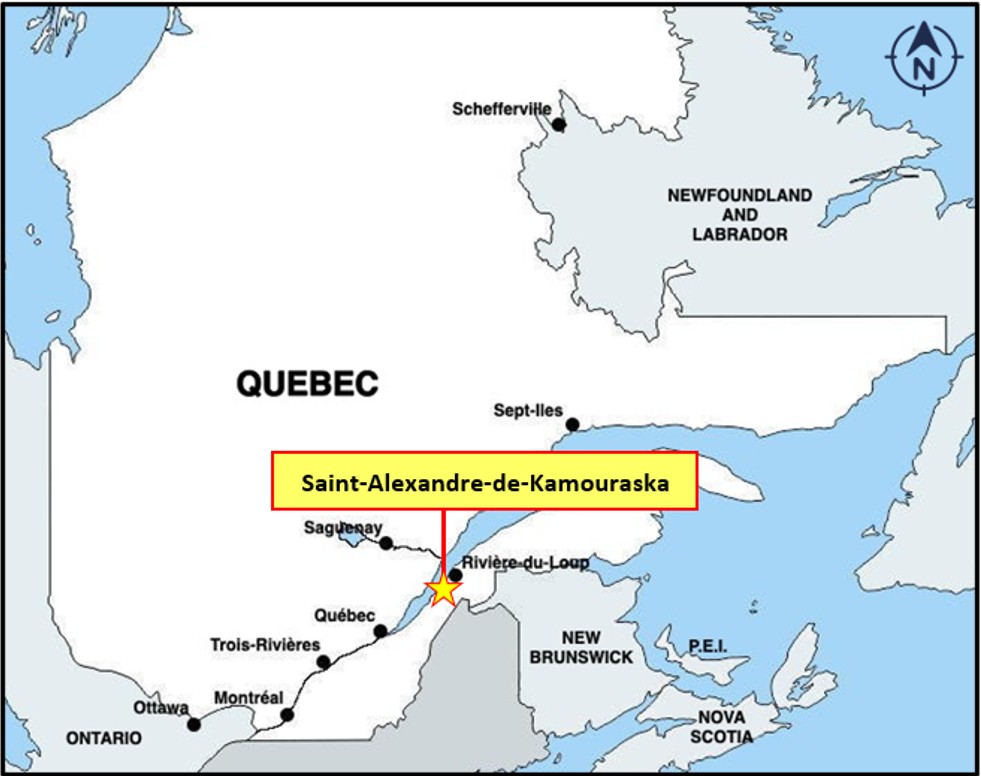
On 12 January 2026, VIA Rail Canada Inc. (VIA) passenger train VIA 14, transporting 114 passengers from Montréal, Quebec, to Halifax, Nova Scotia, was travelling eastward on the main track of the Canadian National Railway Company (CN) Montmagny Subdivision, near Saint-Alexandre-de-Kamouraska, Quebec (Figure 1).
The train consisted of 2 locomotives at the head end of the train and 19 passenger cars. It weighed 931 tons and measured 1622 feet. The train operating crew consisted of 2 qualified locomotive engineers: an operating locomotive engineer and an in-charge locomotive engineer. Ten passenger service employees were also on board.
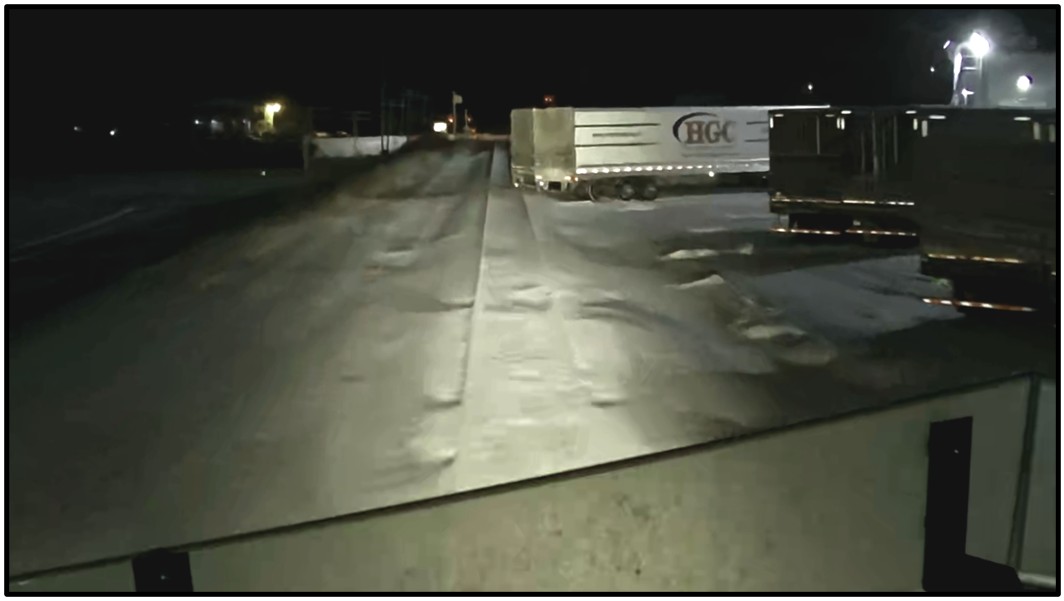
At around 0126,All times are Eastern Standard Time. at Mile 11.92, while the train was travelling at approximately 60 mph, the operating locomotive engineer noticed 2 tractor-trailers partially obstructing the tracks and made an emergency application of the train brakes. As the train’s speed dropped to 40 mph, the lead locomotive (VIA 6435) struck the tractor-trailers that were parked adjacent to the track; the rear portions of the tractor-trailers were foul of the main track (Figure 2).
As a result of the collision, the 2 locomotives and the first 4 passenger cars derailed and remained upright. The train came to a stop approximately 500 feet further along the track, just before a public crossing.The Highway 289 railway crossing. No one on the train or in the tractor-trailers was injured. About 500 feet of track was damaged. The fuel tanks on both locomotives were punctured, which led to a release of approximately 10 220 litres of diesel fuel.
At the time of the occurrence, the temperature was −5 °C, the sky was overcast, and it was snowing. The track was covered with a thin layer of snow.
Site examination
The lot where the tractor-trailers were parked belongs to a meat processing company. It is bordered to the north by the CN railway right-of-way and to the east by Highway 289.
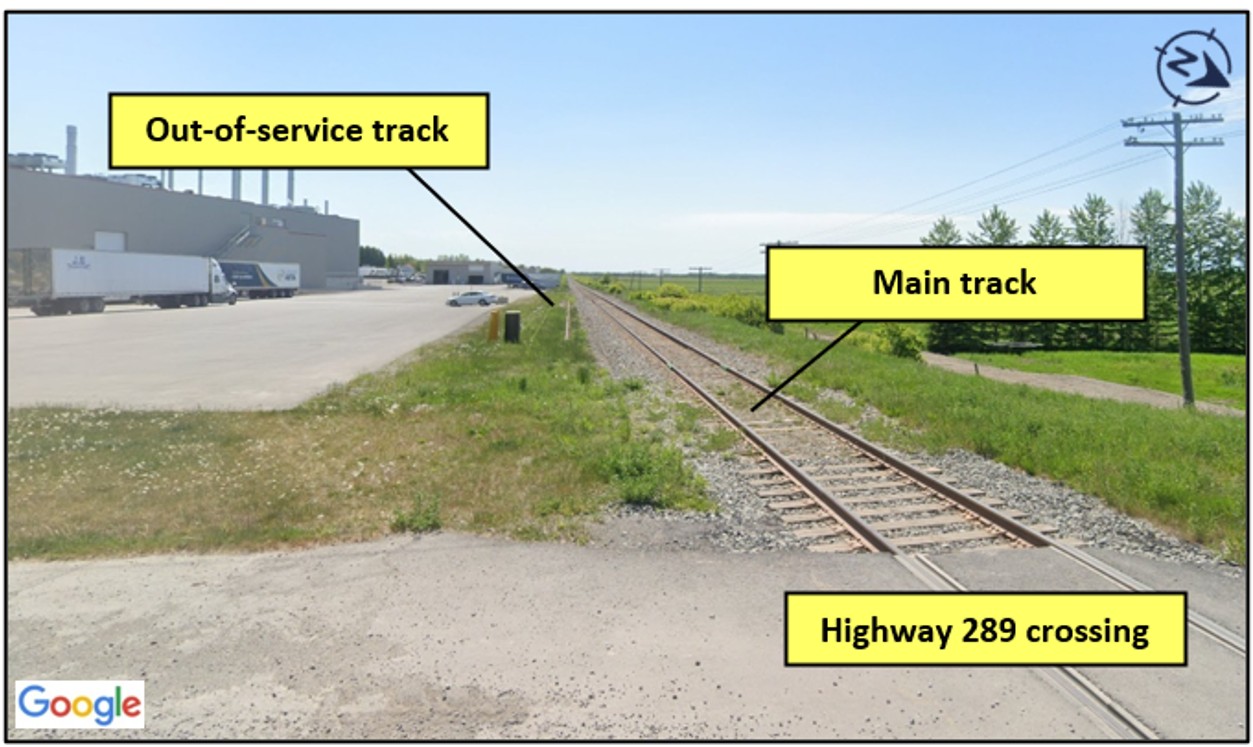
There was an old, out-of-service railway track running parallel to the main track, and there was no difference in elevation between the company lot and the south side of the out-of-service track.This track, whose rails were partially buried, was once used to directly transfer freight to rail cars. The main track, however, was slightly elevated (Figure 3).
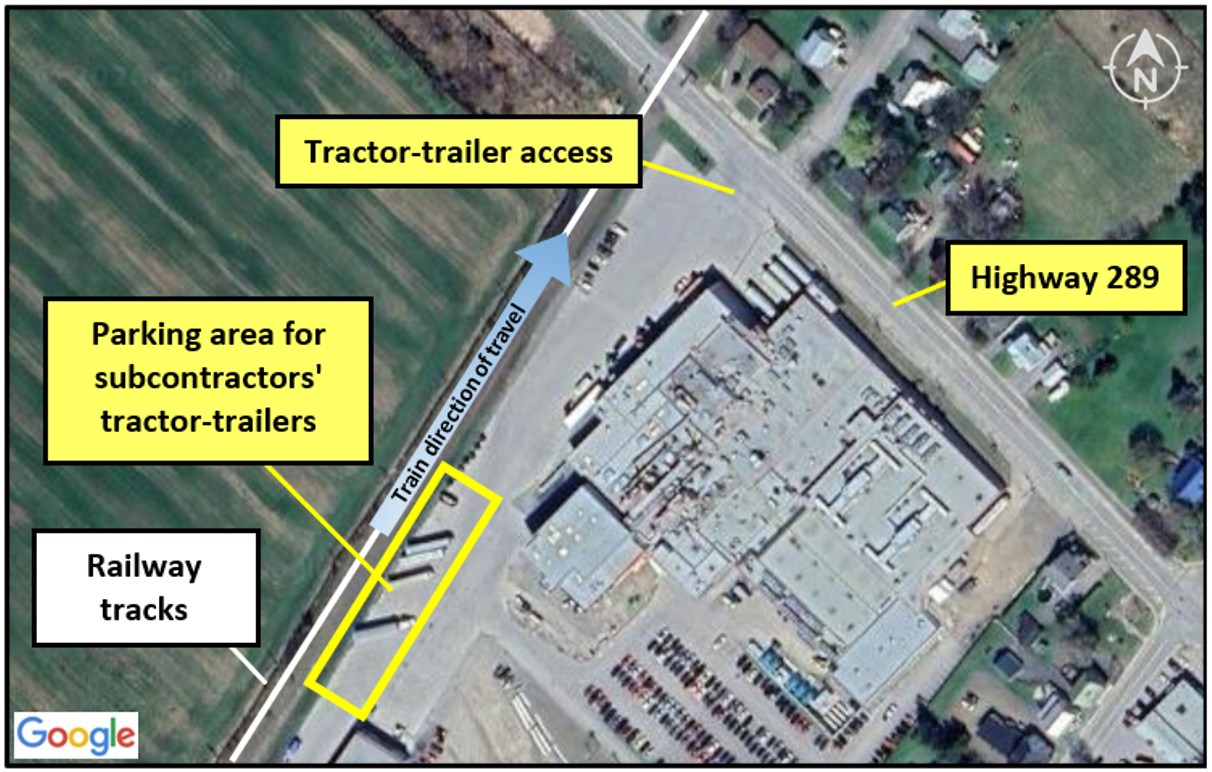
The company lot is directly accessible from Highway 289, and entry is unrestricted, with no security booth or access barrier. Transport trucks travel through the lot very frequently. Drivers for subcontracting carriers typically park their trucks at an angle in the section of the lot adjacent to the south side of the railway tracks (Figure 4).
At the time of the occurrence, there were no signs, fences, or other physical barriers in this area to delineate the parking area for subcontractors’ trucks.
Following the release of diesel fuel, extensive decontamination work was undertaken along the entire length of the damaged track.Additional sections of track had to be removed during the decontamination work. About 10 days after the occurrence, the contaminated soil had partially been removed. These operations continued and were expected to be completed by the summer of 2026.
Passenger management
As soon as the area was secured, the 114 passengers on the train were evacuated by VIA on-board personnel and police officers who responded to the scene. They were all transported by bus to the town hall of the municipality of Saint-Alexandre-de-Kamouraska, where municipal employees provided assistance. Later that morning, buses chartered by VIA arrived on site to accommodate passengers wishing to return to Montréal as well as those wishing to continue on to Halifax.
Following the occurrence, rail traffic resumed as normal late in the day on Tuesday, 13 January 2026, after CN temporarily rebuilt the railway tracks, and the VIA train was put back on the tracks.
Subdivision information
The Montmagny Subdivision is part of CN’s main rail corridor linking Canada from east to west. The main track is single track. VIA operated the passenger train on infrastructure owned and maintained by CN.Rail operations were conducted in accordance with a network access agreement between VIA and CN. In the area of the occurrence, the authorized speed is 80 mph for passenger trains and 60 mph for freight trains. At the time of the occurrence, a temporary slow order of 60 mph was in effect for passenger trains. Train movements are governed by the centralized traffic control system, in accordance with the Canadian Rail Operating Rules, and are supervised by a CN rail traffic controller located in Edmonton, Alberta.
Tractor-trailer information
Each of the 2 tractor-trailers was approximately 75 feet long and belonged to 2 different Ontario-based subcontractors. The trucks, which were empty, arrived separately earlier that night.The 1st tractor-trailer arrived shortly after midnight, and the 2nd at around 0110. Loading was scheduled to begin after the business opened, around 0630. The parking area was well lit and completely cleared of snow, and a few 53-foot-long trailers, without tractor units, were already parked there. Upon arrival, the 1st tractor-trailer parked parallel to the trailer located farthest to the east. When the 2nd tractor-trailer arrived a little over an hour later, it parked the same way, next to the first truck. For all of these drivers, it was their 1st time going there.
Tractor-trailer driver information
Each truck had 2 drivers on board who took turns driving during the trip. All drivers held a valid Class AZ driver’s license issued by the Government of Ontario.Ontario’s AZ driver’s licence is equivalent to the Société de l’assurance automobile du Québec’s Class 1 licence, which authorizes the operation of heavy vehicles. At the time of the occurrence, the driver of the 1st tractor-trailer had 6 months of experience driving tractor-trailers, while his colleague had just over 6 years of experience. The 1st driver of the 2nd tractor-trailer had less than 2 years of experience, while the 2nd driver had been driving tractor-trailers for nearly 3 years.
When the 1st tractor-trailer arrived on site, the driver did not feel comfortable performing the reverse manoeuvre required to park the vehicle. His colleague then took the wheel and performed the manoeuvre, backing up the truck and its trailer until the front of the truck was level with the front of the other trailers already on site. The 2 occupants of the truck then went to the truck’s sleeping compartment.
Upon arriving at the parking area, the 2nd tractor-trailer backed up parallel to the 1st one until it was flush with it.
As with the 1st truck, the 2nd truck’s occupants also went into the sleeper compartment once the vehicle was parked.
In both cases, after completing the parking manoeuvres, none of the occupants got out to walk around the tractor-trailer and check its positioning in the parking lot. As a result, they did not realize that the rear of the tractor-trailers was within the railway right-of-way and encroaching on the railway track.
Other encroachment occurrences at this location
CN had previously reported to the meat processing company in July 2025 that semi-trailer trucks were encroaching on the railway right-of-way at the same location. The company responded by alerting its customers who use subcontracted carriers to the proximity of the railway right-of-way to the parking lot.
Other similar occurrences in Canada
Since 2010, the TSB has recorded 5 occurrences in CanadaTSB rail transportation occurrences R15E0089, R12W0060, R12C0133, R10T0198, and R10D0071. where trains travelling on the main track collided with parked tractor-trailers that were encroaching on the railway track.
Safety action taken
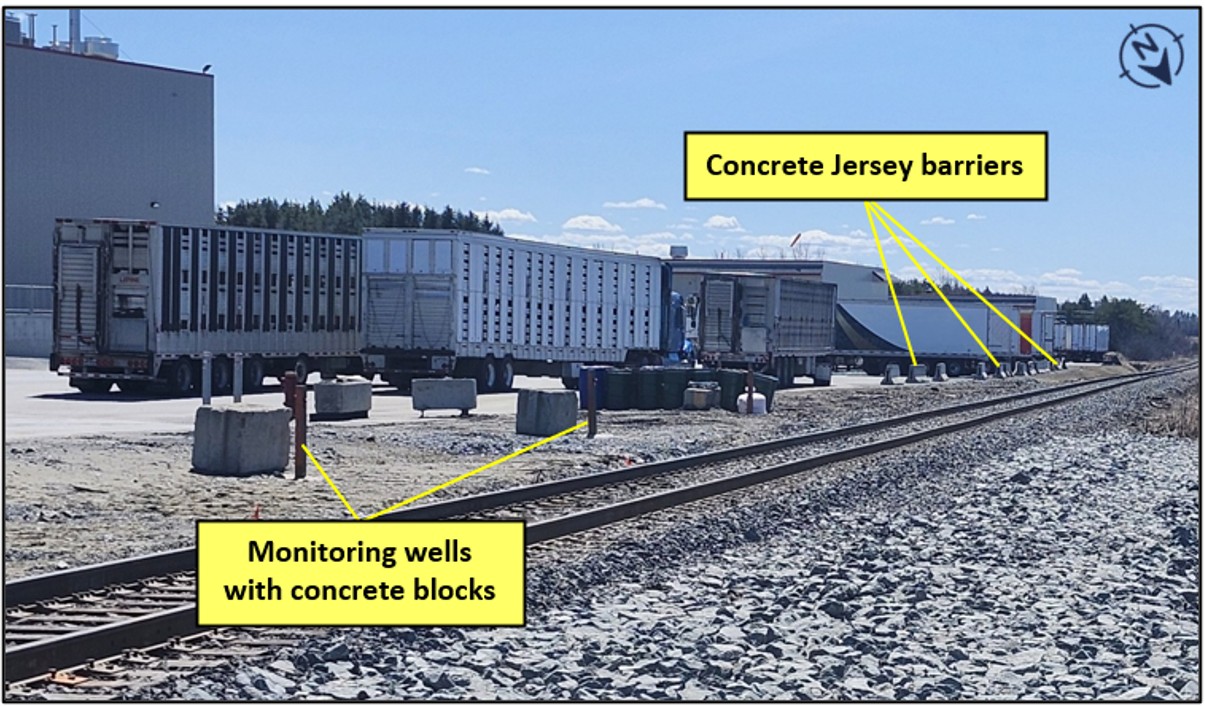
Approximately 1 week after the occurrence, the meat processing company temporarily placed 14 concrete Jersey barriers in the subcontractor truck parking area, between the parking lot and the railway track, and built a snow embankment there. At 27 April 2026, the temporary concrete barriers were still in place.
As part of the soil decontamination work undertaken at the site, 6 monitoring wells were installed on either side of the railway tracks. Concrete blocks were installed in front of each of the 6 wells located on the south side of the track (Figure 5).
On 07 April 2026, the TSB sent Rail Safety Advisory 01/26 to Transport Canada regarding vehicles encroaching on the railway tracks and the risks of collision with trains. The TSB suggested that, given the risks involved, Transport Canada might wish to consider adopting appropriate measures to enable the identification of locations where heavy vehicles could encroach on the railway right-of-way of main tracks and to ensure that preventive measures are implemented. It also suggested that Transport Canada consider collaborating with provincial authorities to enhance training for heavy vehicle drivers and raise their awareness of railway infrastructure and the associated risks.
On 07 May 2026, Transport Canada responded that it acknowledged the safety issue identified by the TSB regarding heavy vehicles encroaching on railway rights-of-way and the associated risk of collision, and that it would continue to monitor and address risks at the rail–road interface, while supporting a coordinated national approach led by headquarters. Regarding training and awareness for heavy vehicle drivers, Transport Canada stressed that driver training falls exclusively under the jurisdiction of the provinces and territories, which are responsible for implementation of mandatory basic training as well as other training required to successfully obtain a commercial driver’s licence.
Safety messages
The consequences of a collision between a train and heavy vehicles encroaching on the railway tracks could be catastrophic, especially when passenger trains or trains carrying dangerous goods are involved.
While heavy vehicle drivers should always ensure that their vehicles are parked safely at all times, effective physical protection measures must be designed and implemented where appropriate to prevent vehicles from encroaching on the railway tracks.
This report concludes the Transportation Safety Board of Canada’s investigation into this occurrence. The Board authorized the release of this report on 08 July 2026. It was officially released on 16 July 2026.