
Hard landing
Commercially registered
Bell Helicopter Textron Canada Limited Bell 206L-4, C-GKVX
Hespero/Safron Residence Heliport (CTS6), Alberta
The Transportation Safety Board of Canada (TSB) investigated this occurrence for the purpose of advancing transportation safety. It is not the function of the Board to assign fault or determine civil or criminal liability. This report is not created for use in the context of legal, disciplinary or other proceedings. See Ownership and use of content. Masculine pronouns and position titles may be used to signify all genders to comply with the Canadian Transportation Accident Investigation and Safety Board Act (S.C. 1989, c. 3).
History of the flight
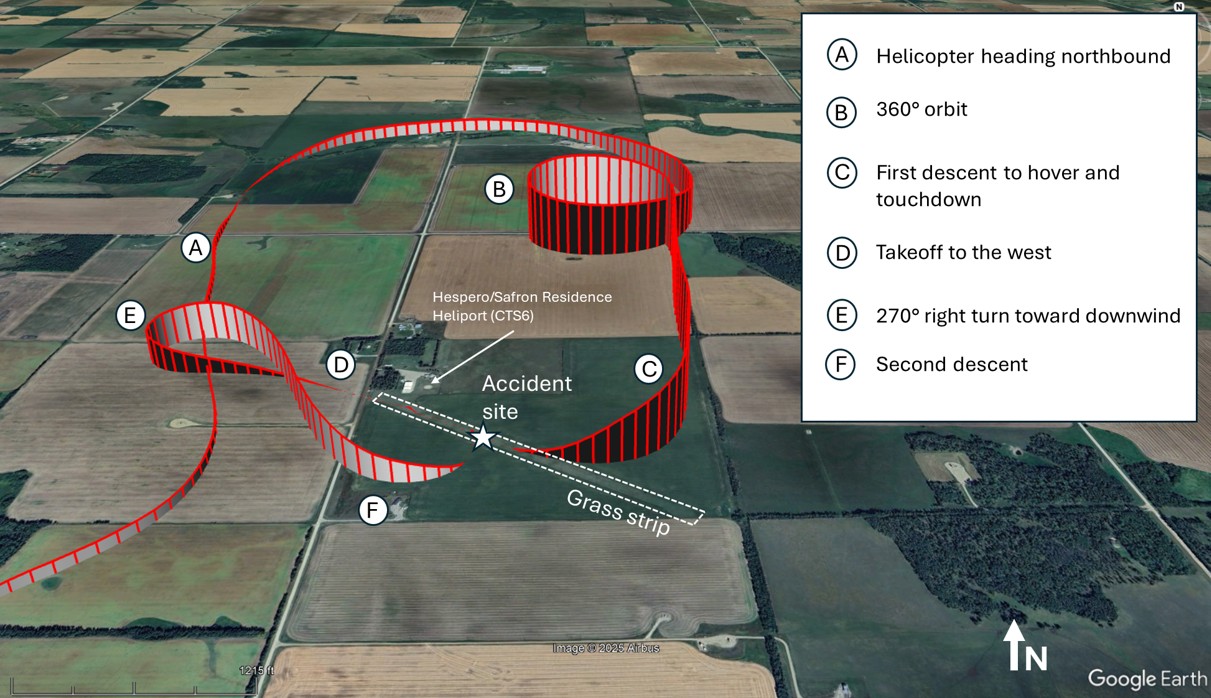
On 06 July 2025, the commercially registered Bell Helicopter Textron Canada Limited (Bell) 206L-4 helicopter (registration C-GKVX, serial number 52387) was conducting a private visual flight rules (VFR) flight from The Lodge at Panther River, Alberta, to the Hespero/Safron Residence Heliport (CTS6), Alberta, with the pilot and 1 passenger on board. At 1213,All times are Mountain Daylight Time (Coordinated Universal Time minus 6 hours) after a 34-minute flight, the helicopter overflew the destination, heading north. The pilot conducted a 360° turn, and from a height of approximately 700 feet above ground level (AGL), commenced a turning approach consistent with an autorotation. The approach consisted of a 123° track change and a rate of descent up to 3846 fpm. The pilot terminated the approach by conducting a power recoveryAccording to Transport Canada’s TP 9982E, Helicopter Flight Training Manual, Second Edition (June 2006), p. 48, a power recovery is the final phase of an autorotation that ends with the helicopter in a stable hover rather than touching down. before landing in the middle of a grass strip, which was oriented on a heading of 290° magnetic (M).The occurrence helicopter was equipped with a Garmin GTN 750. Flight path data from the GTN 750 was downloaded and provided altitude, indicated airspeed, ground speed, vertical speed, pitch, roll and heading data, lateral and vertical acceleration, track, wind speed and wind direction. The pilot then departed along the grass strip, on a northwest heading and conducted a 270° turn to the right, eventually turning downwind on the southwest side of the grass strip. He levelled off at a height of approximately 300 feet AGL, at approximately 80 knots indicated airspeed (KIAS), and on a heading of 140°. At 1218:29, he started a left turn that increased to 43° of bank toward a heading of 351° in another descent consistent with an autorotation (Figure 1). At 1218:41, the maximum rate of descent in the turn was recorded to be 2362 fpm at a height of 100 feet AGL. In the next 5 seconds, the helicopter pitched up to 14° and the rate of descent slowed to 125 fpm at a ground speed of 30 KIAS while the helicopter banked 9° to the right. Over the next 6 seconds, the rate of descent increased, and the pitch fluctuated.
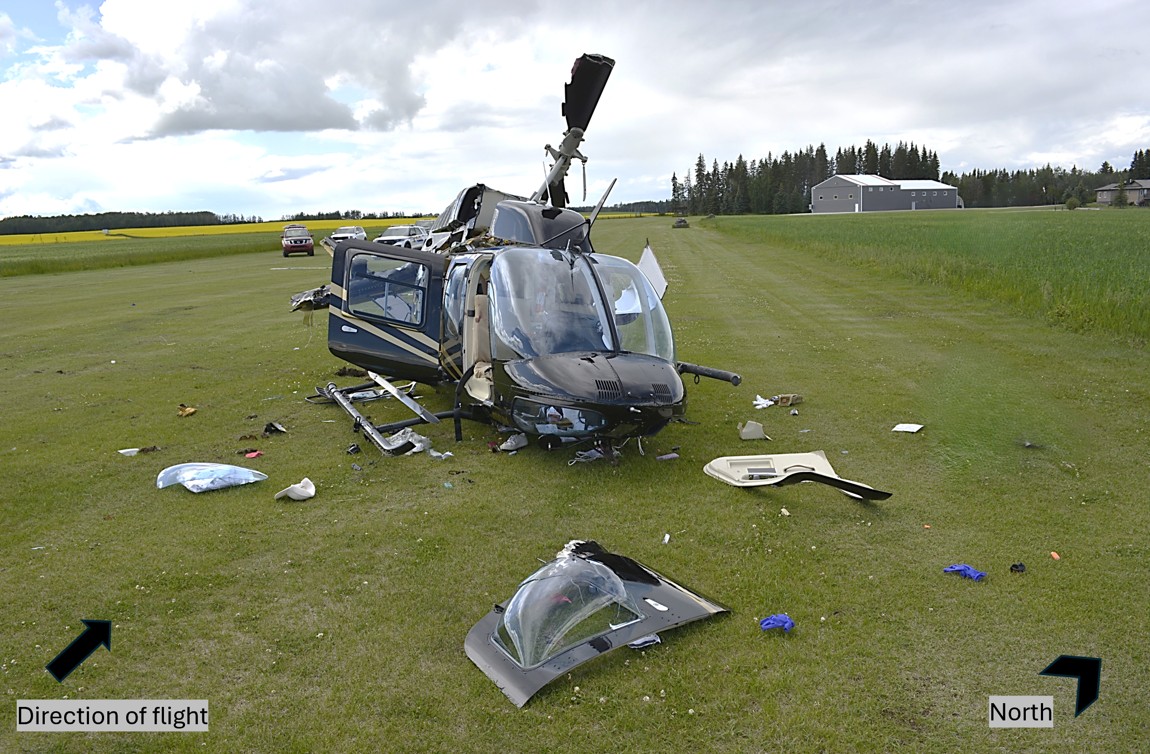
The helicopter contacted the ground at 1218:50, the skid gear collapsed, and the helicopter came to rest facing the opposite direction of travel. One main rotor blade impacted the tail boom, and the tail rotor was separated from the fuselage. The 2nd main rotor blade was found clear of the wreckage, severed outboard of the blade doublers with evidence of contact with the upper wire cutter (Figure 2). There was no post-impact fire. The passenger was fatally injured, and the pilot was seriously injured.
Weather information
The closest weather reporting station was Red Deer Regional Airport (CYQF), Alberta, located 22 nautical miles (NM) east of CTS6. At the time of the occurrence, the winds at CYQF were reported to be from 340° true (T) at 12 knots, gusting to 18 knots and a scattered layer of clouds was at 2400 feet AGL. Data from the onboard Garmin GTN 750 indicated that on average the winds were from approximately 320°T at approximately 10 knots. Weather was not considered to be a factor in this occurrence.
Pilot information
The pilot held a commercial pilot licence – helicopter and a private pilot licence – aeroplane, along with Group 4 and Group 1 instrument ratings. His medical certificate was valid at the time of the occurrence. The pilot had successfully completed his pilot proficiency check (PPC) on the occurrence helicopter in the month before the accident. He maintained a regular training schedule, conducting recurrent training flights with a flight instructor approximately every 6 months. The training flights included helicopter handling and practice autorotations, including turning autorotations from heights lower than 300 feet AGL. He had completed a training flight the day before his most recent PPC. At the time of the occurrence, the pilot had accumulated approximately 3500 hours of rotary-wing flying and about 1800 hours flying the occurrence helicopter. In the 60 days preceding the occurrence, he had logged 33 flight hours, all on the occurrence helicopter.
There was no indication that the pilot’s performance was negatively affected by medical or physiological factors, including fatigue.
Aircraft information
The airframe had accumulated 1919.8 hours total flight time. The collective and cyclic controls for the front-left seat had been removed, and the tail rotor control pedals for the front-left seat had been locked. The helicopter was being operated within its weight and centre of gravity limits. There was no cockpit voice recorder (CVR) or flight data recorder (FDR), nor was either required by regulation.
Representatives from the airframe and engine manufacturers were in attendance during the technical examination of the helicopter at the TSB regional office in Edmonton, Alberta. No issues were identified related to the helicopter’s flight controls, systems, or engine that would have prevented them from operating normally during the occurrence flight.
The caution and warning panel was sent to the TSB Engineering Laboratory in Ottawa, Ontario, for light bulb filament analysis. Using an optical microscope, no broken or deformed filaments were observed; therefore, it could not be determined whether any caution and warning panel lights were illuminated at the time of impact.
Autorotation training
During autorotation training, helicopter pilots are taught to practise varying the direction, speed, and rotor rpm of the helicopter to reach a chosen landing spot.Transport Canada, TP 9982E, Helicopter Flight Training Manual, Second Edition (June 2006), Exercise 18 – Autorotations 3 (Range Variations), p. 61. While it is considered vitalTransport Canada TP 4818E, Flight Instructor Guide – Helicopter (August 2006), Exercise 18 – Autorotations 3, p. 105. that helicopter pilots be proficient with varying parameters, emphasis is placed on returning to a minimum rate of descent as early as possible, and no later than 200 feet AGL.Transport Canada, TP 9982E, Helicopter Flight Training Manual, Second Edition (June 2006), Exercise 18 – Autorotations 3 (Range Variations), p. 62.,Transport Canada TP 4818E, Flight Instructor Guide – Helicopter (August 2006), Exercise 18 – Autorotations 3, p. 106. The risk of the rate of descent increasing up to more than 2500 fpmTransport Canada, TP 9982E, Helicopter Flight Training Manual, Second Edition (June 2006), Exercise 18 – Autorotations 3 (Range Variations), p. 64. while conducting a turning autorotation is highlighted and instructors are taught to emphasize that the skill and judgment to handle the aircraft at varying airspeeds and rates of descent “will only come from frequent practice.”Transport Canada TP 4818E, Flight Instructor Guide – Helicopter (August 2006), Exercise 18 – Autorotations 3, p. 106.
The U.S. Federal Aviation Administration (FAA) has published an advisory circular on best practices to mitigate the risks of autorotations during training, specifically while turning.Federal Aviation Administration (FAA), Advisory Circular (AC) No. 61-140A: Autorotation Training (31 August 2016), at www.faa.gov/documentLibrary/media/Advisory_Circular/AC_61-140A.pdf (last accessed on 05 January 2026). The circular places emphasis on maintaining rotor rpm and airspeed, and states, “(d)o not allow the nose to pitch up or down excessively during the maneuver, as it may cause undesirable rotor rpm excursions.”Ibid., paragraph 7.1.2.
In Canada, there are regulations restricting emergency training with passengers during commercial operations but not during private operations.
Survivability
The helicopter’s front seats were each equipped with a 4-point safety belt that consisted of a lap strap and shoulder harness. The passenger was wearing the available safety belt; however, the occurrence was not survivable for the passenger due to the force and direction of impact. The investigation was unable to determine if the pilot was wearing his shoulder harness.
Neither the pilot nor the passenger was wearing a helmet nor were they required to be by regulation. The pilot received a serious head injury on impact. The TSB has documented several occurrences where the use of head protection contributed to the survival of the occupants or would likely have reduced or prevented injuries received by the occupants if worn.TSB air transportation safety investigation reports A21O0056, A21P0018, A21Q0097, A20Q0015, A16P0069, A16P0161, A16W0126, A15A0045, A15Q0126, and A14Q0060. In 2024, an article was published in Transport Canada’s Aviation Safety Letter, advocating for the use of a helmet for all helicopter operations.Transport Canada, “Look Like Maverick, Wear Your Helmet!” in TP 185E, Aviation Safety Letter, Issue 2/2024 (08 August 2024), at https://tc.canada.ca/en/aviation/publications/aviation-safety-letter/issue-2-2024/look-maverick-wear-your-helmet (last accessed on 05 January 2026).
The occurrence helicopter was equipped with a 406 MHz automatic fixed emergency locator transmitter (ELT).Kannad Integra AF 406 MHz ELT, part number S1851501-02. The Joint Rescue Coordination Centre (JRCC) in Trenton, Ontario, was informed of the ELT transmission at 1219 and later confirmed with local first responders that rescue and medical assistance were onsite.
TSB laboratory reports
The TSB completed the following laboratory reports in support of this investigation:
- LP050/2025 – NVM [non-volatile memory] Recovery – MFDS [multi-function displays]
- LP053/2025 – Caution and Warning Panel Light Bulb Filament Analysis
Safety messages
While essential to helicopter pilot training, conducting practice autorotations can introduce risks that are higher than regular flight. Exposing passengers to these elevated risk levels should be carefully considered before pilots commence this exercise.
Pilots are reminded that the role of helmet use in preventing serious injury in helicopter accidents has been well documented.
This report concludes the Transportation Safety Board of Canada’s investigation into this occurrence. The Board authorized the release of this report on 21 January 2026. It was officially released on 05 February 2026.