
On this page
- From the Chair
- Plans to deliver on core responsibilities and internal services
- Department-wide considerations
- Planned spending and human resources
- Supplementary information tables
- Federal tax expenditures
- Corporate information
- Definitions
Read a summary of the Departmental Plan Departmental Plan in PDF
From the Chair
I am pleased to present the Transportation Safety Board of Canada’s (TSB) Departmental Plan for 2026–27, which details our plans and priorities for the coming fiscal year.
Before outlining the road ahead, I want to acknowledge the progress we made last year in advancing transportation safety and modernizing our operations. We completed the migration of our core systems to the cloud and expanded our capacity to engage with families, loved ones, and survivors (FLS) through a dedicated liaison.
We also released the latest TSB Watchlist, which highlights systemic safety issues that require urgent action across all modes of transportation. Going forward, the Watchlist will be kept up-to-date on a continuous basis, allowing the TSB to add new issues as they emerge and remove issues as soon as they are considered mitigated.
This past year, the TSB launched dozens of new investigations across all modes, including a major aviation investigation at Toronto Pearson International Airport, which remains ongoing. We also continue to support and lead multiple international investigations, reflecting the global reach of our expertise and the growing technical complexity of modern transportation systems.
Canadians expect timely, clear, and reliable safety information when transportation accidents occur. Looking forward, and in alignment with the TSB Strategic Plan 2026–27 to 2027–28, we will focus on three strategic pillars: timeliness, impact, and excellence. These priorities will guide not only what we deliver, but how we work by accelerating safety learning, strengthening our influence across the transportation system, and continuously improving how we collaborate, analyze, and communicate.
As the transportation sector continues to change, so do the risks. New technologies, complex systems, and vast amounts of data that demand deeper analysis require us to adapt quickly and think ahead. To meet those challenges, we need the right tools, expertise and infrastructure for the future.
To support this evolution, progress continues on the new state-of-the-art Transportation Safety and Technology Science hub, created in partnership with the National Research Council (NRC) under the Government of Canada’s Laboratories Canada Program. Located on the NRC’s Ottawa campus, this joint facility will provide advanced tools and a collaborative environment to support rigorous investigations and innovation. While modern facilities and technologies are essential, it is ultimately our people—our investigators, engineers, analysts, and support staff—who transform evidence into safety learning.
At the TSB, we recognize the human dimension of our work. Investigations often involve difficult circumstances for those most directly affected by an occurrence. Our new FLS liaison function is dedicated to keeping families, loved ones, and survivors informed on the progress of investigation, the purpose of our work and the laws we work under. This function strengthens transparency and trust by ensuring those involved understand our role, our process, and the independence that underpins our findings.
As the work we do here at the TSB comes with specific stressors outside of the typical day-to-day pressures, the mental health of our employees remains a top priority. Without a healthy workforce, we would not be able to deliver our mandate and achieve our strategic objectives.
Our focus remains steady, to ensure a safer transportation system for Canadians. Through continued enhancements across our operations, we will deliver results that protect lives, build trust, and sustain public confidence. As we look ahead to a new fiscal year, I am proud of the dedication and professionalism of our employees. Together, we will keep learning, adapting, and leading as we deliver independent, trusted safety information that brings us closer to a safer future for all Canadians.
Yoan Marier
Chair
Plans to deliver on core responsibilities and internal services
Core responsibilities and internal services
- Core responsibility 1: Independent safety investigations and communication of risks in the transportation system
- Internal services
Core responsibility 1: Independent safety investigations and communication of risks in the transportation system
In this section
- Description
- Quality of life impacts
- Indicators, results and targets
- Plans to achieve results
- Gender-based Analysis Plus
- Planned resources to achieve results
- Program inventory
Description
The Transportation Safety Board of Canada’s sole objective is to advance air, marine, rail and pipeline transportation safety. This mandate is fulfilled by conducting independent investigations into selected transportation occurrences to identify the causes and contributing factors, and the safety deficiencies evidenced by these occurrences. The Transportation Safety Board of Canada makes recommendations to reduce or eliminate any such safety deficiencies and reports publicly on its investigations. The Transportation Safety Board of Canada then follows up with stakeholders to ensure that safety actions are taken to reduce risks and improve safety.
Quality of life impacts
Through the activities outlined under this core responsibility, the organization contributes to the Good Governance domain from the Quality of Life Framework for Canada and, more specifically the Confidence in Institutions indicator.
Indicators, results and targets
This section presents details on the department’s indicators, the actual results from the three most recently reported fiscal years, the targets and target dates for independent safety investigations and communication of risks in the transportation system. Details are presented by departmental result.
Table 1, 2 and 3 provide a summary of the target and actual results for each indicator associated with the results under independent safety investigations and communication of risks in the transportation system.
| Departmental Result Indicators | Actual Results | 2026–27 Target | Date to achieve target |
|---|---|---|---|
| Number of accidents over 10-year period | 2022–23: Met, 1,402 compared to 1,555 2023–24: Met, 1,331 compared to 1,535 2024–25: Met, 1,303 compared to 1,507 | Reduction in number of accidents | March 2027 |
| Departmental Result Indicators | Actual Results | 2026–27 Target | Date to achieve target |
|---|---|---|---|
| Average time recommendations have been outstanding (active recommendations) | 2022–23: Not Met, 10.8 years 2023–24: Not Met, 8.1 years 2024–25: Not Met, 9.6 years | 8 years | March 2027 |
| Percentage of responses to recommendations assessed as Fully Satisfactory (since TSB’s creation) | 2022–23: Not Met, 1% decrease 2023–24: Not Met, 0.5% decrease 2024–25: Not Met, 1% increase | 1.5% increase from previous fiscal year result | March 2027 |
| Percentage of safety advisories on which safety actions have been taken | 2022–23: Not Met, 46% 2023–24: Met, 86% 2024–25: Not Met, 56% | 60% | March 2027 |
| Departmental Result Indicators | Actual Results | 2026–27 Target | Date to achieve target |
|---|---|---|---|
| Average time to complete a class 1 safety issue investigation | 2022–23: N/A 2023–24: N/A 2024–25:1,528 days | 730 days | March 2027 |
| Average time to complete a class 2 complex investigation | 2022–23: 1,143 days 2023–24: 1,208 days 2024–25: 925 days | 600 days | March 2027 |
| Average time to complete a class 3 detailed investigation | 2022–23: 611 days 2023–24: 796 days 2024–25: 683 days | 450 days | March 2027 |
| Average time to complete a class 4 limited-scope investigation | 2022–23: 235 days 2023–24: 258 days 2024–25: 305 days | 220 days | March 2027 |
| Average time to complete a class 5 data-gathering investigation | 2022–23: 56 days 2023–24: 53 days 2024–25: 43 days | 60 days | March 2027 |
| Percentage of class 1-4 investigations that were completed within the target time | 2022–23: 32% 2023–24: 28% 2024–25: 13% | 60% | March 2027 |
Additional information on the detailed results and performance information for the TSB’s program inventory is available on GC InfoBase.
Plans to achieve results
The following section describes the planned results for independent safety investigations and communication of risks in the transportation system in 2026–27.
Transportation system is safer
This departmental result is assessed by examining the number of accidents across all modes of transportation over a 10-year period. This indicator provides a long-term perspective on accidents within the Canadian transportation system and provides an assessment of whether there has been a reduction in their number.
Transportation safety is influenced by many factors and reflects the combined efforts of multiple organizations, including regulators, industry, and transportation operators. As such, it is not possible to directly attribute changes in accident levels to the actions of any single organization.
In recent years, accident and fatality data have generally reflected improvements in transportation safety.
Results we plan to achieve
- Number of accidents over 10-year period
- Target: reduction in number of accidents
Regulators and the transportation industry respond to identified safety deficiencies
This departmental result will be measured using three indicators: the average length of time that recommendations remain active, the percentage of responses to recommendations assessed as Fully Satisfactory since the TSB’s creation, and the percentage of safety advisories for which safety actions have been taken.
These indicators support an assessment of the extent to which the TSB’s safety communications contribute to timely and meaningful responses by regulators and the transportation industry. By tracking responses received, actions taken, and their timeliness, the TSB monitors progress in addressing identified safety deficiencies.
As part of its strategic objective to increase its impact, the TSB will modernize the way it communicates and continue to engage with stakeholders across all federally regulated transportation sectors to raise awareness about the actions that are required to make our transportation system safer. Performance targets and results vary by transportation sector, reflecting differences in operating environments, risk profiles, and baseline conditions. Results for these indicators are consolidated to provide an overall assessment of departmental progress and outcomes across the TSB’s jurisdiction.
Results we plan to achieve
- Average time recommendations have been outstanding (active recommendations)
- Target: 8 years or less
- Percentage of responses to recommendations assessed as Fully Satisfactory (since TSB’s creation)
- Target: 1.5% increase from previous fiscal year result
- Percentage of safety advisories on which safety actions have been taken
- Target: At least 60%
Occurrence investigations are efficient
This departmental result will be measured by the timeliness of investigation reports. The average time required to complete an investigation report, categorized in accordance with the TSB’s Policy on Occurrence Classification, will be used as the efficiency indicator.
Although investigation complexity, scope, and external dependencies can affect timelines, improving the timeliness of investigation reports remains a key organizational focus, as it enhances responsiveness and supports the timely communication of safety information to stakeholders.
In 2026–27, the TSB will advance actions aligned with its strategic objective on timeliness, which focuses on modernizing and simplifying investigative processes to communicate safety information faster. These efforts will include streamlining end-to-end workflows; strengthening early, risk-based scoping to establish appropriate investigation depth and timelines; and improving planning and sequencing of investigative activities to reduce downstream delays. The TSB will also strengthen oversight of investigation timelines as a defined performance outcome, supported by clearer expectations, active monitoring of key milestones, and continuous improvement across investigations.
In parallel, the TSB will continue to examine how and when safety information can be shared earlier in the investigation lifecycle, where appropriate, to support timely awareness and safety action—while maintaining analytical rigour, independence, and credibility. Together, these actions are intended to improve the predictability and efficiency of investigations and to reduce the time between deployment to an occurrence and the publication of final investigation reports.
Results we plan to achieve
- Average time to complete a class 1 safety issue investigation
- Target: Equal to or under 730 days
- Average time to complete a class 2 complex investigation
- Target: Equal to or under 600 days
- Average time to complete a class 3 detailed investigation
- Target: Equal to or under 450 days
- Average time to complete a class 4 limited-scope investigation
- Target: Equal to or under 220 days
- Average time to complete a class 5 data-gathering investigation
- Target: Equal to or under 60 days
- Percentage of class 1-4 investigations that were completed within the target time
- Target: At least 60%
Gender-based Analysis Plus
As a small government department, the TSB has a very clear mission— we conduct independent safety investigations and communicate risks in the transportation system. Our sole objective is to make the transportation system safer— a system that plays a vital role in Canada’s economy and in everyone’s life.
Our work is done in an unbiased manner for the general benefit of all Canadians regardless of gender, race, ethnicity, religion, age, or mental / physical disability. However, where appropriate, the TSB does not refrain from addressing issues it uncovers that may focus on a specific segment of the population so that corrective actions can be taken to improve safety for that particular group. For example, in one investigation the TSB made recommendations about proper restraint systems for infants and young children, and in another, the TSB made a recommendation to improve the safety of railway grade crossings for persons with disabilities.
At this time, the TSB does not have a specified gender-based analysis plus (GBA+) implementation plan. However, the TSB is continuing to raise awareness among the management team about the applicability of GBA+ to TSB programs and activities.
The TSB programs do not collect sufficient data to enable monitoring or reporting on the programs impacts by gender and diversity with respect to the Gender Results Framework, Quality of Life and Sustainable Development indicators. Given the specific nature of the TSB mandate, it does not lend itself to making these correlations. Therefore, there are no current plans to add further monitoring or reporting on GBA+.
Planned resources to achieve results
Table 4 provides a summary of the planned spending and full-time equivalents required to achieve results.
| Resource | Planned |
|---|---|
| Spending | 33,213,405 |
| Full-time equivalents | 193 |
Complete financial and human resources information for the TSB’s program inventory is available on GC InfoBase.
Program inventory
Independent safety investigations and communication of risks in the transportation system is supported by the following programs:
- Aviation occurrence investigations
- Marine occurrence investigations
- Pipeline occurrence investigations
- Rail occurrence investigations
Additional information related to the program inventory for independent safety investigations and communication of risks in the transportation system is available on the Results page on GC InfoBase.
Internal services
In this section
- Description
- Plans to achieve results
- Planned resources to achieve results
- Planning for contracts awarded to Indigenous businesses
Description
Internal services are the services that are provided within a department so that it can meet its corporate obligations and deliver its programs. There are 10 categories of internal services:
- acquisition management services
- communications services
- financial management services
- human resources management services
- information management services
- information technology services
- legal services
- material management services
- management and oversight services
- real property management services
Plans to achieve results
This section presents details the department’s plans to achieve results and meet targets for internal services.
The Internal Services program remains committed to providing strong, reliable support to TSB operations, even as it adapts to a more constrained fiscal environment. Reductions stemming from the Government’s Refocusing Government Spending initiatives in Budget 2023 and the 2025–26 Comprehensive Expenditure Review mean that Internal Services will be required to operate with fewer resources. This reality reinforces the need to accelerate modernization efforts, streamline processes, and maximize the value of artificial intelligence (AI) and every tool, system, and capability available.
A central part of this evolution will be a deliberate push toward digital transformation, automation, and the strategic use of AI. Internal Services will increasingly look to AI‑enabled solutions to reduce manual workloads, enhance service delivery, and support faster, data‑driven decision making. The TSB’s ongoing transition to cloud‑based platforms is a key enabler of this shift. Continued migrations will ensure employees can access modern, efficient technologies from any location. In the coming year, the move to SharePoint Online will further strengthen investigative support by improving integration across the M365 ecosystem and enhancing overall usability and productivity.
Major advancements have also been made on the Transportation Safety and Technology Science (TSTS) Hub, a transformative initiative that will bring the TSB’s laboratory and head office together with other departments in a new shared facility on the National Research Council campus in Ottawa under the Laboratories Canada program. This past year saw the initial ground breaking for supporting works such as utilities and site work. The next year is expected to see the construction start of the new building. The TSB will continue to collaborate closely with Laboratories Canada, the National Research Council, and other partners to ensure this project delivers a modern, innovative, and highly functional environment that supports scientific excellence, operational efficiency, and future‑ready technology integration. Because this initiative requires operating funding beyond current appropriations, securing sustainable investment for both implementation and ongoing operations remains a top priority.
At the same time, the TSB continues to recognize that its people are its greatest asset. Internal Services will maintain strong support for initiatives that promote employee well‑being, including actions responding to the Public Service Employee Survey, efforts to strengthen mental health awareness, and activities that advance diversity, inclusion, and a positive workplace culture.
With an ambitious agenda, significant modernization goals, and fewer resources, the year ahead will be demanding for Internal Services. The impacts of spending reduction exercises are significant, and the TSB will monitor them closely to safeguard operational continuity. Even so, this period of change presents an opportunity to rethink how work is done, embrace new technologies—including AI—and build a more agile, efficient, and future‑focused Internal Services program.
Planned resources to achieve results
Table 5 provides a summary of the planned spending and full-time equivalents required to achieve results.
| Resource | Planned |
|---|---|
| Spending | 8,303,351 |
| Full-time equivalents | 52 |
Complete financial and human resources information for the TSB’s program inventory is available on GC InfoBase.
Planning for contracts awarded to Indigenous businesses
The Government of Canada remains committed to advancing reconciliation with Indigenous peoples by strengthening Indigenous participation in the federal procurement process and improving socio-economic outcomes for First Nations, Inuit and Métis businesses. As set out in Appendix E of the Directive on the Management of Procurement, departments are required to plan for and achieve the award of at least 5% of the total value of contracts to Indigenous businesses annually.
Building on the successful achievement of the Indigenous procurement target in 2025–26, the TSB will continue to take a planned, category-based approach to Indigenous procurement in 2026–27. TSB’s strategy focuses on procurement areas where Indigenous supplier capacity is well established and aligns with the organization’s operational and corporate requirements.
In 2026–27, the TSB will prioritize Indigenous procurement in furniture, information technology (IT) products, and professional services, because these categories represent a significant portion of the organization’s forecasted contracting activity and offer consistent opportunities to engage qualified Indigenous suppliers. Where market capacity allows, the TSB will continue to leverage existing procurement tools and mechanisms, including standing offers and supply arrangements that identify Indigenous businesses, and will consider Indigenous set-asides for furniture and related goods.
For professional services requirements, the TSB will continue to make use of the Centralized Professional Services System (CPSS) and other applicable procurement instruments to identify and solicit Indigenous suppliers. Procurement planning activities will include early consideration of Indigenous procurement opportunities to ensure requirements are structured in a manner that supports Indigenous participation.
Through deliberate procurement planning, use of Indigenous-inclusive procurement instruments, and ongoing engagement with available Indigenous suppliers in key commodity areas, the TSB expects to meet or exceed the minimum 5% Indigenous procurement target in 2026–27.
Table 6 presents the current, actual results with forecasted and planned results for the total percentage of contracts the department awarded to Indigenous businesses.
5% Reporting Field | 2024–25 Actual Result | 2025–26 Forecasted Result | 2026–27 Planned Result |
|---|---|---|---|
| Total percentage of contracts with Indigenous businesses | 10.68 % | 5.74% | 5.80 % |
The 2025–26 planned results are expected to be realized, based on a similar procurement profile and continued use of established procurement instruments that support Indigenous participation.
To support achievement and monitoring of the Indigenous procurement target, contracting officers will continue to systematically consult the Indigenous Business Directory during procurement planning and solicitation activities to confirm the availability and qualification of Indigenous businesses for individual requirements, in alignment with Appendix E of the Directive on the Management of Procurement.
Department-wide considerations
Related government priorities
Artificial Intelligence
The department is integrating general AI capabilities to streamline drafting, translation, research support, and quality assurance across investigative and corporate workflows. Modular AI components will accelerate key steps in the investigation‑to‑report process while maintaining human oversight, improving productivity and reducing process delays.
AI‑enabled workflow optimization, supported by Lean process reviews and improved data architecture, will help lower operational costs and enhance service timeliness. Preparations include staff training, structured change management, strengthened data governance, and modernized technical foundations to ensure safe and effective adoption of AI tools.
Planned spending and human resources
This section provides an overview of the TSB’s planned spending and human resources for the next three fiscal years and of planned spending for 2026–27 with actual spending from previous years.
In this section
Spending
This section presents an overview of the department's planned expenditures from 2023–24 to 2028–29.
Budgetary performance summary
Table 7 presents the TSB’s spending over the past three years to carry out its core responsibilities and for internal services. Amounts for the 2025–26 fiscal year are forecasted based on spending to date.
| Core responsibilities and Internal services | 2023–24 Actual Expenditures | 2024–25 Actual Expenditures | 2025–26 Forecast Spending |
|---|---|---|---|
| Independent safety investigations and communication of risks in the transportation system | 31,285,048 | 29,947,826 | 33,032,158 |
| Internal services | 12,243,603 | 13,029,259 | 8,258,040 |
| Total (s) | 43,528,651 | 42,977,085 | 41,290,198 |
Analysis of the past three years of spending
Expenditures for the 2023–24 and 2024–25 fiscal years reflect actual results, as reported in the Public Accounts of Canada. Higher spending in 2023–24 was primarily attributable to additional funding received for critical operational requirements through Budget 2023, as well as increased salary costs resulting from the implementation of collective agreements.
In 2024–25, the TSB experienced budget reductions as part of the Refocusing Government Spending initiative, which contributed to lower overall spending levels. While the TSB continued to make strategic investments in information technology and to upgrade and replace essential laboratory equipment, spending in these areas was lower than in the previous year.
Forecasted spending for 2025–26 is based on anticipated authorities at the time of preparation. It includes funding above the Main Estimates, reflecting the operating budget carryforward from the previous year, as well as salary increases resulting from collective agreements.
The TSB also anticipates carrying forward a portion of its available funding into the 2026–27 fiscal year. The higher-than-usual carry forward is primarily attributable to adjustments in timing of planned government reductions, which affected planned purchases and anticipated staffing actions.
More financial information from previous years is available on the Finances section of GC Infobase.
Table 8 presents the TSB’s planned spending over the next three years by core responsibilities and for internal services.
| Core responsibilities and Internal services | 2026–27 Planned Spending | 2027–28 Planned Spending | 2028–29 Planned Spending |
|---|---|---|---|
| Independent safety investigations and communication of risks in the transportation system | 33,213,405 | 33,034,211 | 32,688,604 |
| Internal services | 8,303,351 | 8,258,552 | 8,172,151 |
| Total | 41,516,756 | 41,292,763 | 40,860,755 |
Analysis of the next three years of spending
In accordance with the definition of planned spending, the amounts for 2026–27 and subsequent fiscal years include only funding reflected in the Main Estimates and the Annual Reference Level Update (ARLU). These amounts do not include any additional or exceptional funding that may be received through Supplementary Estimates or other one-time adjustments. These amounts reflect reductions associated with the Comprehensive Expenditure Review that are incorporated in the Main Estimates and ARLU.
More detailed financial information on planned spending is available on the Finances section of GC Infobase.
Funding
This section provides an overview of the department's voted and statutory funding for its core responsibilities and for internal services. For further information on funding authorities, consult the Government of Canada budgets and expenditures.
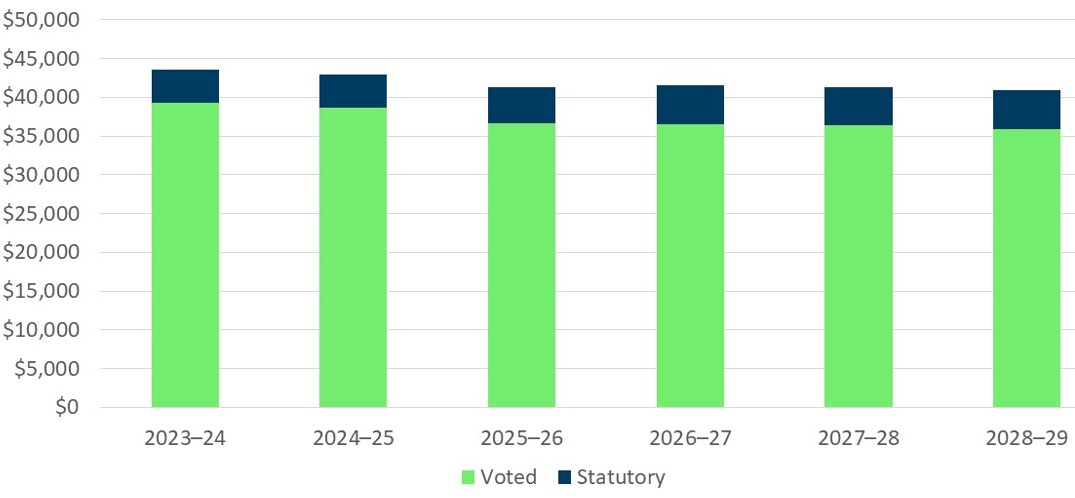
Graph 1 summarizes the department's approved voted and statutory funding from 2023–24 to 2028–29 (thousands of dollars).
| Fiscal year | Total | Voted | Statutory |
|---|---|---|---|
| 2023–24 | 43,529 | 39,334 | 4,195 |
| 2024–25 | 42,977 | 38,661 | 4,316 |
| 2025–26 | 41,290 | 36,660 | 4,630 |
| 2026–27 | 41,517 | 36,525 | 4,992 |
| 2027–28 | 41,293 | 36,326 | 4,967 |
| 2028–29 | 40,861 | 35,943 | 4,918 |
Analysis of statutory and voted funding over a six-year period
The departmental spending trend graph presents actual spending for 2023–24 and 2024–25 and forecasted and planned spending for 2025–26 to 2028–29, in thousands of dollars. Variations in statutory amounts over the years are primarily attributable to changes in Employee Benefit Plan (EBP) requirements associated with employee salaries. As salaries increase due to collective bargaining adjustments or changes in full-time equivalent levels, corresponding EBP requirements also increase. Additional context related to spending variations is provided in the sections above.
For further information on the TSB’s departmental appropriations, consult the 2026–27 Main Estimates.
Future-oriented condensed statement of operations
The future-oriented condensed statement of operations provides an overview of the TSB’s operations for 2025–26 to 2026–27.
Table 9. Future-oriented condensed statement of operations for the year ended March 31, 2027 (thousands of dollars)
Table 9 summarizes the expenses and revenues which net to the cost of operations before government funding and transfers for 2025–26 to 2026–27. The forecast and planned amounts in this statement of operations were prepared on an accrual basis. The forecast and planned amounts presented in other sections of the Departmental Plan were prepared on an expenditure basis. Amounts may therefore differ.
| Financial information | 2025–26 Forecast results | 2026–27 Planned results | Difference (Planned results minus forecasted) |
|---|---|---|---|
| Total expenses | 46,063 | 48,022 | 1,959 |
| Total revenues | 85 | 7 | (78) |
| Net cost of operations before government funding and transfers | 45,978 | 48,015 | 2,037 |
Analysis of forecasted and planned results
The TSB’s 2026–27 planned results reflect an increase compared to the 2025–26 forecasted results. This increase is largely attributable to the planned use of the department’s carry forward to mitigate the impact of funding reductions associated with the Comprehensive Expenditure Review, which reduces expenses in 2025–26 while increasing expenses in 2026–27. The increase also reflects higher statutory spending resulting from collective bargaining adjustments.
Revenues at the TSB are of a low-dollar nature and have a minimal impact on the overall net cost of operations. The higher amount in 2025–26 is attributable to the replacement of two fleet vehicles and the resulting sale of the retired vehicles.
A more detailed Future-Oriented Statement of Operations and associated Notes for 2026–27, including a reconciliation of the net cost of operations with the requested authorities, is available on the TSB’s website.
Human resources
This section presents an overview of the department’s actual and planned human resources from 2023–24 to 2028–29.
Table 10 shows a summary of human resources, in full-time equivalents, for the TSB’s core responsibilities and for its internal services for the previous three fiscal years. Human resources for the 2025–26 fiscal year are forecasted based on year to date.
| Core responsibilities and internal services | 2023–24 Actual full-time equivalents | 2024–25 Actual full-time equivalents | 2025–26 Forecasted full-time equivalents |
|---|---|---|---|
| Independent safety investigations and communication of risks in the transportation system | 173 | 179 | 193 |
| Internal services | 54 | 54 | 52 |
| Total | 227 | 233 | 245 |
Analysis of human resources over the last three years
The increase in full-time equivalents from 2023–24 to 2024–25 reflects the completion of staffing processes initiated in the previous year following the approval of new funding under Budget 2023. Although staffing levels increased in 2024–25, delays in confirming funding, establishing new positions, and completing staffing processes limited the extent of the increase, resulting in a variance from originally planned levels.
As staffing processes continued into 2025–26, the TSB forecast 245 full-time equivalents; however, the final FTE count may be impacted by government-wide reduction exercises.
Table 11 shows information on human resources, in full-time equivalents, for each of the TSB’s core responsibilities and for its internal services planned for the next three years.
| Core responsibilities and internal services | 2026–27 Planned full-time equivalents | 2027–28 Planned full-time equivalents | 2028–29 Planned full-time equivalents |
|---|---|---|---|
| Independent safety investigations and communication of risks in the transportation system | 193 | 193 | 193 |
| Internal services | 52 | 52 | 47 |
| Total | 245 | 245 | 240 |
Analysis of human resources for the next three years
For fiscal years 2026–27 and 2027–28, the TSB plans to maintain a stable number of full-time equivalents. The anticipated reduction of approximately 5 full-time equivalents in 2028–29 is as result of the Comprehensive Expenditure Review initiative and is planned to be achieved through attrition.
Supplementary information tables
The TSB has no supplementary information tables.
Information on the TSB’s departmental sustainable development strategy can be found on the TSB’s website.
Federal tax expenditures
The TSB’s Departmental Plan does not include information on tax expenditures.
The tax system can be used to achieve public policy objectives through the application of special measures such as low tax rates, exemptions, deductions, deferrals and credits. The Department of Finance Canada publishes cost estimates and projections for these measures each year in the Report on Federal Tax Expenditures.
This report also provides detailed background information on tax expenditures, including descriptions, objectives, historical information and references to related federal spending programs as well as evaluations and GBA Plus of tax expenditures.
Corporate information
Departmental profile
Appropriate minister: The Honourable Dominic LeBlanc, P.C., K.C., M.P.
Institutional head: Yoan Marier
Ministerial portfolio: Privy Council
Enabling instrument(s): Canadian Transportation Accident Investigation and Safety Board Act, S.C. 1989, c. 3
Year of incorporation / commencement: 1990
Departmental contact information
Mailing address:
Transportation Safety Board of Canada
Place du Centre, 4th floor
200 Promenade du Portage
Gatineau, Quebec K1A 1K8
Telephone: 1-800-387-3557
Email: communications@tsb-bst.gc.ca
Website(s): www.tsb.gc.ca
Definitions
appropriation (crédit)
Any authority of Parliament to pay money out of the Consolidated Revenue Fund.
budgetary expenditures (dépenses budgétaires)
Operating and capital expenditures; transfer payments to other levels of government, departments or individuals; and payments to Crown corporations.
core responsibility (responsabilité essentielle)
An enduring function or role performed by a department. The intentions of the department with respect to a core responsibility are reflected in one or more related departmental results that the department seeks to contribute to or influence.
Departmental Plan (plan ministériel)
A report on the plans and expected performance of an appropriated department over a 3-year period. Departmental Plans are usually tabled in Parliament each spring.
departmental result (résultat ministériel)
A consequence or outcome that a department seeks to achieve. A departmental result is often outside departments’ immediate control, but it should be influenced by program-level outcomes.
departmental result indicator (indicateur de résultat ministériel)
A quantitative measure of progress on a departmental result.
departmental results framework (cadre ministériel des résultats)
A framework that connects the department’s core responsibilities to its departmental results and departmental result indicators.
Departmental Results Report (rapport sur les résultats ministériels)
A report on a department’s actual accomplishments against the plans, priorities and expected results set out in the corresponding Departmental Plan.
full-time equivalent (équivalent temps plein)
A measure of the extent to which an employee represents a full person-year charge against a departmental budget. For a particular position, the full-time equivalent figure is the ratio of number of hours the person actually works divided by the standard number of hours set out in the person’s collective agreement.
gender-based analysis plus (GBA Plus) (analyse comparative entre les sexes plus [ACS Plus])
Is an analytical tool used to support the development of responsive and inclusive policies, programs, and other initiatives. GBA Plus is a process for understanding who is impacted by the issue or opportunity being addressed by the initiative; identifying how the initiative could be tailored to meet diverse needs of the people most impacted; and anticipating and mitigating any barriers to accessing or benefitting from the initiative. GBA Plus is an intersectional analysis that goes beyond biological (sex) and socio-cultural (gender) differences to consider other factors, such as age, disability, education, ethnicity, economic status, geography (including rurality), language, race, religion, and sexual orientation.
Using GBA Plus involves taking a gender- and diversity-sensitive approach to our work. Considering all intersecting identity factors as part of GBA Plus, not only sex and gender, is a Government of Canada commitment.
government priorities (priorités gouvernementales)
For the purpose of the 2026–27 Departmental Plan, government priorities are the high-level themes outlining the government’s agenda in the 2025 Speech from the Throne.
horizontal initiative (initiative horizontale)
An initiative where two or more federal departments are given funding to pursue a shared outcome, often linked to a government priority.
Indigenous business (entreprise autochtones)
Requirements for verifying Indigenous businesses for the purposes of the departmental result report are available through the Indigenous Services Canada Mandatory minimum 5% Indigenous procurement target website.
non‑budgetary expenditures (dépenses non budgétaires)
Non-budgetary authorities that comprise assets and liabilities transactions for loans, investments and advances, or specified purpose accounts, that have been established under specific statutes or under non-statutory authorities in the Estimates and elsewhere. Non-budgetary transactions are those expenditures and receipts related to the government's financial claims on, and obligations to, outside parties. These consist of transactions in loans, investments and advances; in cash and accounts receivable; in public money received or collected for specified purposes; and in all other assets and liabilities. Other assets and liabilities, not specifically defined in G to P authority codes are to be recorded to an R authority code, which is the residual authority code for all other assets and liabilities.
performance (rendement)
What a department did with its resources to achieve its results, how well those results compare to what the department intended to achieve, and how well lessons learned have been identified.
performance indicator (indicateur de rendement)
A qualitative or quantitative means of measuring an output or outcome, with the intention of gauging the performance of a department, program, policy or initiative respecting expected results.
plan (plan)
The articulation of strategic choices, which provides information on how a department intends to achieve its priorities and associated results. Generally, a plan will explain the logic behind the strategies chosen and tend to focus on actions that lead to the expected result.
planned spending (dépenses prévues)
For Departmental Plans and Departmental Results Reports, planned spending refers to those amounts presented in Main Estimates.
A department is expected to be aware of the authorities that it has sought and received. The determination of planned spending is a departmental responsibility, and departments must be able to defend the expenditure and accrual numbers presented in their Departmental Plans and Departmental Results Reports.
program (programme)
Individual or groups of services, activities or combinations thereof that are managed together within the department and focus on a specific set of outputs, outcomes or service levels.
program inventory (répertoire des programmes)
Identifies all the department’s programs and describes how resources are organized to contribute to the department’s core responsibilities and results.
result (résultat)
A consequence attributed, in part, to a department, policy, program or initiative. Results are not within the control of a single department, policy, program or initiative; instead they are within the area of the department’s influence.
statutory expenditures (dépenses législatives)
Expenditures that Parliament has approved through legislation other than appropriation acts. The legislation sets out the purpose of the expenditures and the terms and conditions under which they may be made.
target (cible)
A measurable performance or success level that a department, program or initiative plans to achieve within a specified time period. Targets can be either quantitative or qualitative.
voted expenditures (dépenses votées)
Expenditures that Parliament approves annually through an appropriation act. The vote wording becomes the governing conditions under which these expenditures may be made.