
Crossing collision
Canadian Pacific Railway Company (CPKC)
Mile 115.64, Belleville Subdivision
Township of Cramahe, Ontario
The Transportation Safety Board of Canada (TSB) investigated this occurrence for the purpose of advancing transportation safety. It is not the function of the Board to assign fault or determine civil or criminal liability. This report is not created for use in the context of legal, disciplinary or other proceedings. See Ownership and use of content. Masculine pronouns and position titles may be used to signify all genders to comply with the Canadian Transportation Accident Investigation and Safety Board Act (S.C. 1989, c. 3).
The occurrence
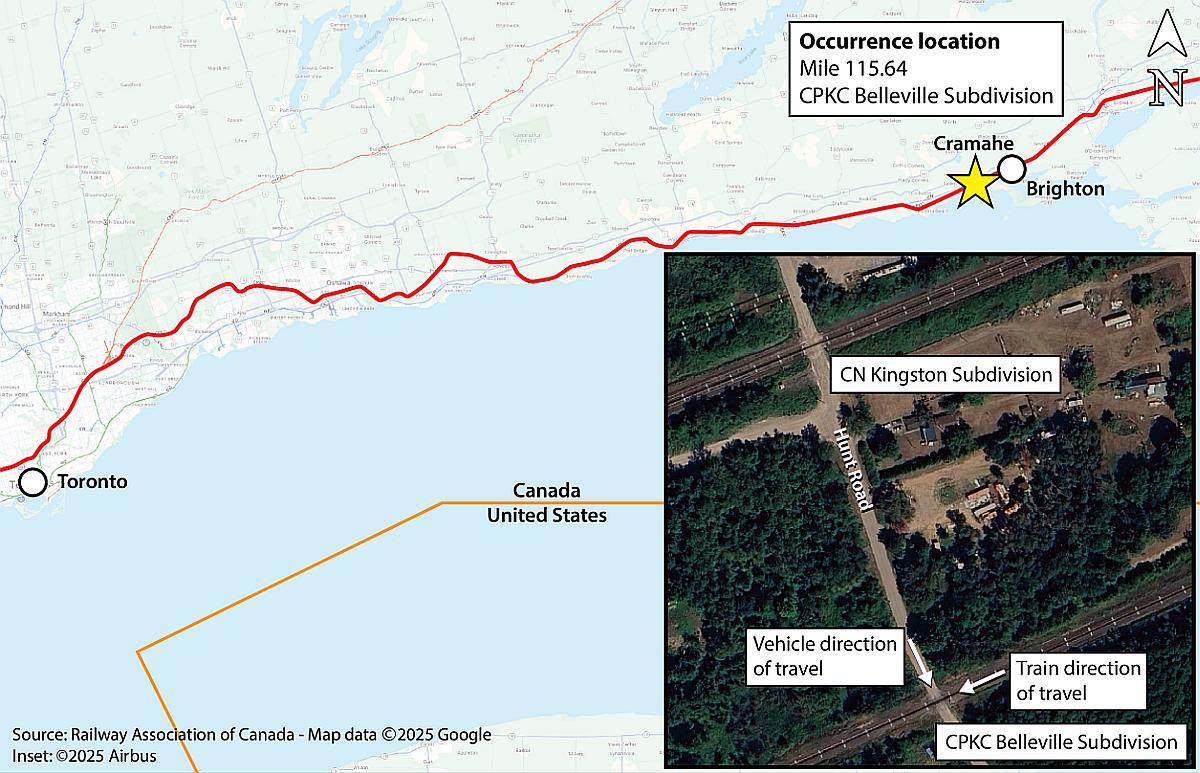
On 14 July 2025, at about 0809,All times are Eastern Daylight Time. intermodal freight train 113-13 of the Canadian Pacific Railway Company, doing business as CPKC, was proceeding westward at 56 mph on the CPKC Belleville Subdivision when it collided with a southbound pickup truck (the vehicle) as it was traversing the Hunt Road grade crossing (Mile 115.64) in Cramahe, a rural township in southern OntarioAll locations are in the province of Ontario. (Figure 1). On impact, the vehicle was thrown to the southwest. The vehicle driver, and sole occupant, was fatally injured.
Crossing information
In the area of the occurrence, there are 2 railway crossings within 200 m of each other. One traverses the double main track of the Canadian National Railway Company (CN) Kingston Subdivision; the other traverses the single main track of the CPKC Belleville Subdivision. A southbound vehicle on Hunt Road crosses the CN tracks on the approach to the CPKC railway crossing.
The CN crossing is an automated public crossing. It is equipped with an active train warning system (flashing lights, a bell, and gates) that activates when a train is approaching or occupying the crossing. Road users are warned of an approaching train before the train is visible.
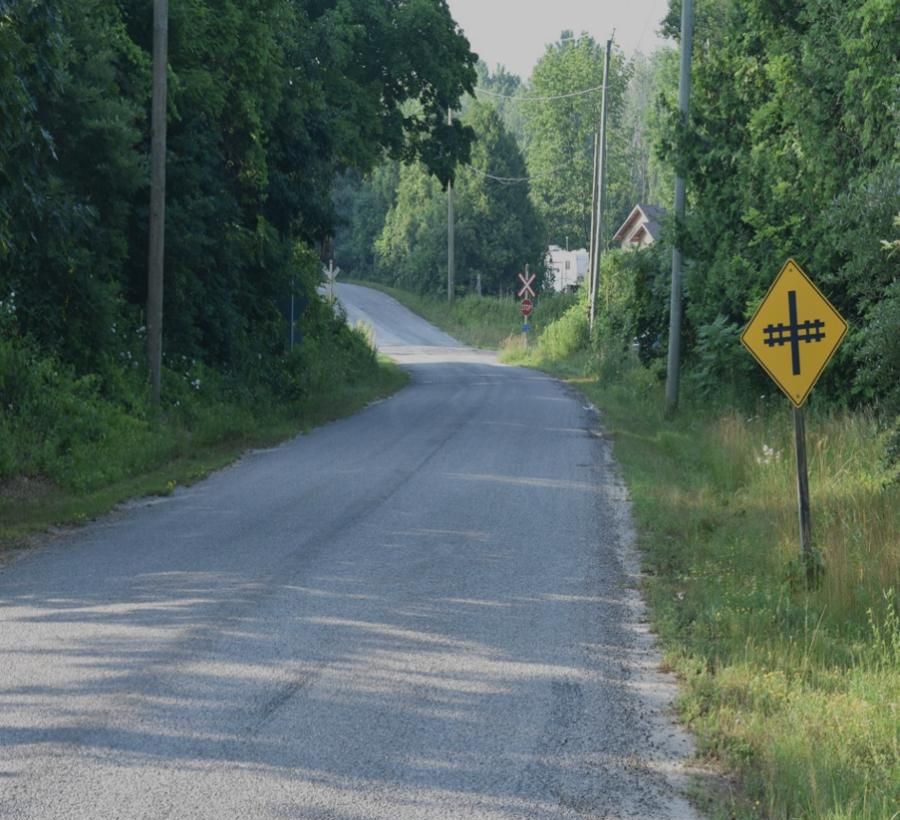
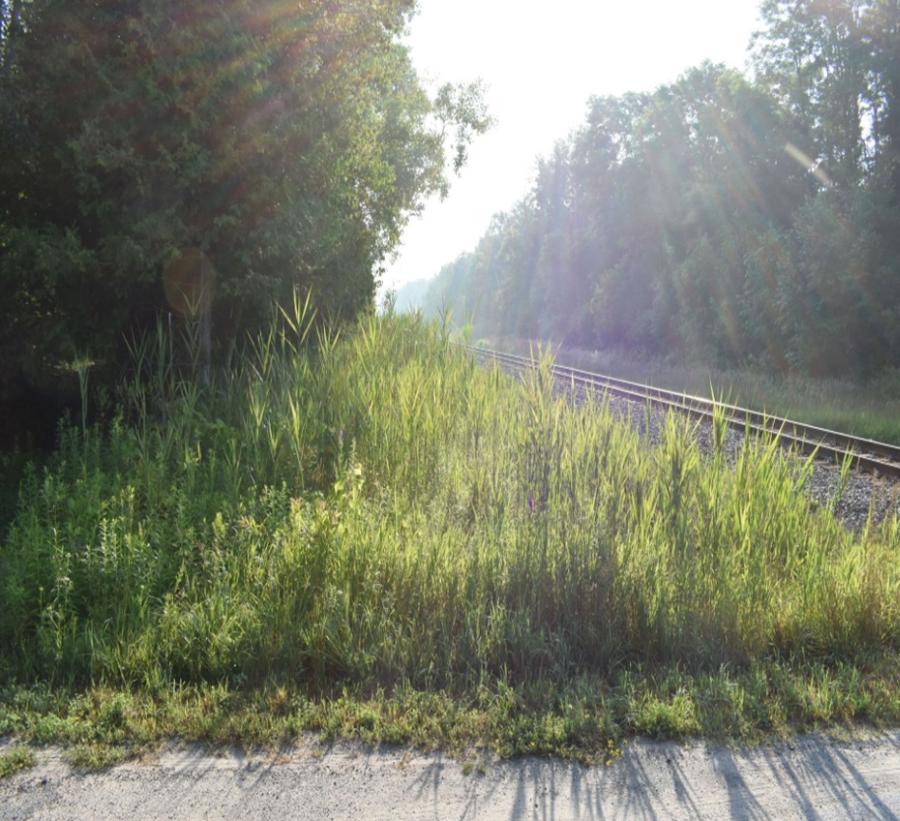
The CPKC crossing further south (the occurrence crossing) is a passive public crossing equipped with a standard retroreflective crossing sign (SRCS) and a stop sign. In the final approach to the crossing from the southbound direction, the road curves gently to the left, on a 5° downgrade, and crosses the Belleville Subdivision at an 85° angle (figures 2 and 3). The surface of the public roadway is paved and, at the time of the occurrence, the pavement was dry.
Crossing protection (automated or passive) at any given crossing is dependent on factors such as rail and road traffic volumes and maximum speed of both trains and vehicles.
Train activity data suggest that normally 2 to 3 trains per day pass the CPKC Hunt Road crossing during daylight.Data provided by RailState, from its Rail Network Intelligence database.
The vehicle driver in this occurrence routinely traversed the 2 crossings and was familiar with them.
Passive public grade crossings
Passive public grade crossings rely on road signs to notify drivers of an upcoming railway crossing. All passive public crossings include at a minimum an SRCS, which can be supplemented with a stop sign.
Passive public crossing systems do not warn drivers of an approaching train; they rely on the vehicle driver to take the necessary steps to avoid a collision.
At passive public crossings equipped with only an SRCS, vehicles are not required to stop but must be prepared to yield to any approaching train. At crossings equipped with both an SRCS and a stop sign, vehicles are required to stop, whether or not a train is present.
In 2024, there were approximately 12 500 public grade crossings on federally regulated rail lines in Canada. Of these, about 7000 had passive protection (69% were equipped with an SRCS only, the other 31% featured an SRCS supplemented with a stop sign). Between 2015 and 2024, the number of passive grade crossings equipped with an SRCS supplemented with a stop sign has more than doubled.Data reported under section 12.3(g) of the Transportation Information Regulations (SOR/96-334), which require that Class I, II and III rail carriers annually report the location of, and type of warning system for, each grade crossing. The number of crossings with both a standard reflectorized crossing sign and a stop sign has increased from 2115 in 2015 to 5431 in 2024, an increase of 3316 (2.6x).
Recorded information
As part of the investigation, data from the vehicle’s event data recorder for the 2.5 secondsOnly 2.5 seconds of data from the vehicle’s event data recorder were available. before the collision were reviewed by the TSB laboratory in Ottawa.
The data indicate that the vehicle was travelling at about 26 km/h while approaching the crossing, below the 80 km/h speed limit. Upon seeing the train, the driver attempted to accelerate clear of the crossing, with a possible moment of hesitation.
The data from the vehicle and from the locomotive event recorder on the train were also used by the TSB laboratory to conduct a photogrammetric analysis based on distances, velocity, and acceleration to determine if there was enough time, once the driver perceived the approaching train, to stop the vehicle and avoid the collision. The results indicate that the vehicle’s speed of travel was too great to have permitted the driver to stop the vehicle short of the crossing based on the vehicle’s position once the train became visible to the driver (approximately 2.2 seconds before the collision). Furthermore, the results are not consistent with a vehicle preparing to stop short of the crossing.
The TSB laboratory also inspected the vehicle right-side brake system and wheel assemblies. It determined that there were no visible faults, other than those resulting from the collision.
Sightlines
Under the Grade Crossings Regulations, the responsibility of maintaining sightlines at all public crossings is shared by the railway and the road authority. At public passive crossings equipped with both an SRCS and a stop sign, sightlines ensure that approaching trains are visible from a vehicle in a stopped position.
The day after the occurrence, Transport Canada (TC) inspected the crossing and found non-compliances with the Grade Crossings Regulations. The TC inspection expressed concern about the sightlines from the stopping sight distance, indicating that they “may not be adequate for the grades as well as current road use.”Transport Canada, Transport Canada Rail Safety – Crossings Inspection Report, Township of Cramahe (15 July 2025). Furthermore, TC indicated that “vegetation management [was] required along all approaches of the crossing to ensure that all warning signs are visible to road users.”
For a vehicle driver unfamiliar with a crossing, warning sign visibility could affect the driver’s ability to recognize and comply with the requirement to stop. However, in this occurrence, the vehicle driver was familiar with the crossing and therefore likely aware of the requirement to stop.
Train horn audibility
The effectiveness of train horns is affected by horn location, the speed of the train, and the dampening of sound through the road-vehicle shell.G. W. English and T. N. Moore, Locomotive Horn Evaluation: Effectiveness at Operating Speeds, TP 14103E, TranSys Research Ltd. (on behalf of Transport Canada), 2003. In this occurrence, the train horn was sounded in compliance with the Canadian Rail Operating Rules and continued when it became apparent that the vehicle was not stopping.
The driver’s car windows were closed and the engine was running at the time of the collision. Previous investigations have demonstrated that train horns may not be audible to a vehicle driver under such circumstances until the train is less than 2 seconds from the point of collision.TSB rail transportation safety investigation reports R18T0006, R13E0015, R13D0001, R10W0123, R11T0175, R08M0002, R04H0014, and R02W0063. The vehicle driver’s behaviour was consistent with him not hearing the train before it became visible.
Research on driver compliance at stop signs
The required vehicle driver behaviour at a stop sign is to bring the vehicle to a complete stop, look in all directions for traffic, and then proceed when the driver deems it safe to do so. The defence against a collision at a passive grade crossing equipped with a stop sign relies on driver compliance. If the vehicle driver does not stop, as often happens, the system fails. There is considerable evidence showing that what happens in practice differs from what is required. A study on driver behaviour at a road T-intersection controlled by stop signs showed that only 4.6% of vehicle drivers performed a legal stop when there was no oncoming traffic. A. R. Lebbon, J. Austin, R. Van Houten, and L. E. Malenfant, “Evaluating the effects of traffic on driver stopping and turn signal use at a stop sign: A systematic replication,” Journal of Organizational Behavior Management, 27(2) (2007), pp. 27-35. In contrast, 100% of vehicle drivers in this research performed a legal stop when oncoming traffic was present.
A similar pattern of vehicle driver behaviour has been observed at passive railway grade crossings equipped with a stop sign. A study conducted at one crossing reported that stopping compliance ranged from 61% to as low as 29% for a familiar crossing.P. S. Parsonson and E. J. Rinalducci, “Positive-guidance demonstration project at a railroad-highway grade crossing,” in Automotive Technology, Information Needs of Highway Users, and Promotion of Safety Belt Usage, Transportation Research Record 844, Washington, DC: Transportation Research Board, National Research Council (1982), pp. 29-34. A study by the U.S. National Transportation Safety Board cited another studyA. Burnham, “Stop sign effectiveness at railroad grade crossings (abuse without excuse),” in Proceedings: Third International Symposium on Railroad-Highway Grade Crossing Research and Safety (Knoxville, TN: University of Tennessee, 1995), pp. 91-113, cited in National Transportation Safety Board, Safety Study: Safety at Passive Crossings, Volume 1: Analysis, NTSB/SS-98/02, PB98-917004, Notation 7036 (adopted 21 July 1998). in which only 18% of vehicle drivers came to a complete stop, even when there was no available sightline.
The research asserts that a vehicle driver behaviour at a stop sign is context-dependent and changes based on a driver’s perceived risk of collision with oncoming traffic. If the perceived risk of a collision is low because the driver does not currently observe other traffic and/or knows that traffic is infrequent, the normative behaviour of a vehicle driver will be to not come to a complete stop.
Driver compliance based on perceived likelihood of collision
Although a decision maker tends to overestimate the likelihood of a rare event in the abstract, research has shown that, in practice, they make decisions that underestimate the likelihood of the rare event.G. Barron and E. Yechiam, “The coexistence of overestimation and underweighting of rare events and the contingent recency effect,” Judgment and Decision Making, 4(6) (October 2009), pp. 447-460. When the decision maker’s mental model is primarily informed by experience with a given task or scenario (compared to a mental model being informed by theory), the decision maker tends to underestimate the likelihood of rare events. One explanation for this underestimation is that the decision maker tends to rely on limited experiences, most notably those associated with recent similar experiences.
In this occurrence, given his familiarity with the crossing, the vehicle driver would have observed that trains did not travel along that track very frequently. Therefore, a scenario where a train arrived at the same time as his vehicle was occupying the crossing likely would have been perceived as an extremely rare event. Even rarer still would have been a scenario where a collision occurs. The perceived extreme unlikelihood of these scenarios would have been reinforced by the fact that the crossing where the collision occurred had less protection than the crossing immediately to the north, which had higher activity.
This type of driver decision making—and the resulting behaviour—is not unique to this occurrence. A recent report by the Australian Transport Safety Bureau found that, in 12 of 24 collisions at grade crossings between 2014 and 2022, the vehicle driver used the occurrence crossing on a regular basis. The report attributed this finding to previous experience with the occurrence crossing, leading to a low expectancy for trains, and therefore to an underestimation of the risk of not coming to a complete stop.Australian Transport Safety Bureau, Review of level crossing collisions involving trains and heavy road vehicles in Australia, Safety study RS-2021-001 (March 2024).
Other train–vehicle collision at the CPKC Hunt Road crossing
According to TSB data, over the past 20 years, there was one other crossing accident at the CPKC Hunt Road crossing. On 18 October 2022, at about 1800, a northbound pickup truck pulling a trailer slid to a stop on the crossing and was struck by westbound CPKC train 231-18 travelling at 52 mph.TSB Rail Transportation Occurrence R22T0197. The driver, who was familiar with the crossing, had been proceeding in the dark on a drizzly foggy evening at an estimated speed of 35 km/h, scanning for an approaching train as the vehicle cleared the treeline.The distance between the edge of the trees and the track for northbound vehicles was about twice the distance for southbound vehicles. The vehicle driver saw the headlight of an approaching train and immediately applied the brakes. The pickup came to rest on the tracks just as the train arrived.
TSB laboratory reports
The TSB completed the following laboratory reports in support of this investigation:
- LP063/2025 – Vehicle Performance Analysis
Safety action taken
On 15 July 2025, CPKC performed localized brush cutting activities to improve sightlines in the vicinity of Mile 115.64 of the Belleville Subdivision. The railway also cleared brush partially obstructing northward and southward advance warning signs for this crossing.
On 24 July 2025, following its 15 July inspection of the crossing at Hunt Road crossing, TC issued a Letter of Non-Compliance to the Township of Cramahe describing the non-compliances and concern noted at the crossing. The non-compliances were related to signage and crossing surface conditions, and a concern was also noted for sightlines at the crossing. TC conducted a follow-up inspection on 24 August 2025 during which it identified that no visible change in the conditions noted in the Letter of Non-Compliance had taken place. Therefore, TC sent a Letter of Insufficient Action to the Township of Cramahe highlighting the items that required its further attention. On 12 September 2025, the Township of Cramahe indicated to TC that the vegetation had been cleared. On 16 October 2025, the Township finished the pavement markings at the crossing.
Safety message
It is important that railways—in conjunction with road authorities, regulators responsible for grade crossing safety, and other stakeholders—assess whether the defence built on the requirement to stop at a passive crossing equipped with a stop sign can be supplemented to improve rail crossing safety.
This report concludes the Transportation Safety Board of Canada’s investigation into this occurrence. The Board authorized the release of this report on 25 February 2026. It was officially released on 04 March 2026.