
Non-main-track collision and derailment
Canadian Pacific Railway Company, doing business as CPKC
Remote control locomotive system yard assignment CK31-10
Mile 8.0, Crowsnest Subdivision
Kipp Yard
Coalhurst, Alberta
The Transportation Safety Board of Canada (TSB) investigated this occurrence for the purpose of advancing transportation safety. It is not the function of the Board to assign fault or determine civil or criminal liability. This report is not created for use in the context of legal, disciplinary or other proceedings. See Ownership and use of content. Masculine pronouns and position titles may be used to signify all genders to comply with the Canadian Transportation Accident Investigation and Safety Board Act (S.C. 1989, c. 3).
Summary
On 11 February 2024, at approximately 0156 Mountain Standard Time, a yard crew of the Canadian Pacific Railway Company, doing business as CPKC, was operating yard assignment CK31-10 at Kipp Yard in Coalhurst, Alberta, when the assignment struck a cut of 79 stationary cars at 13 mph, causing 11 cars to derail, some of which were carrying dangerous goods. None of the cars leaked product, and no one was injured.
1.0 Factual information
1.1 The occurrence
On 10 February 2024 at about 2345,All times are Mountain Standard Time. the crew of yard assignment CK31-10 of the Canadian Pacific Railway Company, doing business as CPKC, went on duty at CPKC’s Kipp Yard in Coalhurst, AlbertaAll locations are in the province of Alberta. (Figure 1).
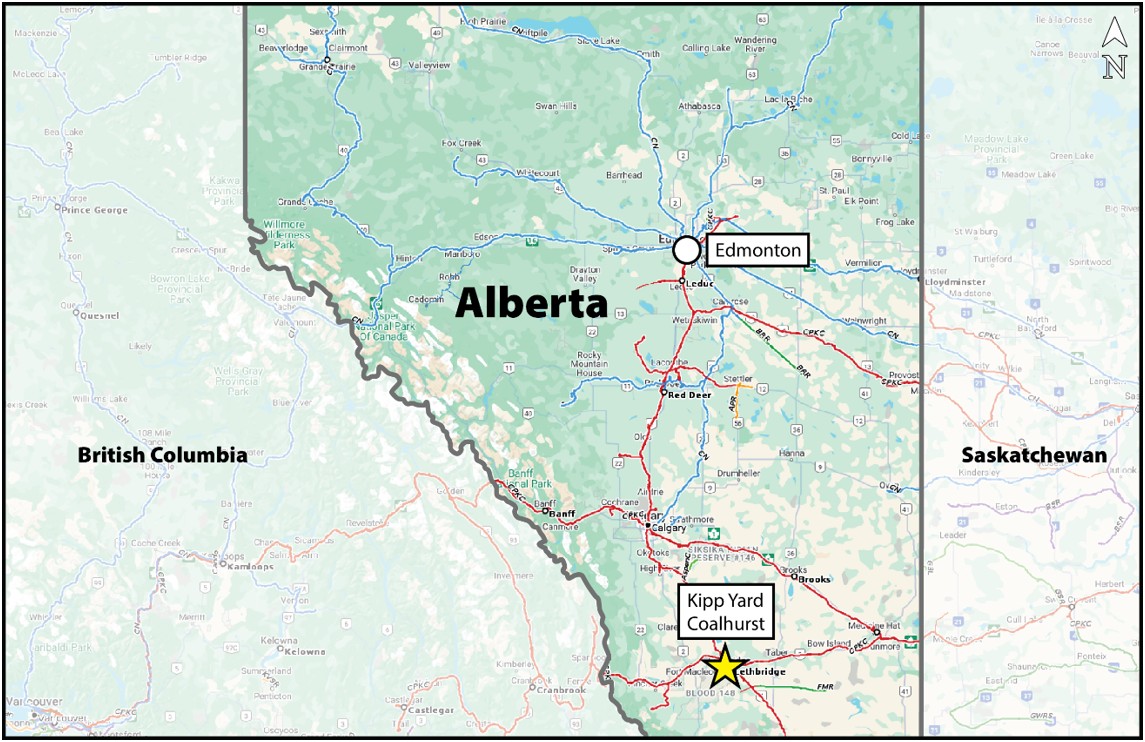
Assignment CK31-10 was operated using a remote control locomotive system (RCLS). The crew consisted of a yard foreman (foreman) and a yard helper (helper), who were later joined by a utility employee. There was a terminal trainmaster on duty supervising operations in the yard; however the crew was not actively supervised while working.
The assignment was to double overDoubling over refers to the practice of pulling cars from one track and backing them onto another track to connect with cars on that track. a cut of 66 cars, weighing 8551 tons and measuring 3830 feet, from track 5 to A trackKipp Yard’s A track runs from Mile 114.0 of the Taber Subdivision to Mile 11.0 of the Crowsnest Subdivision. The track is classified as non-main track. at the east end of the yard. This move would require the assignment to proceed on the east lead track past the A-track switch, then on the Taber Subdivision beyond the 51 Avenue public crossing until the last car was past the A-track switch. The assignment was then to be reversed into A track and coupled to 79 stationary cars, the first of which was at about the midway point in the track (Figure 2).
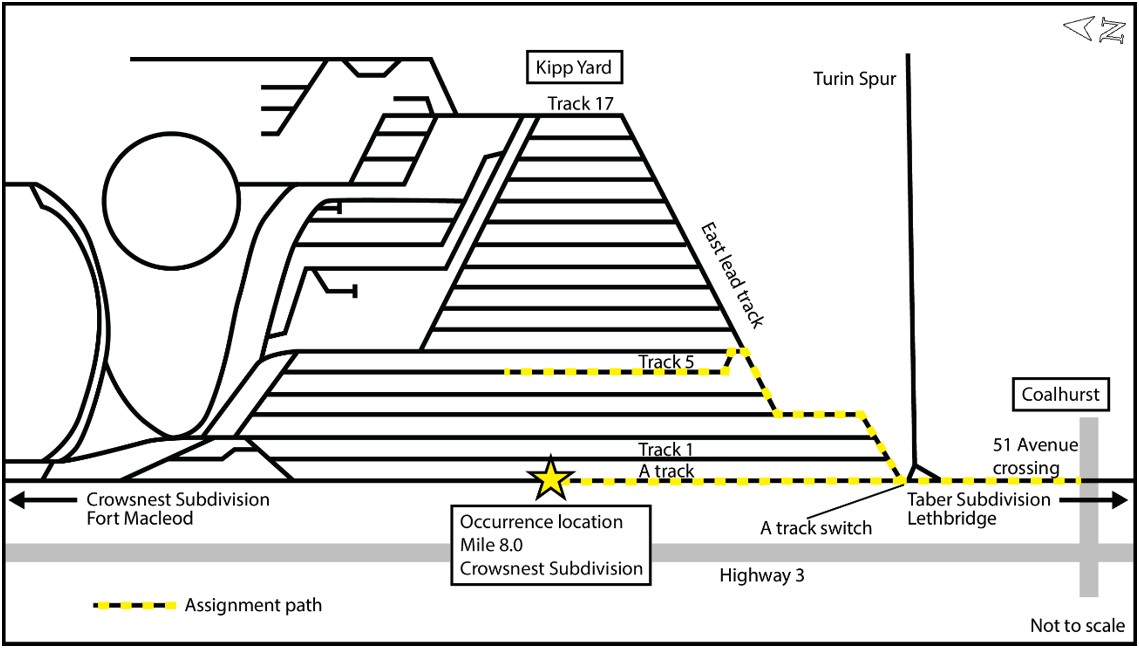
The foreman and the helper prepared the assignment for the intended switching move. The foreman coupled the air hoses between the locomotive and the next 8 cars, as required,When switching or handling equipment, a minimum number of cars […] must have air brakes cut in and verified operational, based on the number of operating locomotives and trailing tonnage (Canadian Pacific Railway Company, Rule Book for T&E Employees [28 October 2021], Rule 12.5: Switching with Air Brakes, p. 32). and tested the air brakes while the helper walked to the tail end of the cut of 66 cars and released the applied hand brakes. After the helper finished releasing the hand brakes, the utility employee, who had just joined him, drove him to the locomotive, where the foreman was working.
At this point, the 3 employees held a job briefing to discuss the next tasks of the double-over operation. They decided that the foreman and the helper would ride the locomotive and provide point protectionProviding point protection means ensuring that the track is clear and that the switches are correctly lined. for the forward move; the utility employee, for his part, would provide point protection for the reverse move and couple the 2 cuts of cars. For both the forward and reverse moves, the foreman would control the locomotive using his RCLS operator control unit (OCU). During the reverse move, the utility employee would use a portable 2-way radio to provide car counts to the foreman (i.e., indicate the maximum distance to travel, expressed in car lengths).
The employees proceeded as agreed and pulled the 66 cars out of track 5. After the last car went past the A-track switch, the utility employee returned the switch to the normal position and indicated to the foreman that he could begin the reverse move on A track. The utility employee provided an initial count of 50 cars (this indicated that A track was clear for a distance of 50 car lengths—about 2500 feet). The foreman acknowledged the car count.
The movement began reversing and the utility employee watched until it occupied the A-track switch. He then boarded the utility vehicle and provided another count of 50 cars, which the foreman acknowledged. He then began driving toward the location of the stationary cars to be coupled.
After the movement had covered about 1910 feet, the utility employee, while driving, provided a third count of 50 cars. The remaining distance to the stationary cars was about 3340 feet. In response, in anticipation of having to slow the train, the foreman selected the Coast function on the OCU (this function places the throttle in the Idle position and removes tractive effort).
When the utility employee arrived at the stationary cars, he realized that he had lost sight of the lead car of the movement and he reversed the utility vehicle eastward. During this time, he did not provide any progress report to the foreman.
When the utility employee regained sight of the movement, he resumed driving forward and provided the foreman a count of 30 cars. The foreman made a medium brake application.
Almost immediately after, the utility employee provided a warning to the foreman that the speed of the movement was too high and gave several car counts in quick succession (15 cars, 10 cars, 5 cars) that were then followed by an instruction to stop. The foreman responded to the quick series of instructions first by making a full service brake application, then by placing the OCU speed selector in the Stop position. However, the train did not stop in time to avert a collision. At about 0158, the assignment collided with the stationary cut of 79 cars at about 13 mph.
As a result of the collision, the 7 leading cars on the assignment derailed in a jackknife position, striking cars on an adjacent track (track 1) and causing 4 cars on this track to also derail (Figure 3).
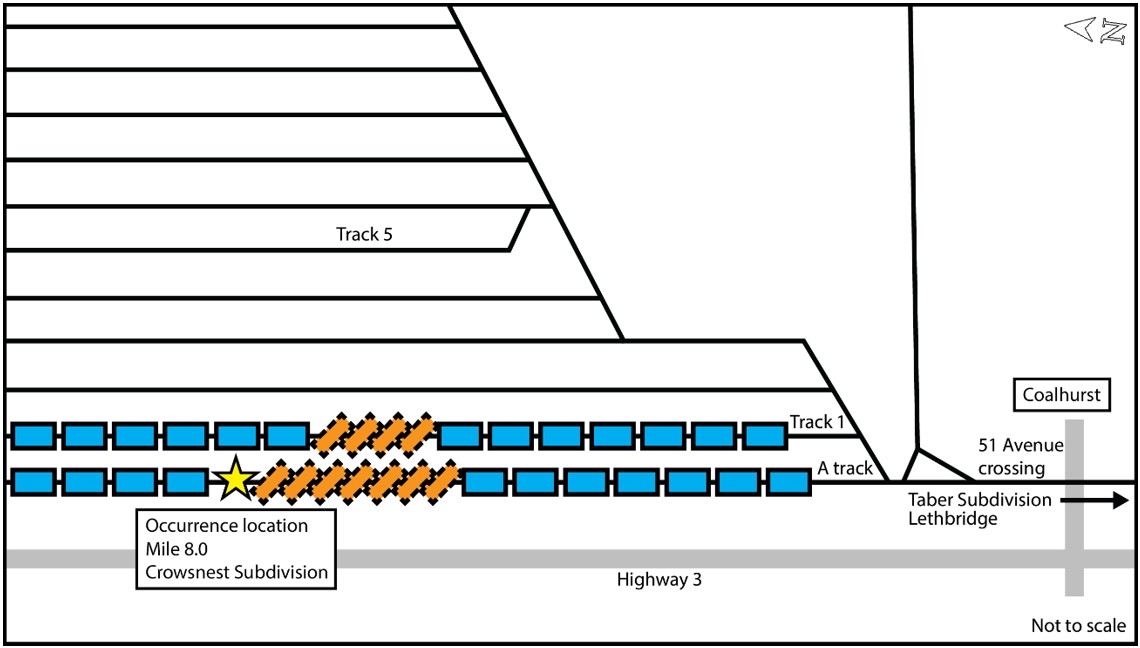
Of the 11 derailed cars, 7 were tank cars loaded with, or having last contained, dangerous goods. Figure 4 shows the first derailed car (tank car PROX 45540). None of the cars leaked product, and there were no injuries.
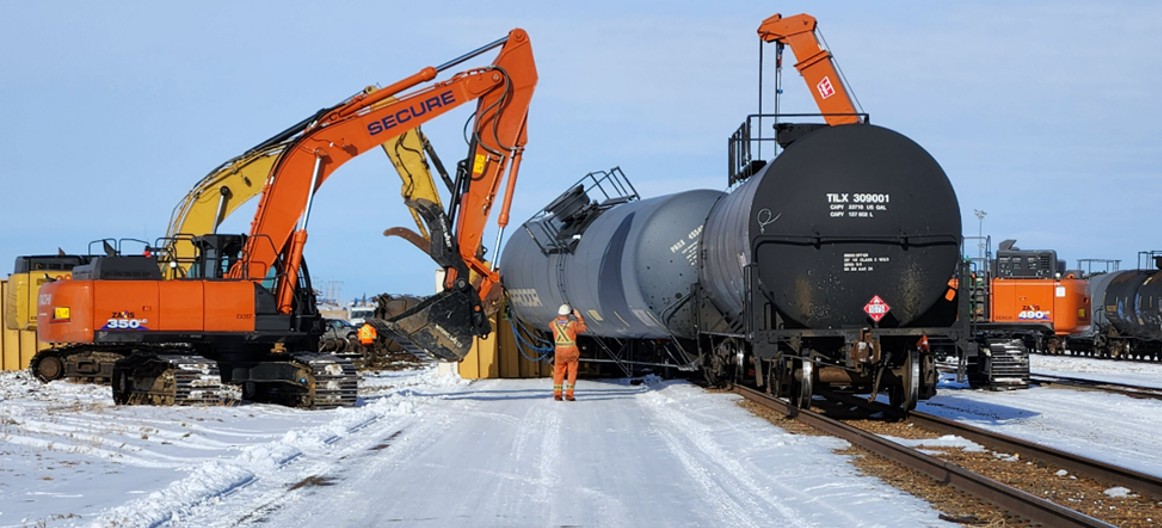
An emergency response contractor arrived on site at 0530 to provide damage assessments to all tank cars involved. A summary of the content and damage to the derailed tank cars is provided in Appendix A.
1.2 Kipp Yard
Kipp Yard is located near Coalhurst, a town about 7 miles west of Lethbridge. The yard is on the north side of the Taber and Crowsnest subdivisions.
The yard is also a crew-change location for freight trains running between Medicine Hat, Crowsnest Pass, and Calgary. There is generally 1 yard assignment per each 8-hour shift, to ensure 24-hour coverage.
Kipp Yard is non–main-track territory and the Canadian Rail Operating Rules (CROR) pertaining to movements on non–main track apply.
At night, lamp posts along the east lead track provide lighting. There are no lamp posts along the other tracks at the east end of the yard.
1.3 Weather information
At the time of the collision, the ambient temperature was about 0 °C. It was mostly cloudy and there was snow on the ground.
The sun had set at 1741 on 10 February 2024 and it was fully dark.
1.4 Crew information
All 3 employees were qualified for their positions and familiar with Kipp Yard.
According to the data collected during the investigation, the crew’s performance was not negatively affected by medical or physiological factors, including fatigue.
1.4.1 Yard foreman
The foreman began conductor training at CPKC in April 2023 and qualified in August 2023. In November 2023, he qualified as an RCLS operator.
At the time of this occurrence, the foreman had about 6 months’ experience as a conductor and about 4 months’ experience as an RCLS operator.
1.4.2 Yard helper
The helper began conductor training at CPKC in May 2023 and qualified in September 2023. He qualified as an RCLS operator a month later, in October.
At the time of this occurrence, the helper had about 5 months’ experience as a conductor and about 4 months’ experience as an RCLS operator.
1.4.3 Utility employee
The utility employee began conductor training at CPKC in January 2023. He qualified as a conductor and RCLS operator in June 2023. At the time of this occurrence, he had about 13 months’ experience.
In September 2023, the utility employee’s service was interrupted by injury and, on 19 January 2024, he went back to work in a utility positionCPKC’s modified return-to-work program provides an opportunity for qualified operations employees who are temporarily unable to perform their regular duties due to an injury or a medical condition to be placed in a different position. under the modified return-to-work program.Employees in a utility position transport other employees to assist with switching operations and can also perform other tasks, depending on restrictions determined by a medical practitioner. In this occurrence, the employee was authorized to perform his regular conductor duties, but had limitations with respect to the number of hours per shift. The date for returning to full-time conductor duty was scheduled for 16 February 2024.
On the day of the occurrence, he was on duty as a utility employee and was assigned to assist the occurrence crew.
1.5 Recorded information
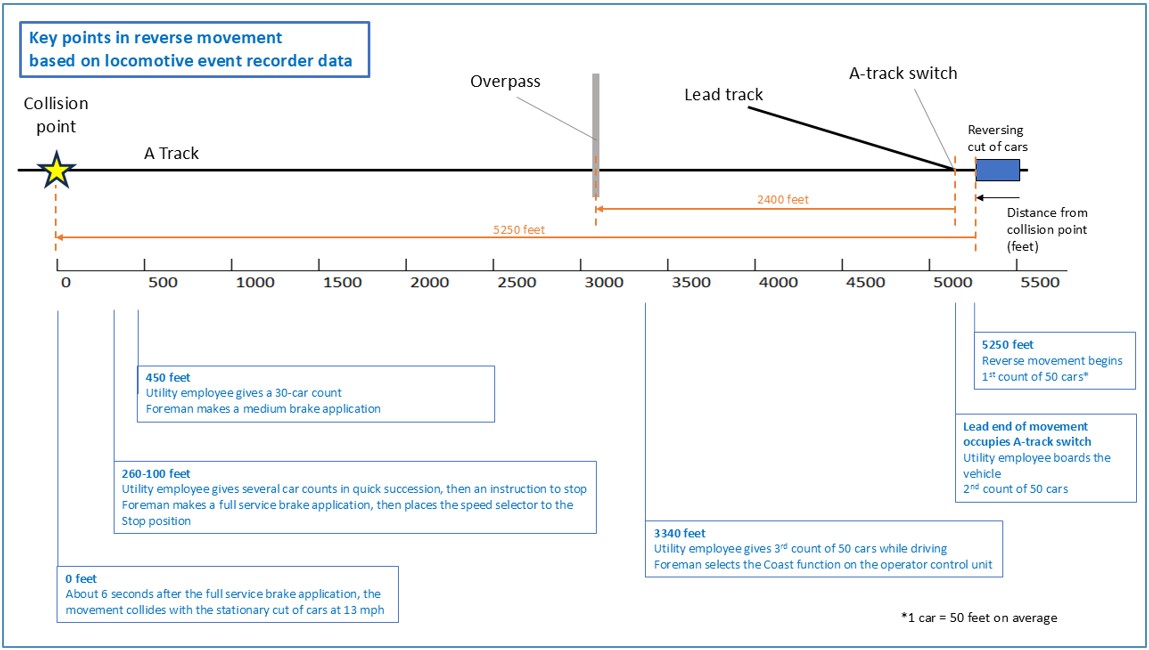
A review of the data from the locomotive event recorder revealed the following salient points (Figure 5):
- Between the 3rd count of 50 cars and the count of 30 cars, the movement reversed about 2890 feet.
- When the utility employee provided the count of 30 cars, the remaining distance to the cut of 79 stationary cars was about 450 feet (about 9 car lengths).
1.6 Remote control locomotive system at Kipp Yard
The RCLS makes it possible to operate a locomotive through remote control. At Kipp Yard, RCLS was implemented in 2021. During the initial implementation, issues with the new system were identified: a faulty GPS receiver, faulty wiring in a locomotive gold box (the onboard transmitter that communicates with the OCU), a few faulty OCUs, and intermittent issues with the west-end repeater.
These issues sometimes disrupted signal communication or resulted in a dropped signal between the controlling locomotive and the OCUs.
Although the issues were resolved, this information was not formally shared with train crews. The crews at Kipp Yard still believed that communication failures were likely to occur.
The investigation determined that communication loss between controlling locomotives and OCUs was rare at Kipp Yard.
1.7 Switching operations at the east end of Kipp Yard
The east lead track at Kipp Yard is a designated point protection zone (PPZ).A point protection zone (PPZ) is an area of track, with clearly defined limits, that is under the control of a single crew. A PPZ allows the operation of yard movements without having an employee riding the leading end of the movement, provided the leading end is the remote control locomotive. Many yards have implemented PPZs in order to facilitate the safety and productivity of remote control locomotive system (RCLS) operations. The PPZ begins at the track 17 switch and extends eastward along the lead track to A track and up to the 51 Avenue public crossing.
When the PPZ is active, a crew has authority to make eastward moves within the zone with the remote-controlled locomotive leading. To operate eastward beyond the end of the PPZ (i.e., past the 51 Avenue public crossing), the crew member protecting the point of the movement must be in the locomotive cab to physically override the automatic stop systemThe automatic stop system detects the approach of an RCLS locomotive to the crossing and automatically applies braking to prevent the movement from occupying and traversing the crossing. that protects the crossing.
When a remotely controlled movement changes direction, control of the movement may be transferred between crew members so that the operator with the best view of the leading car is responsible for the movement. Under CPKC’s General Operating Instructions, when coupling to equipment, the employee protecting the leading end of the movement must have the controlling OCU.Canadian Pacific Railway Company, General Operating Instructions (28 October 2021), Section 13, item 1.6: Coupling, p. 13-3. (This item in CPKC’s General Operating Instructions reflects the requirements of Rule 70 of the Canadian Rail Operating Rules.)
In this occurrence, given their concern that a communication failure with the RCLS system was likely to occur, the crew adapted the procedure for the reverse move such that both crew members with OCUs remained on the locomotive at the east end while the utility employee controlled the westward progress of the movement by issuing commands over his portable 2-way radio.
1.7.1 Rule governing operation on non–main track
When operating on non–main track such as railway yards, movements are governed by Rule 9.1 of CPKC’s Rule Book for T&E Employees, which states, in part, that movements using non–main track must:
- be prepared to stop within one-half the range of vision of equipment (or a track unit), and
- operate at a speed not exceeding 10 mph on tracks other than sidings.Rule 9.1 of CPKC’s Rule Book for T&E Employees reflects the requirements of Rule 105 of the Canadian Rail Operating Rules.
In this occurrence, when the utility employee lost sight of the movement, he was no longer in a position to determine whether the movement’s speed would allow it to stop within one-half the range of vision of equipment. The safe course of action in such a situation is to issue a command to stop until visual contact with the movement can be re-established.Safety and a willingness to obey the rules are of the first importance in the performance of duty. If in doubt, the safe course must be taken (Source: Canadian Pacific Railway Company, Rule Book for T&E Employees (28 October 2021), Section 2, Rule 2.2: While on Duty, p. 10). (Rule 2.2(a) of CPKC’s Rule Book for T&E Employees reflects the requirements under the General Notice of the Canadian Rail Operating Rules.) In this instance the movement had reached 13 mph, 3 mph above the 10 mph maximum.
1.7.2 Rule governing point protection when shoving equipment
When shoving equipment using RCLS on non–main track in a location other than an active PPZ, Rule 12.3 of CPKC’s Rule Book for T&E Employees applies. This rule states, in part:
12.3 SHOVING EQUIPMENT
(a) On non-main track, when equipment is shoved by an engine or is headed by an unmanned remotely controlled engine:
- unless the portion of track to be used is known to be clear, a crew member must be on the leading piece of equipment or on the ground, in a position to observe the track to be used and to give signals or instructions necessary to control the move. Employees are prohibited from engaging in unrelated tasks while providing shove protection, and from providing shove protection from within a vehicle;
[…]
(b) In paragraph (a), “the portion of track to be used is known to be clear” only when a qualified employee:
- can observe the portion of track to be used and has radio contact with the locomotive engineer; and
- sees the portion of track to be used as being clear and remaining clear of:
- equipment;
- a red or blue signal between the rails;
- track units; and
- derails and switches not properly lined for the movement.
- sees the portion of track to be used as having sufficient room to contain equipment being shoved.
[…]Canadian Pacific Railway Company, Rule Book for T&E Employees, 28 October 2021, Section 12, Rule 12.3: Shoving Equipment, p. 31. (Rule 12.3 of CPKC’s Rule Book for T&E Employees reflects the requirements of Rule 115 of the Canadian Rail Operating Rules.)
Given the nighttime darkness, the utility employee could not see the entire portion of track to be used for the reverse move and therefore could not have known that it was clear. Consequently, to comply with the rule, the utility employee was required to either:
- place himself on the leading car of the movement, or
- drive to the location of the coupling or to a location where the lead car of the movement was visible in the darkness and issue radio commands from a position on the ground.
The week before the occurrence, the superintendent had discussed this rule with the utility employee, emphasizing the requirement to provide point protection on the ground or on the leading end of the movement and not from a vehicle.
However, despite being aware of the rule, the utility employee monitored the progress of the movement and issued radio commands while driving the utility vehicle.
1.7.3 Rule governing the use of radio when switching
When using a radio to perform switching operations, Rule 12.4 of CPKC’s Rule Book for T&E Employees applies. This rule states, in part:
12.4 SWITCHING BY RADIO
When radio is used to control switching, the following are required:
[…]
(b) when car lengths are used to communicate distance, unless otherwise arranged, the distance referred to is 50 feet per car length;
(c) when the movement has travelled one half the distance received by the last instruction and no further communication is received, the movement must stop;
[…]
(e) doubt as to the meaning of an instruction or for whom it is intended must be regarded as a stop signal.Ibid., Section 12, Rule 12.4: Switching by Radio, p. 31. (Rule 12.4 of CPKC’s Rule Book for T&E Employees reflects the requirements of Rule 123.2 of the Canadian Rail Operating Rules).
In yard operations, distances when switching are usually expressed in car lengths. Accurately assessing distances using this method takes practice. OCUs do not display to operators the distance travelled. Consequently, it takes experience to comply with the requirement to stop when the movement has travelled one half the distance communicated by the last instruction and no further communication is received.
In this occurrence, the utility employee gave the foreman 3 instructions to back up a distance of 50 cars. After each instruction, he was expected to communicate a progress update before the movement travelled half that distance (i.e., 1250 feet). Otherwise, the foreman was required to stop the movement. After the 3rd car count, the movement travelled about 2890 feet before the utility employee communicated another instruction. The foreman took no action to slow or stop the train during this time.
1.8 Adaptations
Adaptations are decisions to deviate from formalized, written rules, procedures or other written directions. They are intentionally performed, with the individual being aware that such actions are contrary to the written directions. Adaptations are often a result of not fully understanding the purpose of the written directions, not anticipating the potential consequences of deviating from them, or from perceiving that the work can be accomplished more efficiently through an adaptation.
In years past, system safety science used to define adaptations as “violations” or “transgressions,” implying that if people just followed the written directions, things would be safe.
1.8.1 Limitations of written directions
In complex systems, written directions such as rules and procedures can help guide the behaviour of people toward safe practices.N. G. Leveson, Engineering a Safer World (The MIT Press, 2011), p. 10. However, it is impossible to develop written directions that consistently capture the variability and nuance that workers face on a day-to-day basis. Scientific literature indicates that, across many different industries, written directions are routinely adapted by workers for multiple reasons.S. Dekker, “Failure to adapt or adaptations that fail: contrasting models on procedures and safety”, Applied Ergonomics, Vol. 34, Issue 3 (2003), pp. 233-238.
For example, a procedure may be developed without input from those who actually perform the task, resulting in a procedure that does not match the reality of how the task needs to be done. Workers may be faced with competing pressures, such as the requirement to complete certain tasks within an allotted time period or organizational demands for maximum efficiency. Often, these pressures come with an organizational reward for efficiency or penalty for failing to meet expectations, which incentivizes workers to adapt written directions.
1.8.2 Defences against unsafe adaptations
Adaptations can be safe and effective in some situations, however, adaptations can also increase risk when they undermine the safety controls that are established by written directions.
To prevent unsafe adaptations from taking place, it is common for companies to implement system defences focused around enforcing compliance to written directions.
Under the Railway Safety Management System Regulations, 2015, Canadian railways are required to have processes to identify hazards, assess risks, and implement and maintain remedial actions. Safety management systems are structured to implement multiple complementary layers of defences to address the risks associated with unsafe adaptations, including the following:
- ongoing training and competency assessments, to ensure written directions are fully understood and correctly applied;
- supervision and coaching, to provide real-time guidance, reinforce safe behaviours, and intervene when unsafe adaptations are identified;
- risk assessments and job safety analyses, to identify hazards and implement controls; and
- reporting and review mechanisms, to report unsafe conditions and adaptations.
Such defences are critical. However, modern safety science states it is also paramount for organizations to recognize that adaptations will occur.Ibid. To ensure safe outcomes when they do, they must employ multiple layers of defence beyond just enforcing compliance. Systems that rely exclusively on compliance with written directions do not have other safeguards in place to compensate for adaptations. When adaptations occur, these types of systems are prone to failure.
1.8.3 Building resiliency to adaptations
If organizations recognize that adaptations will still occur regardless of the number of processes in place to prevent them, then the challenge for organizations is to find other defences so that, when adaptations do occur, their systems do not fail catastrophically. The current best practice in safety science indicates that organizations can build this resiliency by performing the following:
- collecting input from front-line workers frequently to ensure written directions adequately reflect reality, and continue to reflect reality;
- looking at their operations to identify any unintended organizational pressures that force unwanted adaptation; and
- finding engineering or technical solutions that either reduce the probability of an adaptation occurring, or reduce the consequences when one occurs.
1.8.4 Crew experience in decision making leading to an adaptation
Crew experience plays an important role both in individual job performance and in team performance. It can also help crews make an informed decision when considering an adaptation and recover from decisions that result in unsafe adaptations.
As outlined in the United Kingdom’s Rail Safety and Standards Board Good Practice Guide on Competence Development,United Kingdom Rail Safety and Standards Board, Document RS/100, Good Practice Guide on Competence Development, Issue 1 (March 2013). initial qualification provides assurance of competence in routine tasks; however, the ability to cope with more complex situations that require judgment is developed through experience, preferably obtained under supervision.
For individual crew members, experience gives a better mental model of system performance. As crew members gain task-specific experience, they learn on which elements to focus their attention.C. D. Wickens, W.S. Helton, J.G. Hollands, and S. Banbury, Engineering Psychology and Human Performance, 5th edition (Routledge, 2022), p. 373. Additionally, experience allows crew members to better understand how these elements relate to the task and to better anticipate future system states. When crew members encounter variability between the task as written and the task as it exists, their deeper understanding of the situation allows them to adapt,Ibid., p. 283. ensuring that the task is still completed safely and effectively. This improved capability only comes through training and exposure to performing the same task under widely varying conditions.
In a team context, experience helps crew members determine the level of risk of a planned task. Additionally, experience helps crews quickly identify the correct action to take should a task begin to stray into unsafe conditions. Thus, having more experienced crew members working with less experienced ones achieves 2 goals: it allows for knowledge to be passed (facilitating on-the-job training) and it provides an administrative layer of defence to prevent adverse outcomes from adaptations.
1.9 Situational awareness and mental models
Situational awareness is the perception of the elements in the environment, the comprehension of their meaning, and the projection of their status in the future.M. R. Endsley, “Design and Evaluation for Situation Awareness Enhancement” in the Proceedings of the Human Factors Society: 32nd Annual Meeting (Santa Monica, CA: 1988), pp. 97-101. In a dynamic environment, situational awareness requires a person to continuously extract information from the environment, integrate this information with relevant internal knowledge to create a coherent mental model of the current situation, and use this model to anticipate future events. Situational awareness can be negatively affected if critical elements are not detected, their importance is not perceived, or their consequences are not anticipated. When this occurs, a person’s mental model of the situation will diverge from reality.
A mental model is a personal, internal representation of an external reality.N. A. Jones, H. Ross, T. Lynam, et al. “Mental Models: An Interdisciplinary Synthesis of Theory and Methods”, Journal of Ecology and Society. Vol 16, No. 1 (2011), p. 46. It is important to note that human perception of the external environment is driven by attention, which in turn is affected by what is considered the most important aspects of a task based on the built-up mental model. Mental models are resistant to change, and new, convincing information must be perceived and understood to initiate change in a mental model. While a person can never lose situational awareness, they can have an inaccurate mental model. Inaccurate mental models are the result of failures in any of the 3 steps that make up situational awareness: perceiving environmental elements, understanding the significance of what is perceived, and understanding the future state of the situation. When any of these do not occur accurately, a person’s performance or decision making may no longer be optimal for the situation.
1.10 Attention and human performance
Attention is a process in which the cognitive resources of a person are concentrated on certain sources of information in reality or held within a person’s memory. A person’s attention is a limited resource, meaning that only some things can be attended to.M. R. Endsley, “Toward a Theory of Situation Awareness in Dynamic Systems,” Human Factors Vol. 37, No. 1, 1995, pp. 32-64.Where attention is placed during a task is based on what the person considers the most critical information required to complete the task. While it is possible to have a person’s attention captured by something, most of the time people will direct their attention to those things that are relevant to completing a task.Ibid. Because of this, other environmental elements may not be processed; they will either simply not be looked for, or if sensed, their existence may be “shed” from the processing stream (not perceived) to save limited cognitive resources for what is considered important. It is also worth noting that people can place their attention on only one information stream at a time. When more than one information stream must be attended to, people will move their attention and associated cognitive resources rapidly from one stream to another. This introduces the possibility of missed information while attention is focused elsewhere. In addition, the state of a task is held in short-term memory while attention is shifted to focus on another information source and retrieved when attention is returned. This process therefore can introduce errors that degrade a person’s mental model and negatively affect their performance.C. D. Wickens, W. S. Helton, J. G. Hollands, and S. Banbury, Engineering Psychology and Human Performance, 5th edition (Routledge, 2022), chapter 4, pp. 70-115.
For yard crews, there are often situations where different tasks or sub-tasks require the ability to quickly switch attention between important information sources such as controlling the speed of a movement, monitoring the distance travelled, and carrying out radio communications. Being able to do so quickly without experiencing performance decrements in any task is only possible through training and experience to ensure crew members have a strong understanding and mental model of the situation they are working in.
1.11 Pairing of inexperienced conductors on yard assignments
In the railway industry, conductors are generally unionized positions that are governed by collective agreements between the employer and the union. In most cases, local yard assignments are posted for bidding. After the employees submit their bids, the positions are awarded based on seniority in accordance with the collective agreement.
Some of the posted positions are favoured owing to the rate of pay, days off, and hours of work. Typically, the evening shifts and the night shifts are considered the least desirable, and yard positions in particular are normally regarded as the least desirable because the pay rates for these positions are the lowest. If no bids are received for a specific position, the position is awarded to the employee with the least seniority.
It is therefore not unusual for the employees with the least seniority, who often are also the least experienced, to be working together in yards, particularly during the evening and night shifts. Collective agreements can be amended to require a balanced assignment system—such as pairing junior employees with senior ones or rotating seniority-based coverage—so that experience and staffing are more evenly distributed across all shifts and yard positions.
In this occurrence, the helper and the foreman had about 5 and 6 months of experience respectively, and the utility employee had about 1 year.
The pairing of inexperienced employees has previously been raised as an issue of concern for the railway industry by the U.S. Federal Railroad Administration (FRA) and by the TSB.
In March 2006, the FRA published its Final Report: Safety of Remote Control Locomotive (RCL) Operations.Federal Railroad Administration, Final Report: Safety of Remote Control Locomotive (RCL) Operations (2006), p. 26. An appendix to the report summarized findings from several supporting research studies conducted on behalf of the FRA, including a human-factors root cause analysis of RCLS-related yard accidents and incidents. That study identified inadequate staffing and the pairing of inexperienced crew members as a potential safety issue, noting that while it was observed in a limited number of cases, industry-wide turnover and training demands could increase its relevance over time, particularly when combined with insufficient training. The supporting research also documented recommended practices identified by experienced RCLS operators; one such practice was that, before becoming an RCLS operator, an employee should have a minimum amount of operating experience as a switchman (conductor) or locomotive engineer.
Since 2007, the TSB has completed 6 investigations, including this one, involving inexperienced crew members working together on yard assignments (Appendix B). The TSB determined the following:
- The relative inexperience of the crew members contributed to these occurrences through increased likelihood of errors and insufficient knowledge to make effective decisions with respect to planning and train handling.
- Junior employees who are paired for yard assignments cannot coach or mentor each other, making it more difficult to develop the effective judgment needed for train handling.
- If the experience of operating employees is not considered when pairing operating crews, there is an increased risk for operational errors and accidents to occur.
1.11.1 Previous Board safety concern
In its investigation into a fatal yard accident on 22 December 2017 at the Canadian National Railway Company Melville Yard in Melville, Saskatchewan, the TSB determined that the RCLS assignment crew’s inexperience played a role in the accident. Given the ongoing employee turnover in the railway industry and the potential adverse outcomes when inexperienced RCLS operators are paired working in yards, the Board issued the following safety concern:
The Board is concerned that, without additional mitigation, inexperienced RCLS operators will continue to be paired together in yards with a commensurate risk of ongoing adverse outcomes.TSB Rail transportation safety investigation report R17W0267.
2.0 Analysis
The analysis will focus on rules and instructions when shoving equipment in a rail yard, adaptations in this occurrence, and the need for multiple layers of defence beyond administrative compliance to written directions. Crew experience will also be discussed.
2.1 The occurrence
The crew of remote control locomotive system (RCLS) yard assignment CK31-10 of the Canadian Pacific Railway Company, doing business as CPKC, was performing a double-over operation at Kipp Yard, which involved reversing a cut of 66 cars to be coupled to a cut of 79 stationary cars. The crew consisted of a yard foreman (foreman) and a yard helper (helper), assisted by a utility employee.
When the crew was ready for the reverse move, the utility employee—who was providing point protection from a vehicle—radioed an initial car count to the foreman—who was operating the locomotive using an RCLS operator control unit (OCU) from the locomotive—to back up 50 car lengths (about 2500 feet). After the utility employee saw the movement heading westward on A track, he boarded a utility vehicle and gave another count of 50 cars. He then began driving westward ahead of the movement toward the stationary cut of cars where the coupling would be made. While driving, he gave another instruction to the foreman to continue backing up for 50 more car lengths.
When the utility employee arrived at the stationary cars, he realized that he had lost sight of the lead car of his movement. He immediately reversed the utility vehicle eastward. After he regained visual contact with the lead car of the movement, he resumed driving forward and provided the foreman with another car count, this time of 30 cars. A review of locomotive event recorder data indicates that, at this point, there was a distance of about 450 feet (9 cars) left between the lead car of the movement and the stationary cut of cars.
The utility employee soon realized that he had inaccurately assessed the remaining distance and that his movement was closing in on the stationary cars. At this point, he issued a rapid succession of smaller car counts and indicated to the foreman that the movement was approaching the coupling too fast. The foreman applied the brakes and placed the OCU speed selector to the Stop position, but the movement was unable to stop. Contact with the stationary cut of cars was made at about 13 mph. As a result of the collision, the 7 leading cars on the assignment derailed, striking cars on an adjacent track and causing 4 of them to also derail.
Finding as to causes and contributing factors
During a double-over switching operation at Kipp Yard in Coalhurst, Alberta, a cut of 66 cars was being reversed to be coupled to a cut of 79 stationary cars; due to an inaccurate estimate of the remaining distance to the coupling, the reverse movement collided with the stationary cars at about 13 mph, resulting in the derailment of 11 cars.
2.2 Adaptations
During the reverse move, the crew adapted the following written instructions:
- The crew had 2 OCUs, one was held by the foreman, who was using it to control the movement, and the other was held by the helper; both employees were in the lead locomotive. However, CPKC’s General Operating Instructions state that, when coupling to equipment, the employee providing point protection (the utility employee in this occurrence) must have the controlling OCU.
- The utility employee provided point protection while driving, which is not permitted. Rule 12.3 of CPKC’s Rule Book for T&E Employees states, in part, that employees are prohibited from providing point protection from within a vehicle.
- Under Rule 9.1 of CPKC’s Rule Book for T&E Employees, movements operating on non-main track must be prepared to stop within one-half the range of vision of equipment and, on tracks other than sidings, operate at a speed not exceeding 10 mph. In this occurrence, when the utility employee lost sight of the movement, he was no longer in a position to determine whether the movement’s speed remained within these parameters, and hence he was no longer meeting the requirements of this rule. In addition, the movement had reached 13 mph (3 mph above the 10 mph maximum). The safe course of action in such a situation is to issue a command to stop until visual contact with the movement can be re-established.
- According to Rule 12.4 of CPKC’s Rule Book for T&E Employees, if a movement travels half the distance received by the last instruction and no further communication is received, the movement must stop. After the utility employee provided the 3rd car count of 50 cars (2500 feet), the foreman was required to stop if he did not receive further communication after covering half that distance (1250 feet). However, the movement covered about 2890 feet before the utility employee communicated a new car count, and no action was taken to stop the train.
In this occurrence, the crew’s belief that they might lose communication between the controlling locomotive and the OCUs was a motivating factor in their decision to adapt the General Operating Instructions and station both OCU operators in the cab of the locomotive. The utility employee’s decision to provide point protection while driving and not to stop the movement when sight was lost were also adaptations, although the reasoning behind these decisions was not determined by the investigation.
Finding as to causes and contributing factors
The crew’s approach to the reverse move included numerous adaptations to written directions, reducing the safety margins that these directions were meant to provide.
Organizations can reduce the likelihood of unsafe adaptations through training, compliance monitoring, and looking at their operations to identify any unintended organizational pressures that force unwanted adaptations. North American railways have several such defences, aimed at controlling the risks associated with unsafe adaptations through prevention. Examples include the following:
- ongoing training and competency assessments to ensure written direction is fully understood and correctly applied, and
- supervision and coaching, to provide real-time guidance, reinforce safe behaviours, and intervene when unsafe adaptations are identified.
These defences are an important layer in a safety system. However, it is also paramount for organizations to recognize that adaptations will occur. To ensure safe outcomes when they do, they must employ multiple layers of defence beyond just enforcing compliance with written directions.
Additional layers of defence can include non-rule-based administrative controls to improve recognition and monitoring of operational risks, such as increasing or modifying training to include discussions on how to improve risk recognition in ambiguous situations, or balancing experience between crew members. Other ways to improve safety include the addition of physical or technological defences, such as improving lighting on a track at night, or providing a more effective means for OCU operators to measure the distance a train has travelled.
In this occurrence, the defences in place were centred on preventing unsafe adaptations. When the adaptions occurred despite these defences, there were no other safeguards to prevent the accident or reduce its consequences.
Finding as to risk
When defences against unsafe adaptations of written directions are not supplemented by additional layers that do not rely on compliance enforcement, there is an increased risk that adaptations resulting in reduced safety margins will lead to an accident.
2.3 Divided attention while assessing distances
When the utility employee provided an incorrect count of 30 cars, he was performing multiple tasks at the same time:
- ensuring that the track was clear (i.e., that the track was free of obstructions and that there was sufficient room to contain the equipment being shoved),
- communicating with the foreman over his portable 2-way radio, and
- attending to the position and speed of the utility vehicle while driving.
This combination of tasks required that he rapidly switch his attention between multiple information sources, correctly perceive the information being provided, understand the information in relation to the tasks, integrate this information into his predictive mental model, and store the status of each task in short-term memory while attending to another task. This would have caused a high demand on his cognitive resources.
Further, it was nighttime and there were no lamp posts along A track. Reduced lighting impairs depth perception at night, affecting the ability to judge distances accurately.
The utility employee’s high cognitive load, combined with the difficulty associated with nighttime distance estimation, likely severely degraded his mental model of the location of the moving cut of cars in relation to the stationary cut of cars.
Finding as to causes and contributing factors
The utility employee was driving in a vehicle at night while providing switching instructions over a portable 2-way radio. This high cognitive load, combined with a degraded ability to estimate distance due to the darkness, reduced his ability to provide accurate distance estimation instructions to the foreman.
2.4 Crew inexperience
In the railway industry, it is not unusual for the least experienced employees to be working together in yards, particularly during the evening and night shifts.
The pairing of inexperienced employees has previously been raised as an issue of concern for the railway industry by the U.S. Federal Railroad Administration (FRA) and by the TSB.
In March 2006, the FRA published its Final Report: Safety of Remote Control Locomotive (RCL) Operations.Federal Railroad Administration, Final Report: Safety of Remote Control Locomotive (RCL) Operations (2006), p. 26. An appendix summarized findings from several FRA-sponsored research studies, including a human-factors root cause analysis of RCLS-related yard accidents and incidents. That analysis identified the pairing of inexperienced crew members as a potential safety issue, noting that although observed in few cases, industry-wide turnover and training demands could increase its significance over time, particularly when combined with insufficient training.
Since 2007, the TSB has completed 6 investigations, including this one, involving inexperienced crew members working together on yard assignments. The TSB determined that the experience level of the crew members contributed to these occurrences through increased likelihood of errors and insufficient knowledge to make effective decisions with respect to planning and train handling. Following an investigation into a fatal yard accident, it was found that, if the experience of operating employees is not considered when pairing operating crews, there is an increased risk for operational errors and accidents to occur. As a result, the Board issued a safety concern, stating that, without additional mitigation, inexperienced RCLS operators will continue to be paired in yards with a commensurate risk of ongoing adverse outcomes.TSB Rail transportation safety investigation report R17W0267.
Within a team context, experience plays a role in determining the level of risk of a planned task, assessing whether an adaptation is warranted and safe, and identifying the correct action to take should a task begin to stray into unsafe conditions.
In this occurrence, the helper and the foreman had about 5 and 6 months of experience respectively, and the utility employee had about 1 year. While they were all trained and qualified for their roles, they likely did not have the necessary experience to recognize the increased risk associated with their adaptations of the written instructions until after it was too late to avoid a collision.
Finding as to risk
When paired in a crew, inexperienced crew members may not have sufficient experience to ensure that the risks of certain actions and decisions are fully understood.
3.0 Findings
3.1 Findings as to causes and contributing factors
These are the factors that were found to have caused or contributed to the occurrence.
- During a double-over switching operation at Kipp Yard in Coalhurst, Alberta, a cut of 66 cars was being reversed to be coupled to a cut of 79 stationary cars; due to an inaccurate estimate of the remaining distance to the coupling, the reverse movement collided with the stationary cars at about 13 mph, resulting in the derailment of 11 cars.
- The crew’s approach to the reverse move included numerous adaptations to written directions, reducing the safety margins that these directions were meant to provide.
- The utility employee was driving in a vehicle at night while providing switching instructions over a portable 2-way radio. This high cognitive load, combined with a degraded ability to estimate distance due to the darkness, reduced his ability to provide accurate distance estimation instructions to the foreman.
3.2 Findings as to risk
These are the factors in the occurrence that were found to pose a risk to the transportation system. These factors may or may not have been causal or contributing to the occurrence but could pose a risk in the future.
- When defences against unsafe adaptations of written directions are not supplemented by additional layers that do not rely on compliance enforcement, there is an increased risk that adaptations resulting in reduced safety margins will lead to an accident.
- When inexperienced crew members are paired, there may not be sufficient experience within the crew to ensure that the risks of certain actions and decisions are fully understood.
4.0 Safety action
4.1 Safety action taken
4.1.1 Transport Canada
On 01 April 2024, Transport Canada conducted an inspection at Kipp Yard and issued a letter of non-compliance to CPKC on 22 April for CROR 115(a), CROR 106, and General Rules A(i) and (vi).
In response, CPKC conducted a formal investigation, at which time, crew members were coached on the rules. The company also conducted job briefings and a safety blitz to educate local crews on the occurrence.
Following the response and corrective measures taken, TC issued a letter acknowledging sufficient action taken on 13 May 2024.
4.1.2 CPKC
On 11 March 2024, CPKC issued an operating bulletin to train and engine employees working in Kipp Yard stating that all crew members shoving equipment on non-main track must have a qualified employee riding the leading piece of equipment while controlling the movement.
This report concludes the Transportation Safety Board of Canada’s investigation into this occurrence. The Board authorized the release of this report on 04 March 2026. It was officially released on 11 March 2026.
Appendices
Appendix A–Tank car damage assessment
Table A1 summarizes the content and damages to the 7 derailed tank cars.
Tank car | Content | Damages |
|---|---|---|
TILX 150622 | Last contained molten sulfur (UN2448) | Critical damage |
TILX 150666 | Last contained molten sulfur | Critical damage |
NDYX 113577 | Last contained molten sulfur | Minor damage; the car was re-railed |
PROX 60455 | Last contained molten sulfur | Minor damage; the car was re-railed |
UTLX 672352 | Loaded with asphalt (UN1999) | Damage to the 2 derailed A-end wheel sets and the tank heat shield; load transfer was required |
TILX 253474 | Last contained combustible liquid, not otherwise specified (UN1993) | Critical damage |
PROX 45540 | Last contained liquid hydrocarbons, not otherwise specified (UN3295) | Critical damage to the B-end |
Appendix B–Other TSB investigations involving inexperienced crew members working together on yard assignments
R18H0039 – On 14 April 2018, a crew of the Canadian Pacific Railway Company (CP)—a foreman and a helper (both of whom had about 7 months of experience as qualified conductors)—were performing switching operations at CPKC’s Toronto Yard in Toronto, Ontario, using a remote control locomotive system (RCLS). The foreman was operating yard assignment T16-13 when it began to roll uncontrolled eastward on the Staines connecting track toward Signal 1952B of the Belleville Subdivision main track, which displayed a Stop indication. The assignment ran through the main track switch, entered the main track, and rolled uncontrolled for an additional 3 miles before coming to a stop near Mile 192.5 of the Belleville Subdivision. There was no derailment or collision and there were no injuries.
After coupling the locomotives onto the freight cars, the foreman did not connect the air hoses between the locomotives and the lead car because the air hose on the lead car was not properly aligned. The foreman was not aware of the risks associated with switching on a descending grade without air brakes connected to the freight cars. The crew therefore proceeded to switch the assignment without any functioning air brakes. With only the locomotive independent brakes available, there was not sufficient braking power to slow or stop the movement when the foreman placed the speed selector to the Stop position and, as a result, the assignment began to roll uncontrolled.
The investigation found the following:
- Despite his training and experience, the foreman lacked the knowledge to safely handle long, heavy cuts of cars on a descending grade at the east end of the yard when accessing the Staines connecting track.
- If experience with the task involved is not specifically considered when the roles are assigned to operating crew members, inexperienced operating employees can be scheduled to work together or can be put in charge of unfamiliar tasks, increasing the risk of error.
R17W0267 – On 22 December 2017, at about 1800 Central Standard Time during hours of darkness, a Canadian National Railway Company (CN) foreman and a helper were performing switching operations at CN’s Melville Yard in Melville, Saskatchewan. The foreman was operating extra yard assignment Y1XS-01 using an RCLS when the foreman became pinned between the assignment and the lead car of an uncontrolled movement while applying a hand brake. The foreman received fatal injuries. There was no derailment and no dangerous goods were involved.
The movement consisted of 3 open-top hopper cars loaded with ballast. The foreman had kicked these cars up an ascending grade toward a connecting track, but at too slow a speed for them to reach it. Without sufficient speed, the cars stalled on the grade and began to roll back uncontrolled. The foreman ran to and boarded the lead car and applied a hand brake, but the braking efficiency of the hand brake was compromised. As a result, the uncontrolled movement did not stop or slow down, reducing the opportunity and time available for the foreman to get out of harm’s way.
The investigation found the following:
- The foreman’s limited experience in operating a RCLS during switching operations likely contributed to the development of an inadequate work plan and the attempt to kick the 3 cars at too slow a speed in an area of known ascending grade.
- The crew members’ reserve, inexperience in working together, and relative inexperience in their roles on the day of the accident likely contributed to their infrequent communication during their shift.
R16T0111 – On 17 June 2016, at about 2335 Eastern Daylight Time, the CN RCLS 2100 west industrial yard assignment was performing switching operations at the south end of CN’s MacMillan Yard in Vaughan, Ontario. The assignment was in the process of pulling 72 loaded cars and 2 empty cars southward from the yard onto the York 3 main track to clear the switch at the south end of the Halton outbound track to gain access to the west industrial lead track (W100) switch. While attempting to stop in preparation for reversing into track W100 to continue switching for customers, the yard helper lost control of the assignment. The assignment rolled uncontrolled for about 3 miles, reaching speeds of up to 30 mph before stopping on its own at about Mile 21.1 of the York Subdivision. There were no injuries. There was no release of dangerous goods and no derailment.
The investigation found that:
- The assignment crew did not have sufficient operational experience to safely perform the tasks of the west industrial yard assignment at MacMillan Yard.
- While the assignment crew was aware of the assignment’s length and weight, they lacked the knowledge to fully understand the effect that the assignment’s length and weight had on train handling while descending a 0.70% grade with only locomotive independent brakes available to control the assignment.
R16W0074 – On 27 March 2016, while switching in Sutherland Yard in Saskatoon, Saskatchewan, CPKK 2300 RCLS training yard assignment was shoving a cut of cars into track F6. As the assignment was brought to a stop, empty covered hopper car EFCX 604991 uncoupled from the train, unnoticed by the crew. The car rolled uncontrolled through the yard and onto the main track within cautionary limits of the Sutherland Subdivision. The car travelled about 1 mile and over 2 public automated crossings before coming to a rest on its own. There were no injuries and no derailment. No dangerous goods were involved.
The investigation found that:
- The combination of learning the additional tasks associated with RCLS operations and managing the point protection zone, with the relative inexperience of the yard crew, contributed to the slip of attention relating to the coupler.
- If the experience of operating employees is not considered when pairing operating crews, there is an increased risk for operational errors and accidents to occur.
R07V0213 – On 04 August 2007, a CN RCLS assignment was pulling 53 loaded cars from track PA02 at the north end of Prince George South Yard, in Prince George, British Columbia. While attempting to clear the switch to access the classification tracks, the movement ran away northbound, striking another CN freight train which was entering the north end of the yard. The RCLS assignment struck a tank car loaded with gasoline, derailing it as well as the next tank car ahead, also loaded with gasoline. The tank cars released product and a fire ensued.
Two locomotives, a slug unit, and a loaded centrebeam flat car in the yard assignment derailed and, along with the 2 tank cars from the other train, were destroyed in a subsequent fire. Approximately 172 600 litres of fuel (1600 litres of diesel and 171 000 litres of gasoline) was spilled. Most of the fuel was consumed by fire. There were no injuries.
The investigation found that:
- Although considered qualified from a regulatory perspective for their respective duties, the management employees operating the RLCS switching assignment were inadequately trained and had no experience switching long, heavy cuts of cars on the pullback track descending grade.
- The practice of temporarily assigning management employees to do the work of experienced operating employees might increase the risk of accidents.