Loss of control and collision with water
Wilderness Seaplanes Ltd.
Cessna A185F, C-GBTJ
Port Hardy Water Aerodrome (CAW5), British Columbia, 25 NM NNE
The Transportation Safety Board of Canada (TSB) investigated this occurrence for the purpose of advancing transportation safety. It is not the function of the Board to assign fault or determine civil or criminal liability. This report is not created for use in the context of legal, disciplinary or other proceedings. See Ownership and use of content. Masculine pronouns and position titles may be used to signify all genders to comply with the Canadian Transportation Accident Investigation and Safety Board Act (S.C. 1989, c. 3).
History of the flight
On 02 October 2024, the float-equipped Cessna A185F aircraft (registration C-GBTJ, serial number 18503950) departed Port Hardy Water Aerodrome (CAW5), British Columbia (BC), at approximately 1543All times are Pacific Daylight Time (Coordinated Universal Time minus 7 hours). on a visual flight rules (VFR) flight to a logging camp located on the west side of Warner Bay, BC, with the pilot, 2 passengers, and 215 pounds of cargo on board. The passengers were part of a helicopter crew based at the camp and were being transported to the site to begin their work rotation.
The pilot was seated in the front left seat, with 1 passenger in the front right seat, and the other passenger in the rear right folding seat. The left rear folding seat was stowed and some cargo was placed in this space. Other cargo was placed in the baggage area.
The occurrence flight was the pilot’s 2nd flight of the day to Warner Bay, and the same north-northeast route across Johnstone Strait toward the mainland was flown on both flights. While crossing the strait, the pilot noted a northwest wind that had a direction similar to the wind during the 1st flight but with less speed. As a result, the pilot flew to the southern end of Warner Bay to conduct a landing approach in a northbound direction, similar to the 1st flight (Figure 1).
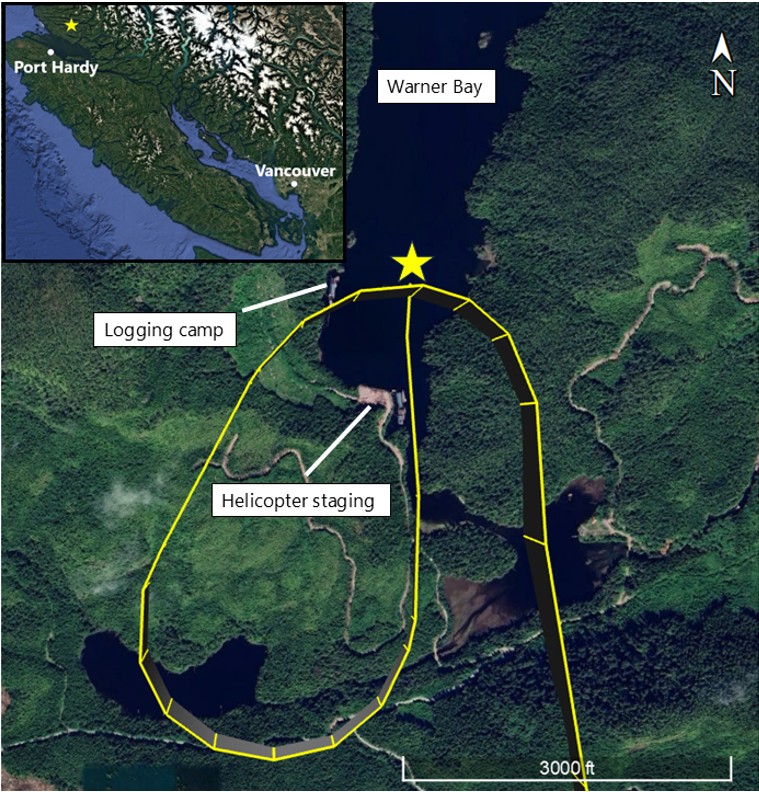
The aircraft approached the bay over terrain on the southeast side at approximately 1000 feet above sea level (ASL). The pilot initiated a left turn and crossed over the bay to assess the water surface for wind speed and objects in the landing area. The aircraft continued southbound before completing a left turn and setting up for final approach on a northbound heading.
At approximately 1601, the aircraft was 1000 feet south of the bay and on approach at 198 feet ASL with a ground speed of 84 knots and a vertical descent rate of 1194 fpm. Fifteen seconds later and just before touchdown, the aircraft was at 24 feet ASL and the ground speed and descent rate had both slowed to 75 knots and 307 fpm, respectively. At that time, the water surface in the vicinity of the landing site had areas of both glassy water and rippled water.
When the aircraft landed, a float dug in, and the aircraft immediately veered to the right. The left wing then contacted the water and the aircraft overturned. The aircraft cabin rapidly filled with water and the aircraft settled upside down with only the keels of both floats above the surface.
Rescue coordination
An eyewitness at the logging camp called 911, which activated the search-and-rescue (SAR) response. At approximately the same time, 2 camp members departed the dock in a small aluminum boat to assist.
The rear passenger was the first to egress, exiting through the left door. The passenger surfaced briefly and then put his head back underwater in an attempt to find the other occupants. The passenger felt the pilot’s hand and pulled the pilot out of the same door. They both surfaced at the same time as the boat arrived.
The front right passenger attempted to egress through the same door, but his left leg was trapped in the cabin. The rear passenger swam down several times and tried to free the leg while the pilot and camp members pulled up on the front passenger’s arms. The occurrence aircraft continued to sink, and rescuers were only able to keep the front passenger’s head above water temporarily.
At approximately 1645, a larger camp vessel arrived on the scene and towed the aircraft toward the dock.
At approximately the same time, a Royal Canadian Air Force Cormorant SAR helicopter arrived at the scene. Three SAR technicians (SAR Techs) dispatched from the Cormorant and swam to the dock. Following several dives, the SAR Techs identified that a safety belt was under tension in the vicinity of the trapped passenger’s foot and worked to release the foot and recover the passenger’s body from the aircraft. The passenger had been in the water for approximately 75 minutes and had drowned.
The aircraft was substantially damaged, and no signal from the submerged emergency locator transmitter (ELT) was received by the Canadian Mission Control Centre.
Pilot information
General
The occurrence pilot held an airline transport pilot licence – aeroplane and was rated for the flight in accordance with regulations. The pilot had a valid Category 1 medical certificate and had accumulated 20 200 total flight hours, of which 15 500 flight hours were on float-equipped aircraft. The pilot had flown 2000 hours on Cessna 185 float-equipped aircraft.
The pilot joined Wilderness Seaplanes Ltd. in April 2024 and had completed a pilot competency check on the occurrence aircraft on 14 June 2024.
Underwater egress training
The Canadian Aviation Regulations (CARs) require “initial training followed by training every three years on underwater egress for seaplane pilots”.Transport Canada, SOR/96-433, Canadian Aviation Regulations, paragraphs 703.98(2)(c.1) and 704.115(2)(a.1). Although there are no current standards for underwater egress training programs, Transport Canada (TC) guidance states that effective egress training for pilots must include both a ground school component and a water component at each recurring interval.Transport Canada, Advisory Circular (AC) 700-056: Pilot Egress Training (Seaplane), Issue 02 (13 May 2022), Section 5.0: Course content – General, at https://tc.canada.ca/en/aviation/reference-centre/advisory-circulars/advisory-circular-ac-no-700-056 (last accessed 13 March 2026.)
Records indicate that the pilot had completed the ground school component of egress training on 11 February 2022. At that time, many COVID-19 restrictions were in place, which may have limited the availability of in-water training. The investigation could not determine when the pilot had last completed the water component. Records also indicate that the pilot had completed practical training for emergency exits with a previous employer on 04 July 2023 and with Wilderness Seaplanes Ltd. on the occurrence aircraft on 01 May 2024.
Aircraft information
The occurrence Cessna A185F aircraft was manufactured in 1979 and equipped with a Continental IO-520D reciprocating engine. The aircraft was maintained under a TC-approved maintenance schedule. There were no recorded defects outstanding at the time of the occurrence.
The aircraft was equipped with folding seats that were installed in accordance with a TC-approved Supplemental Type Certificate (STC).A Supplemental Type Certificate (STC) is issued for major design changes to type-certified products when the change is not extensive enough to require a new type certificate. The aft folding seats can be stowed against the fuselage to allow for more cargo space.
Weather information
The nearest aviation weather reporting station to the occurrence site was Port Hardy Aerodrome (CYZT), BC, which is located 24 nautical miles (NM) south-southwest of the occurrence site. The aerodrome routine meteorological report (METAR) for CYZT issued at 1600 and valid at the time of the occurrence indicated the following:
- Winds from 350° true (T), variable in direction from 310°T to 20°T at 6 knots
- Visibility of 12 statute miles (SM) in light rain showers
- A broken ceiling at 2000 feet above ground level (AGL), a broken cloud layer at 5700 feet AGL, and an overcast cloud layer at 7500 feet AGL
- Temperature 12 °C and dew point 10 °C
- Altimeter setting 30.31 inches of mercury (inHg)
At the time of the occurrence, local observations indicated that there was a ragged cloud ceiling with no precipitation and the wind was calm. The surface of the water in the vicinity of the landing site had areas of glassy water and rippled water.
Wreckage information
The aircraft was recovered to a barge using heavy equipment and then transported to Port Hardy for further examination.
The float struts no longer connected the floats to the fuselage. On the forward struts, the left and right fittings had fractured on both the fuselage and float, whereas on the rear struts, only the right fitting on the float and the left fitting on the fuselage had fractured. The float front spreader bar had fractured at the interface with the left float and the rear spreader bar remained attached to both floats. The front lower left side of both float keels had indentations.
The flaps were extended on both wings, and it was determined that there were no issues with control continuity of the flight control surfaces, engine, and propeller.
The Royal Canadian Mounted Police’s (RCMP’s) West Coast Marine Services travelled to the site the day after the occurrence and captured underwater video of the aircraft before it was recovered from the water. The left door was found open with the upper hinge pin missing and the window intact. The right door was found closed and the window had been broken. Subsequent examination above water found that the right door handle functioned normally and the door could be opened and closed.
There was minimal damage to the interior of the aircraft cabin with sufficient occupiable space. The pilot’s seat was adjusted forward for access to the aircraft controls; the front passenger’s seat was adjusted further aft.
Survival aspects
Before the flight, the pilot provided a passenger briefing that emphasized the operation of the safety belts, emergency exits, and inflatable personal flotation devices (PFDs). The briefing was completed at the dock with the passengers on board the aircraft and the pilot confirmed there were no questions before departure.
All 3 occupants survived the impact and overturning of the aircraft with only minor injuries. The pilot and front passenger wore 3-point safety belts, consisting of a shoulder harness and lap strap, and the rear passenger wore a lap strap. Each lap strap had an outboard and inboard strap that connected with a buckle. The shoulder harness attached to the outboard lap strap to form the 3-point safety belt.
The pilot’s shoulder harness was found disconnected from the outboard lap strap and stowed by the inertia reel. The front passenger’s shoulder harness remained connected to the outboard lap strap and the lap strap was hanging from the inertia reel.
The pilot and passengers wore inflatable PFDs during the flight, but the PFDs were not inflated during the occurrence. The rear passenger had removed his inflatable PFD during the attempted rescue and, for undetermined reasons, the front passenger no longer had his inflatable PFD on when he was removed from the water.
When the aircraft overturned, the occupants were immersed in water that had an approximate temperature of 11 °C. Sudden exposure to cold water causes a physiological gasp reflex, hyperventilation, and involuntary water intake. According to the TC publication Survival in Cold Waters: Staying Alive, the cold water “shock response begins at water temperatures below 25°C and peak[s] at a temperature between 10–15°C.”Transport Canada, TP13822E, Survival in Cold Waters: Staying Alive (January 2003), The Initial Responses to Immersion (Stage 1 and Stage 2) – New Scientific Information Since 1975, p. 16.
Underwater egress
From 1990 to 2024, there were 124 fatal seaplane accidents that occurred on water in Canada, and drowning accounted for 32% of the 223 total fatalities. Following a TSB analysis of seaplane accidents,TSB Aviation Safety Study SA9401: A Safety Study of Survivability in Seaplane Accidents (1994). it was determined that most drownings occur inside the cabin of the aircraft. The analysis also noted that, of those who survived, most experienced difficulty in exiting the aircraft.
In the occurrence aircraft, the 2 cabin doors served as the only available emergency exits. When viewed from inside the cabin, the approximate positions of the interior door handles are as follows:
- 9 o’clock: locked
- 12 o’clock: closed
- 2 o’clock: spring loaded open to release the latch on the door
The interior door handles were located beside and behind the front seats. To open the door from the adjacent seat, the front seat occupants had to reach directly behind their shoulder and rotate the levers up and aft to the open position. With the front passenger seat being adjusted aft, the seatback lined up with the right door handle and provided approximately 2.5 cm between the seat and the handle (Figure 2).
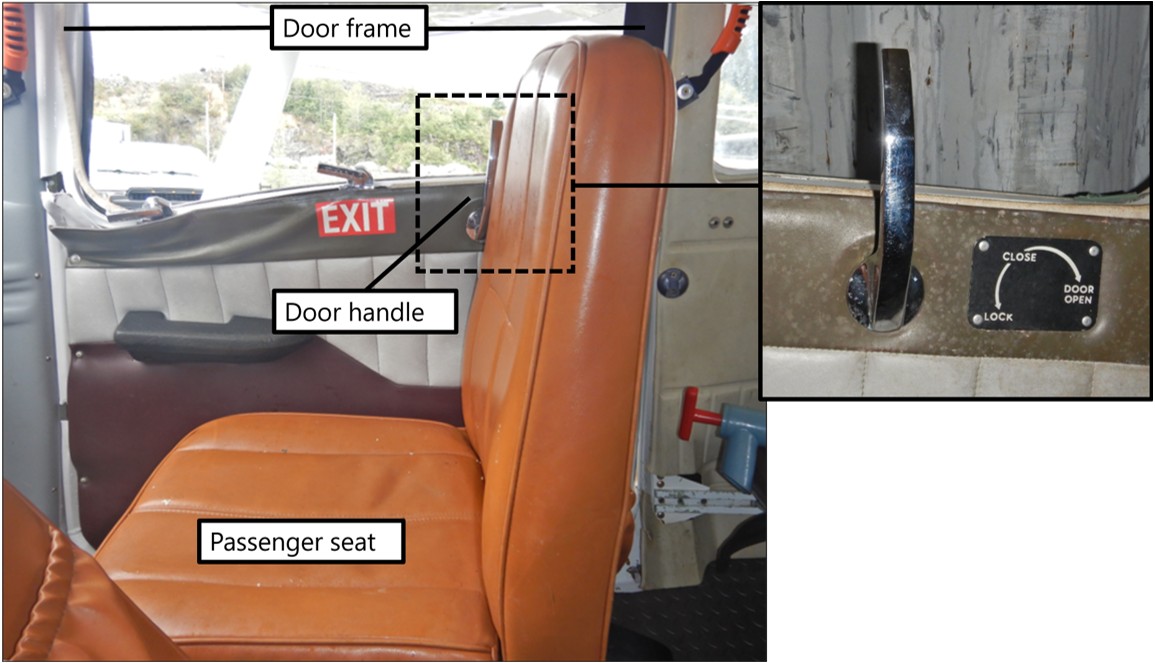
* The visible damage on the door was caused during the recovery of the aircraft.
Although the right interior door handle was found in the closed position and the left door had been opened, the investigation could not determine if either front occupant was able to rotate the door handle to the open position and thus release the latch for their respective door.
In this occurrence, all occupants exited out the left cabin door. The rear passenger initially attempted to exit the nearest right door, but the exit was fully obstructed by the front passenger, who was still in the front seat. However, the forward position of the pilot’s seat provided enough space for the rear passenger to egress out the left door. The rear passenger then pulled the pilot out of the same exit.
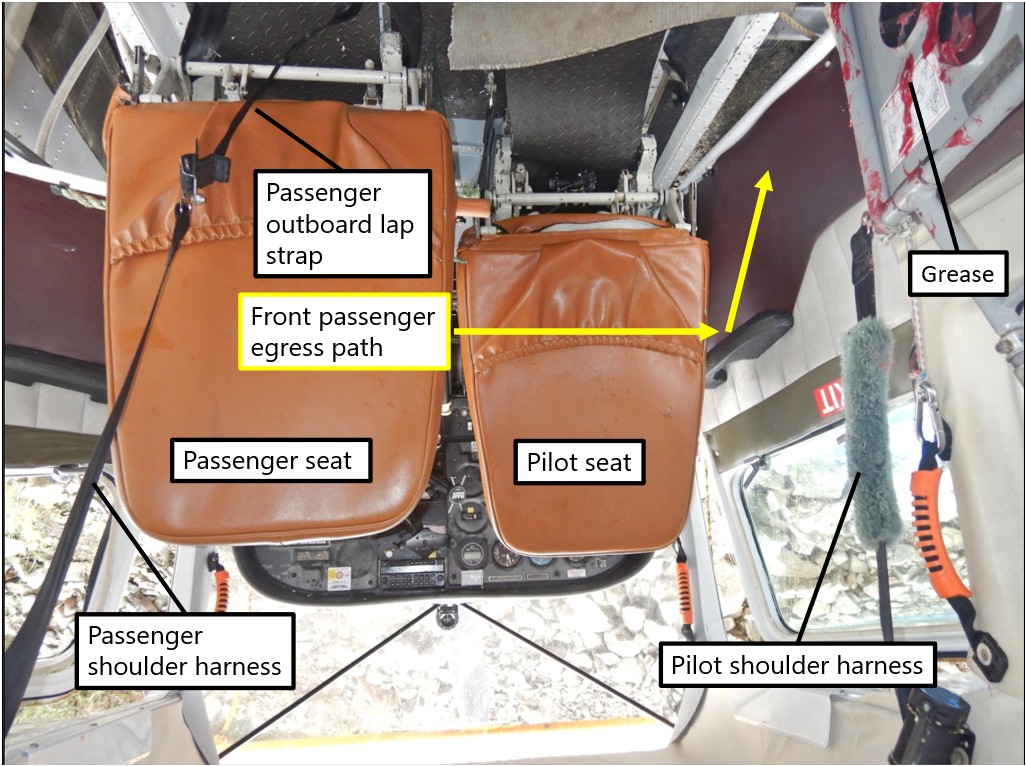
The front passenger crossed the cabin to exit through the left door (Figure 3). Based on the pilot seat position, the front passenger had to move past the pilot seatback and the safety belts in dark and cold water to reach the door. During the egress, the passenger’s left leg likely became entangled in a loop created by the front passenger seat’s shoulder harness and lap strap and, even though the straps were fully extended, they prevented the passenger from completely surfacing.
In 2012, the Office of the Chief Coroner of BC prepared a report after there were 4 commercial seaplane accidents on BC’s coast from 2005 to 2009.Report to the Chief Coroner of British Columbia, Death Review Panel: Four Fatal Aviation Accidents Involving Air Taxi Operations on British Columbia’s Coast (March 2012). The report recommended to TC that “enhanced safety briefings outlining underwater egress procedures be mandatory on all commercial seaplane flights.”Ibid., Item 12, p. 15. The Commercial Air Service Standards do not mandate this briefing either verbally or on the safety features card for commercial or private air operators.
TC has an online resource for both air operators and passengers when flying on seaplanes. The websiteTransport Canada, “Flying On Board Seaplanes/Floatplanes,” at https://tc.canada.ca/en/aviation/commercial-air-services/carrying-passengers/floatplanes (last accessed on 13 March 2026). provides an underwater egress briefing that can be used by air operators as well as a safety brochure, Seaplane/Floatplane: A Passenger’s GuideTransport Canada, TP12365E, Seaplane/Floatplane - A Passenger’s Guide.(Appendix A), that can be distributed to passengers.
The report from the Office of the Chief Coroner also strongly recommended underwater egress training for “passengers who frequently fly over water, such as workers commuting to remote coastal workplaces.”Report to the Chief Coroner of British Columbia, Death Review Panel: Four Fatal Aviation Accidents Involving Air Taxi Operations on British Columbia’s Coast (March 2012), Item 12, p. 15. The rear passenger had completed underwater egress training on 3 occasions with the last training in October 2022. The investigation could not determine if the front passenger had received underwater egress training.
Glassy-water landings
The pilot was experienced in landing on water; however, glassy-water conditions are considered to be difficult for landing a seaplane regardless of pilot experience. The mirror effect created during glassy-water conditions affects depth perception making it difficult to judge the aircraft’s height above water and forward speed.
The TSB has investigated multiple accidentsTSB air transportation safety investigation reports A21Q0097, A14O0077, A11W0070, A06C0131, A05P0262, and A02P0256. where glassy-water conditions were a contributing factor. In 1 case involving a Cessna 185E on amphibious floats, the aircraft cartwheeled and sank after the floats dug into the water on landing, resulting in fatal injuries to the pilot.TSB Aviation Investigation Report A14O0077.
If glassy-water conditions exist, the Transport Canada Aeronautical Information Manual (TC AIM) recommended practice is to establish a nose-high attitude with a minimum rate of descent at approximately 200 feet above the surface and then maintain the approach speed until the aircraft contacts the surface.Transport Canada, TP14371E, Transport Canada Aeronautical Information Manual (TC AIM), AIR – Airmanship (21 March 2024), Section 2.11.4, Landing Seaplanes on Glassy Water, p. 409. In addition, the occurrence aircraft’s pilot operating handbook recommends a flap setting of 20° and no flare before touchdown.Cessna Aircraft Company, Pilot’s Operating Handbook and FAA Approved Airplane Flight Manual, Revision 1 (01 December 1978), Section 9: Supplements-Floatplane, Section 4: Normal Procedures, Amplified Procedures, Landing. The investigation could not determine the pitch of the aircraft during touchdown.
TSB laboratory reports
The TSB completed the following laboratory reports in support of this investigation:
- LP162/2024 – NVM [non-volatile memory] Data Recovery – GPS and Flight Tracker
- LP177/2024 – NVM Data Recovery – Cellphone
- LP025/2025 – Shoulder Harness Examination
Safety messages
Glassy-water conditions are difficult conditions for landing a seaplane, regardless of pilot experience. Pilots must recognize glassy-water conditions and ensure they use the appropriate landing technique.
During an underwater egress, aircraft occupants face multiple hazards such as spatial disorientation, limited time for egress, aircraft equipment obstacles, and cold-water shock. To improve mental preparation and increase the likelihood of survival, the pilot’s pre-flight safety briefing should include underwater egress techniques that are described in TC’s seaplane passenger’s guide.
This report concludes the Transportation Safety Board of Canada’s investigation into this occurrence. The Board authorized the release of this report on 27 May 2026. It was officially released on 18 June 2026.
Appendices
Appendix A – Information about underwater egress from Transport Canada’s Seaplane/Floatplane: A Passenger’s Guide
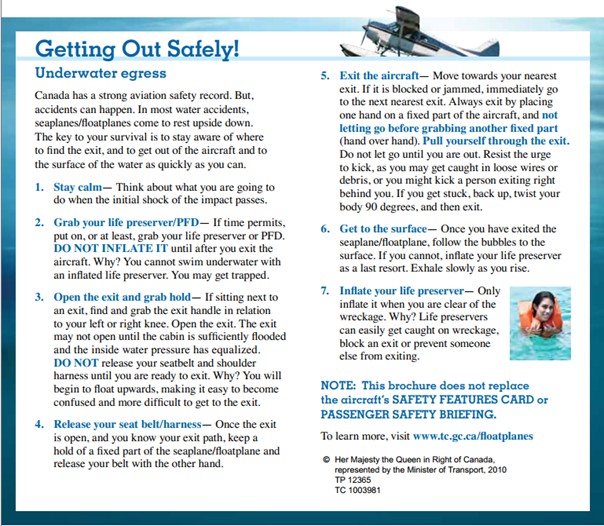
Source: Transport Canada, TP12365E, Seaplane/Floatplane: A Passenger’s Guide (June 2010), p. 3, at https://tc.canada.ca/en/aviation/publications/seaplane-floatplane-passenger-s-guide-tp-12365 (last accessed on 28 May 2026).