
Engine failure and forced landing
Kudlik Aviation Inc.
Pilatus PC-12/47, C-FKGE
Rankin Inlet Airport (CYRT), Nunavut, 5 NM E
The Transportation Safety Board of Canada (TSB) investigated this occurrence for the purpose of advancing transportation safety. It is not the function of the Board to assign fault or determine civil or criminal liability. This report is not created for use in the context of legal, disciplinary or other proceedings. See Ownership and use of content. Masculine pronouns and position titles may be used to signify all genders to comply with the Canadian Transportation Accident Investigation and Safety Board Act (S.C. 1989, c. 3).
Background
On 06 May 2024, the flight crew of the Kudlik Aviation Inc. Pilatus PC-12/47 aircraft (registration C-FKGE, serial number 761) was conducting a series of flights beginning at Québec/Jean Lesage International Airport (CYQB), Quebec, and ending at Taloyoak Airport (CYYH)All locations mentioned in this report are in Nunavut, unless otherwise noted. with intermediate stops. During a flight from Gjoa Haven Airport (CYHK) to CYYH, the flight crew heard an unusual bang. After landing, troubleshooting, including a ground run, was coordinated with the maintenance provider. During the troubleshooting, the engine’s parameters remained normal, and the noise could not be reproduced. It was determined that the noise was possibly caused by a momentary bleed-off valve fault.
At 0659All times are Central Daylight Time (Coordinated Universal time minus 5 hours). on 07 May 2024, the occurrence flight crew departed CYYH for a flight to Naujaat Airport (CYUT). They then departed CYUT at 0820 for a flight to Chesterfield Inlet Airport (CYCS). The aircraft performed normally during those flights.
History of the flight
At 0937 on 07 May 2024, the occurrence aircraft, operating as flight KUK761, took off on an instrument flight rules flight from CYCS to Rankin Inlet Airport (CYRT) with 2 flight crew members and 1 passenger on board.
During the flight, the aircraft performed normally until the power was reduced for descent. Shortly after starting the descent from 4000 feet above sea level (ASL), the engine emitted a series of bangs with flames appearing from the exhaust ducts followed by a sharp reduction in power.
After attempts to regain power were unsuccessful, the flight crew called Rankin Radio to declare a MAYDAY. At 0951, the aircraft landed on the sea ice approximately 5 nautical miles (NM) east of CYRT with the landing gear in the retracted position. The emergency locator transmitter (ELT) did not activate automatically but was manually activated. The signal was received by the Canadian Mission Control Centre and relayed to the Joint Rescue Coordination Centre (JRCC) in Trenton, Ontario. There were no injuries. The Royal Canadian Mounted Police (RCMP) and the local fire department responded and arrived on site by snowmobile approximately 1 hour and 20 minutes after the landing.
Weather information
The aerodrome special meteorological report (SPECI) for CYRT issued at 0941 reported light winds from the southwest, visibility of 2 statute miles (SM) in mist with scattered clouds at 200 feet above ground level (AGL), and that the visibility to the north was 10 SM.
Aircraft information
The Pilatus PC-12/47 aircraft is a single-engine, turbine-powered, pressurized light airplane with a passenger seating capacity of 9, and 2 flight crew seats. It has a maximum gross take-off weight of 10 450 pounds. The occurrence aircraft was built in 2006 and had accumulated 13 747.8 hours of total flying time since new. At the time of the occurrence, the aircraft had no outstanding maintenance defects and the airworthiness directives and service bulletins applicable to the aircraft had been complied with. The last 150-hour maintenance cycle was completed on 25 April 2024 at 13 701.2 hours airframe time.
On the occurrence flight, the aircraft’s weight and centre of gravity were within the prescribed limits.
Company information
Kudlik Aviation Inc. is a Québec-based aviation subsidiary of Construction Gély Inc. Kudlik Aviation Inc. operates 4 aircraft under Canadian Aviation Regulations Subpart 703 (Air Taxi Operations) in support of Construction Gély Inc. operations throughout northern Canada.
Flight crew information
The captain had been flying commercially since 2001 and held an airline transport pilot licence ‒ aeroplane. The captain had 15 300 total flight hours at the time of the occurrence. Of these, approximately 14 200 hours were on the Pilatus PC-12/47 aircraft, including approximately 13 000 hours as pilot-in-command. He completed his pilot proficiency check on 24 August 2023 and it was valid at the time of the occurrence.
The first officer began flying commercially in 2023 and held a commercial pilot licence ‒ aeroplane. The first officer had approximately 712 total flight hours, of which approximately 502 hours were as first officer on the Pilatus PC-12/47 aircraft. He completed his pilot proficiency check on 25 June 2023 and it was valid at the time of the occurrence.
Both pilots had valid medical certificates and held the appropriate licences and ratings for the flight in accordance with existing regulations.
Survivability information
The aircraft came to rest upright and intact. The flight crew and passenger were wearing safety belts with attached shoulder harnesses, and they were not injured. Cargo restraints were in use. The occupants egressed quickly and safely through the main cabin door, onto the sea ice.
Damage to the aircraft
![Figure 1. Occurrence site (Source: Royal Canadian Mounted Police [RCMP])](/sites/default/files/2025-11/A24C0042-figure-01-BIL.jpg "Figure 1. Occurrence site (Source: Royal Canadian Mounted Police [RCMP])")
The aircraft landed on its belly on the sea ice, which was covered in a layer of snow (Figure 1). The aircraft’s lower fuselage and trailing edge flaps received some abrasion damage, and several plastic fairings were cracked or broken. The largest area of structural damage was on the bottom aft fuselage area at the location of a Nav/Com antenna, which broke loose and tore open approximately 0.5 ft2 of the fuselage. Two of the 4 propeller blades were bent from contacting the snow and ice.
There was no post-occurrence fire or fuel/oil leakage.
Engine information
The Pratt & Whitney Canada PT6A-67B engine (serial number PCE-PR0639) was manufactured in 2006 and had accumulated 13 498.6 hours and 8694 cycles since new. On 04 February 2020, at an overhaul facility approved by the engine manufacturer, the engine was overhauled to the manufacturer’s overhaul specifications, which included the power turbine section (serial number PS-PRO639) and the gas generator section (serial number GG-PRO639). All airworthiness directives and service bulletins applicable to the engine model and serial number were complied with at the time of the overhaul. During the overhaul, the 1st stage power turbine blades (part number 3122972-01) were inspected and deemed serviceable, and the 2nd stage power turbine blades (part number 3056693-01) were replaced with a complete new set.
At the time of the occurrence, the engine had accumulated 4558.4 hours and 2417 cycles since its last overhaul and was operating under a Transport Canada-approved overhaul time extension to 5000 hours. The 1st stage power turbine blades had accumulated 8671 cycles since new. The 2nd stage power turbine blades had accumulated 2395 cycles since new.
Initial inspection of the engine shortly after the occurrence (before the teardown) was conducted by the TSB at CYRT. The inspection revealed the following:
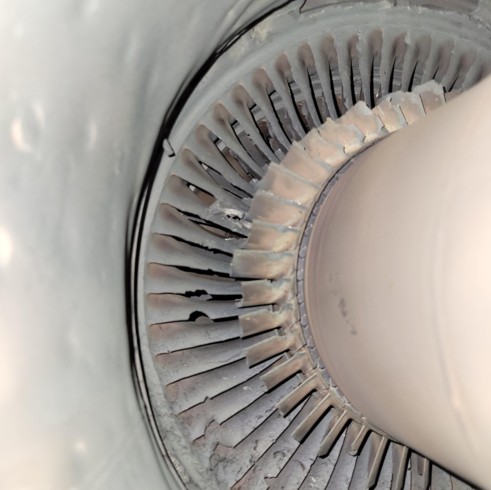
- The engine did not rupture and remained intact with the exception of the 2 power turbine stages, in which all the blades had experienced midspan fractures (Figure 2).
- The majority of the blade fragments exited through the exhaust ducts.
- The exhaust ducts and power turbine vane ring were heavily dented.
- The blade fragments did not appear to damage the aircraft’s windscreen or fuselage.
- The compressor section turned freely and, along with the combustion section, presented no abnormalities.
- A borescope inspection of the engine revealed that 1 compressor turbine blade had a small piece of material missing from its trailing edge.
- The front engine (gearbox) magnetic chip detector plug was covered with metal contaminants.
- There were no observed oil or fuel leaks.
Data from the aircraft’s engine condition monitoring system (ECMS) were recovered by the TSB laboratory. The occurrence flight data indicated that the engine was being operated within the power settings recommended by the aircraft manufacturer for the altitude, temperature, and flight configuration preceding the engine failure. Following the engine failure, the propeller speed did not decrease to a level consistent with a feathered propeller condition.
Analysis of the ECMS data did not establish a connection between the unusual bang heard on a previous flight and the engine failure, nor did it reveal any anomalies that could suggest an imminent engine failure.
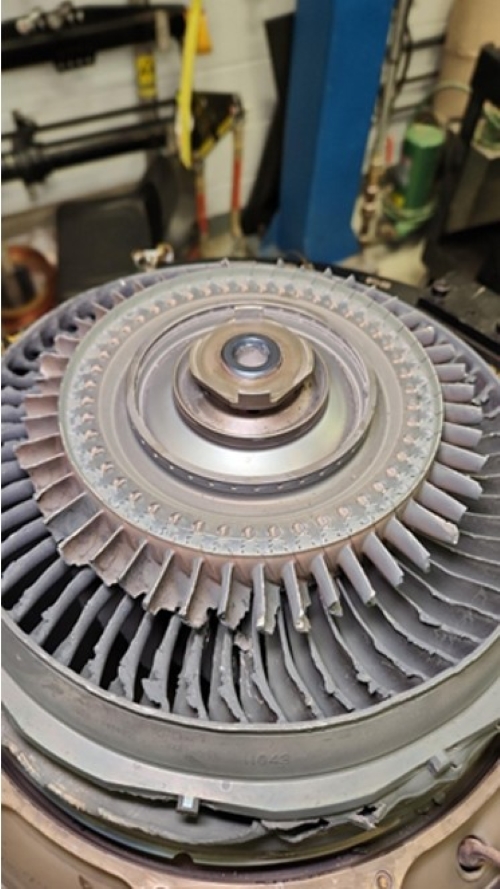
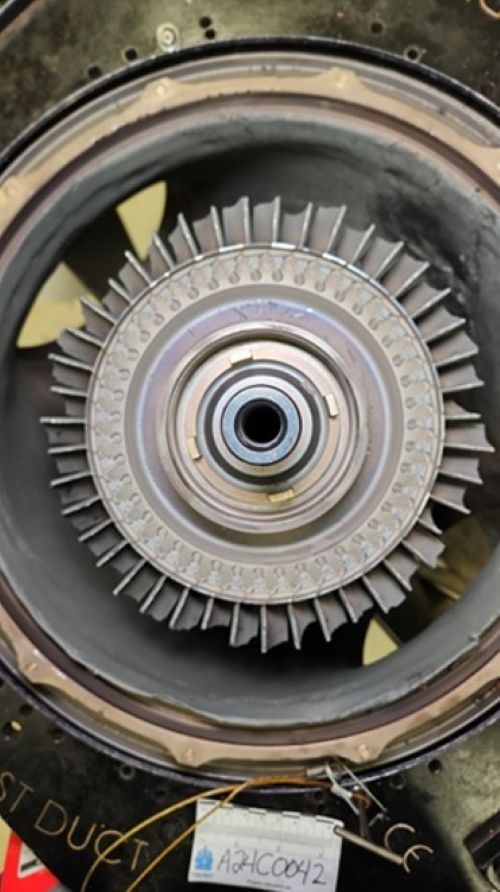
The engine underwent a teardown and visual inspection at the engine manufacturer’s facility under TSB supervision. The teardown and visual inspection revealed that:
- There was damage to the power turbine section that was consistent with midspan fractures of the power turbine blades (figures 3 and 4).
- There were also overheat signatures and galling of bearing surfaces at the primary planetary reduction gears in the propeller reduction gearbox. The cause of this was not determined.
- The small piece of missing compressor turbine blade was not causal to the power turbine blades fracture.
- The compressor, combustion, lubrication, and fuel sections presented no further abnormalities.
Engine oil and fuel samples were sent for analysis, which revealed that they met the specifications. The oil sample taken from the reduction gearbox showed dark discolouration and the presence of particles that were mainly rich in lead and copper.
The power turbine blades were subjected to a metallurgical analysis. The metallurgical analysis revealed that the alloying concentrations of the turbine blade remnants were consistent with the manufacturer’s material specifications. No evidence of fatigue fracture or degradation of materials was noted. The results of the metallurgical analysis showed fracture by tensile overload. The cause of the power turbine blades fracture could not be established.
TSB laboratory reports
The TSB completed the following laboratory reports in support of this investigation:
- LP083/2024 – NVM [non-volatile memory] Data Recovery – EMCS [engine condition monitoring system] Data Card
- LP087/2024 – Fuel and Oil Analysis
- LP089/2024 – Engine Teardown
- LP090/2024 – Aircraft Track Superimposed Over Terrain
Safety message
The correct use of safety belts and cargo restraints can improve survivability outcomes during forced landings.
This report concludes the Transportation Safety Board of Canada’s investigation into this occurrence. The Board authorized the release of this report on 19 November 2025. It was officially released on 02 December 2025.