Tank explosion during ship-to-ship transfer
Kivalliq W.
Baker Lake, Nunavut
The occurrence
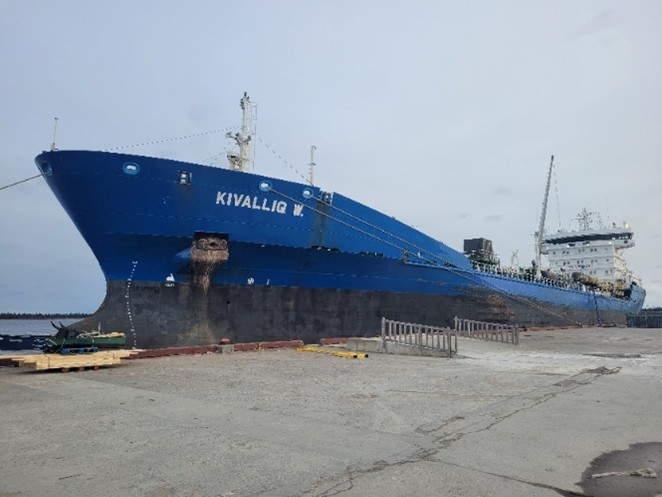
On the morning of 15 October 2025, the oil and chemical tanker Kivalliq W., with 19 crew members on board, began loading product in its cargo tanks via a ship-to-ship transfer of kerosene from the tanker Tuvaq W. in Baker Lake, Nunavut. During the transfer, the crew members on both vessels felt a vibration and observed a mist of product erupting from the forward starboard side of the Kivalliq W.
Transfer operations were immediately suspended when the Tuvaq W.’s crew activated the emergency stop system, after which the Kivalliq W.’s captain sounded the general alarm to muster the crew and task them with investigating the explosion.
After examining all the tanks on the Kivalliq W. and cleaning up the light pollution with the help of the Tuvaq W.’s crew, it was determined that the number 4 cargo tank on the starboard side had experienced a continuous pressure increase until it exploded during loading.
The vessel sustained damage to the main deck of the fourth starboard cargo tank, the bulkhead between the third and fourth starboard cargo tanks, and the tank top communicating with the third starboard ballast tank. No injuries were reported. The TSB is investigating.
Media materials
Investigation information
Photos
Download high-resolution photos from the TSB Flickr page.
Class of investigation
This is a class 3 investigation. These investigations analyze a small number of safety issues, and may result in recommendations. Class 3 investigations are generally completed within 450 days. For more information, see the Policy on Occurrence Classification.
TSB investigation process
There are 3 phases to a TSB investigation
- Field phase: a team of investigators examines the occurrence site and wreckage, interviews witnesses and collects pertinent information.
- Examination and analysis phase: the TSB reviews pertinent records, tests components of the wreckage in the lab, determines the sequence of events and identifies safety deficiencies. When safety deficiencies are suspected or confirmed, the TSB advises the appropriate authority without waiting until publication of the final report.
- Report phase: a confidential draft report is approved by the Board and sent to persons and corporations who are directly concerned by the report. They then have the opportunity to dispute or correct information they believe to be incorrect. The Board considers all representations before approving the final report, which is subsequently released to the public.
For more information, see our Investigation process page.
The TSB is an independent agency that investigates air, marine, pipeline, and rail transportation occurrences. Its sole aim is the advancement of transportation safety. It is not the function of the Board to assign fault or determine civil or criminal liability.