Main-track derailment
Canadian National Railway Company
Mile 8.5, Grimsby Subdivision
St. Catharines, Ontario
The occurrence
On 30 March 2026, a Canadian National Railway Company (CN) freight train was travelling west at approximately 24 mph on the Grimsby Subdivision when 13 cars derailed at Mile 8.5 while crossing the Welland Canal’s Bridge 6, a bascule drawbridge in St. Catharines, Ontario, that allows rail traffic to cross the canal.
The derailed cars continued westward for about 500 feet before coming to a stop; eight of the cars then jackknifed, blocking both the south and north main tracks. Following the derailment, approximately 500 feet of track were extensively damaged, and another 650 feet was completely destroyed.
Four of the derailed cars were residue tank cars. There were no dangerous goods released, and no injuries reported. The TSB deployed investigators to the site and is investigating.
Media materials
Deployment notice
Investigation information
Photos
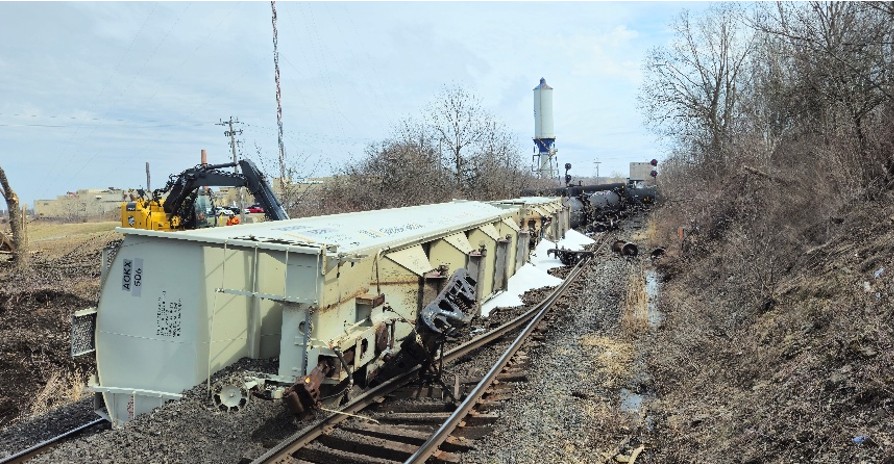
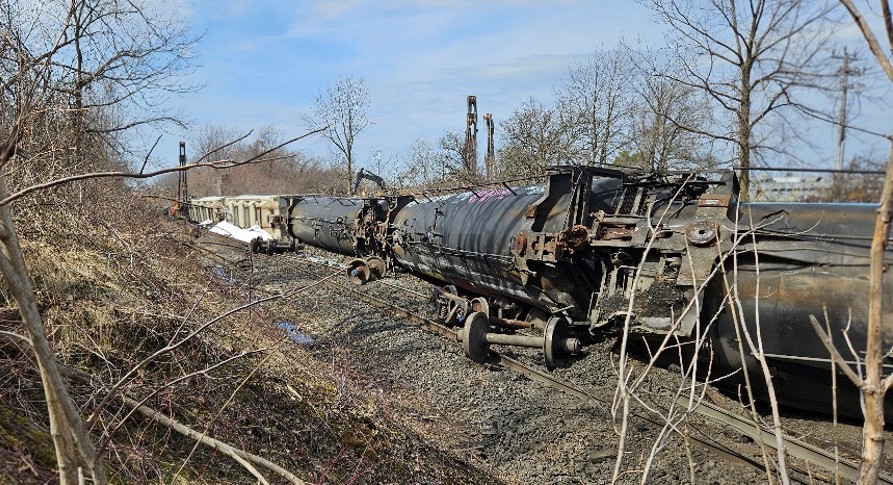
Download high-resolution photos from the TSB Flickr page.
Class of investigation
This is a class 3 investigation. These investigations analyze a small number of safety issues, and may result in recommendations. Class 3 investigations are generally completed within 450 days. For more information, see the Policy on Occurrence Classification.
TSB investigation process
There are 3 phases to a TSB investigation
- Field phase: a team of investigators examines the occurrence site and wreckage, interviews witnesses and collects pertinent information.
- Examination and analysis phase: the TSB reviews pertinent records, tests components of the wreckage in the lab, determines the sequence of events and identifies safety deficiencies. When safety deficiencies are suspected or confirmed, the TSB advises the appropriate authority without waiting until publication of the final report.
- Report phase: a confidential draft report is approved by the Board and sent to persons and corporations who are directly concerned by the report. They then have the opportunity to dispute or correct information they believe to be incorrect. The Board considers all representations before approving the final report, which is subsequently released to the public.
For more information, see our Investigation process page.
The TSB is an independent agency that investigates air, marine, pipeline, and rail transportation occurrences. Its sole aim is the advancement of transportation safety. It is not the function of the Board to assign fault or determine civil or criminal liability.